Visitors

free counters
Showing posts with label Comfort. Show all posts

12.03.2019

What Does Your Heart Earnestly Yearn For?

Dear Friends,

     Maybe I should start by asking:  What is it that you really want?   What is it that you really desire?   What does your heart earnestly yearn for?   Do you even know? 
     This week's "thought" addresses that issue: What  your heart truly yearns for.   The answer I offer today comes to you from David Downing, co-director of the Marion E. Wade Center at Wheaton College in Wheaton, Illinois. It is taken from an Advent Devotional book called, "The Grand Miracle."  Enjoy.
"I Am the Bread of Life."
John 6:35

     "It is not what God can give us, but God that we want," said George MacDonald.  He was a seasoned old soul, and what was true for him may have been more of an ideal for other pilgrims on the journey. The rest of us may feel more inclined to pray: "Father, forgive us, for we do not know what we want."   We seek a gilded afterlife when we could have Eternal Life.  We seek breadcrumbs of earthly pleasure when we could have a heavenly banquet.  We avoid pain when we could embrace joy.  We plead for words that will give us comfort and light, but our own darkness does not comprehend the Word. 
     Help us, Lord.  We ask for a road-map to heaven when the Way, the Truth and the Life stands right before us.  We want the crown without the cross, and we fix our gaze on the crown more than the King.  We look to Glory, but others do not see the glory when they look at us.  We do not ask too much in prayer, but too little.  We follow the One who multiplied the loaves and do not see the Bread of Life.  We want to quench the thirst of the moment, but do not ask for Living Water, the cup of heaven.
     The Everlasting took human form so that we might lift our eyes from the gifts to the Giver. He emptied Himself so that from His fullness we might receive grace upon grace. The baby lay in a feeding trough so we might not be forever hungry. The child spoke in His Father's house, so we might put away childish things. The man told us that we must die to live, that sorrow would turn to joy, that those who seek will find.  He rose that we might rise. He came to be with us for a time, so that we might be with Him forever.  Lord, teach us to know what we want, to want what you want, and most of all, to want you.  Amen." 
     So many today do not realize that their pursuit of joy, happiness, pleasure, contentment and peace in their souls' is really an inner craving after God.  "God has placed eternity in our hearts," says Solomon, in Ecclesiastes 3:11.  And that "eternity" which God has placed within us has left a hole in our soul that can only be filled, as Pascal put it, "by an infinite and immutable object, that is, by God Himself."
     Yes, most people fail to see that their clamoring after all those things -- even sinful things -- is really a pursuit of God and what He alone can supply when He enters our being, by His Spirit, in the grace of regeneration.  To quote Pascal at greater length, "There was once a true happiness in man, of which there now remains only an empty trace, which he vainly tries to fill with things from his environment. Yet all these efforts are inadequate, because the infinite abyss in the human soul can only be filled by an infinite and immutable object, that is, by God Himself."
     Maybe our prayer should be:  Lord Jesus, forgive us for chasing after things that can never truly satisfy when you have told us time and again in your Word that we can find true and lasting satisfaction only in You; in having You.  So often we clamor after everything but you, even venturing into the pursuit of sinful and forbidden things, before we finally come -- broken, empty and damaged -- to see the error of our ways. Convince us, we pray, that our inner hunger can only be satisfied as we feed on You the Bread of Heaven, and our inner thirst can only be quenched as we drink deeply of You the Living Water -- the only water a person can partake of and thirst no more.  Lord, as Mr. Downing has correctly prayed, "teach us to know what we want, to want what you want, and most of all, to want you."  Amen.
In this time of anticipation and waiting, Pastor Jeff


9.03.2019

The Time to Pray is Before the Shooting Starts

Greetings All,

     Today's "thought" comes from the Blog of Melissa Edgington entitled: yourmomhasablog.com  In light of a month that has seen so many needless shooting deaths and injuries, this post caught my attention. I know I sent out a thought on prayer last week, but I would like to follow it up this week with another -- dealing with the rush to pray (or at least promises to pray) AFTER heartbreaking situations occur.  I read Melissa's post and felt it was worth sharing.  I trust you will find it true and challenging. Enjoy.

The Time to Pray is Before the Shooting Starts

  I’ve noticed a disturbing trend among Christians. We are not a praying people.  Oh, we love the idea of prayer.  We love sharing memes about it and ranting on social media about prayer in schools. We love organizing prayer vigils after some awful tragedy has struck.  We follow the same predictable patterns of making prayer a low priority until we have absolutely no other recourse but to turn to the God of the Universe.
     As His children, we must start examining what it is that keeps us from prayer. Is it that we really don’t believe that God is in control? Or do we just not care what He does until He does something that negatively affects us? Do we really think that the best time to pray is after the mass shooting?
     At most prayer meetings, only a fraction of the church takes time to attend. It isn’t a time issue. Parents and grandparents alike can make it to every little league game, anytime, anywhere, with three or four kids in tow. In most cases it isn’t a matter of limited mobility or poor health. The majority of us are perfectly able to meet together to pray. We just don’t want to.
     Imagine how our communities and churches and schools might change if we approached the throne of God with an expectation that He will hear our prayers. With an excitement about what He will do with the pleas of His people.  Consider how things might be different if we had eyes to see how He uses our prayers to accomplish His will, if we had the faith to believe that prayer really matters.
     Imagine if we weren’t afraid to humble ourselves before our God, before our family and friends and fellow believers, if we marked prayer meetings on our calendars in ink, making it clear to our children that we make prayer with fellow believers a priority in our homes. Instead, most of us hear the words “prayer meeting” and tune out. Not for us. Not important. Not worth our time.
     We spend so much time worrying about the world our kids and grand-kids are growing up in, so many hours scheming and planning ways to shelter them, and so little time talking to the One who can actually change things. If you want to know the truth, it isn’t the youth of today or the evil governments or the wicked schemes of man that make me fear for the future. It’s the empty prayer meetings.
     “The Cinderella of the Church today is the prayer meeting. This handmaid of the Lord is unloved and unwooed because she is not dripping with pearls of intellectualism, nor glamorous with the silks of philosophy, neither is she enchanting with the tiara of psychology. She wears the homespuns of sincerity and humility and so is not afraid to kneel.” – Leonard Ravenhill

     After learning of the latest statistics on how few Christians there are that regularly share the gospel, or spend any significant time in prayer, a friend of mine once said (somewhat tongue-in-cheek, of course, regarding what motivates people): "The only mistake God made was that he didn't offer to give us five dollars for every person we share the Gospel with, or contract to pay us an hourly wage for time spent praying. Or better still, that He didn't make our salvation dependent on doing both."   I do often wonder how many more people would do those two things if they were financially reimbursed for the time and efforts. 
     Those are some pretty encouraging promises to be given from the One who has all power in heaven and earth!  Yet, given the commitment to prayer on the part of many Christians, you would never know Jesus had spoken such words!  Yet He did, not only because He intends to make good on them, but also to encourage and move us to pray.  One must ask: What will it take to get us to do so?  Could the carnage be stopped if God's people would flood the throne of grace with petitions for His intervention to prevent them, instead of prayers of comfort for those who have lost loved ones after the fact?  Because I believe Melissa is spot-on - The Time to Pray is Before the Shooting Starts.
     "Be joyful always, pray continually, give thanks in all circumstances, FOR THIS IS GOD'S WILL FOR YOU in Christ Jesus." (I Thessalonians 5:16-18)
Pastor Jeff


7.02.2019

The Comforter

Greetings All!

This week's "thought" comes from someone we haven't heard from for quite a while - Charles H. Spurgeon.  He has been dubbed the "Prince of Preachers" and is considered by many to be the most gifted preacher ever.  This excerpt comes from a message he preached on October 6, 1872 entitled "The Comforter."   Spurgeon began his preaching career in 1850 at the age of 15. By the time he was 19 he had accepted a call to pastor one of the biggest Baptist churches in London.  Within a short time they had to build an addition onto the church to increase the seating capacity from 1200 to 5000 seats to accommodate the weekly crowds. He was an extraordinarily gifted man.
     To those who wrongly believe that Christianity was universally popular back in the mid-to-late-800's in England, this somewhat auto-biographical account should clear up that misunderstanding.  I've been reading this sermon in my devotional time and found it both interesting and true; that's why I wanted to pass it along to you.  Enjoy.


The Comforter

     “In the 15th chapter of John’s Gospel we find the Savior describing His saints in the world as hated and persecuted for His sake, and He bids them expect this. But He consoles them in verses 26-27: “When the Comforter is come, whom I will send unto you from the Father, even the Spirit of truth which proceeds from the Father, He shall testify of Me. And you also shall bear witness, because you have been with Me from the beginning.”
     Now verses 18-27 mean just this—while Jesus Christ was here on earth, if anyone had anything to say against Him or His disciples, the Master came forward to the front, and He soon baffled His foes so that they confessed, “Never has anyone spoken like this man” (John 7:46). At this present time our Master and head is gone from us, so how are we to answer the attacks of the world?  The answer is we have another Counselor who comes to speak for us, and if we had but confidence in Him, beloved, He would have spoken for us much more loudly than He has sometimes done!
     Whenever we learn to leave the business in His hands, He will do two things for us:  FIRST - He will speak for us Himself, and SECOND - He will enable us also to bear witness.  At this present time many questions of doctrine are brought up for discussion, many objections to the truth of God are blocked, and there are many who would lay the axe at the very root of Christianity and cut it down as a rotten tree!  What is our answer?  I will tell you: Nearly all the books that have been written to answer modern philosophies are a waste of time and a waste of paper.  The only way in which the church can hold her own, and answer her detractors is by real power from God!

     Has she done anything for the world?

     Can she produce results?

     By her fruits shall she be proved to be a tree of life to the nations!
     Now the Spirit of God, if we would but trust Him, and give up all this idolatry of human learning, cleverness, genius, eloquence, rhetoric, and I know not what beside, would soon answer our adversaries!  He would silence some of them by converting them as He answered Saul of Tarsus by turning him from a persecutor to an apostle. He would silence others by confounding them and making them see their own children and relations brought to know the truth of God! If there is not a miraculous spiritual power in the Church of God at this day, she is an impostor!  At this moment the only vindication of our existence is the presence and work of the Holy Spirit among us.  Is He still working and witnessing for Christ? I fear He is not in some churches.
     Here in our fellowship we behold Him. Look at His workings in this place.  Nearly 20 years ago [back in August of 1854] our ministry began in this city under much opposition and hostile criticism. The preacher [that is, Spurgeon himself] being condemned on all hands as vulgar, unlearned, and, in fact, a “nine days’ wonder”!  Jesus Christ was preached by us in simpler language than men had been accustomed to hear, and every one of our sermons was full of the old-fashioned gospel. Many other pulpits were intellectual, but we held to the pure Scriptures.  Rhetorical essays were the wares retailed by most of the preachers, but we gave the people the gospel.  We brought out before the world the old Reformers’ doctrines, Calvinistic truth, Augustinian teaching, and Pauline dogma! We were not ashamed to be the, “Echo of a long-dead evangelism,” as some wiseacre called us.
     We preached Christ and Him crucified, and by the space of these 20 years have we ever lacked a congregation? When has not this vast hall been thronged? Have we ever lacked conversions? Has a Sunday passed over us without them? Has not the history of this church, from its littleness in Park Street until now, been a march of triumph with the hearts and souls of men being the spoils of the war and the flag under which we have marched been Christ crucified?
     And it is so everywhere! Only let men come back to the gospel and preach it ardently, not with pretty words and the artificiality of polished speech, but as a burning heart compels them, and as the Spirit of God teaches them to speak it.  Then will great signs and wonders be seen!  We must have signs following—else we cannot answer the world!  Let them sneer; let them rave; let them curse; let them lie—God will answer them!  It is ours in the power of the Spirit of God to keep on preaching Christ and glorifying the Savior.  Just as Jesus always met the adversary in a moment, and the disciples had no need of any other defender, so we have another Helper, who in answer to prayer will vindicate His own cause, and gloriously avenge His own elect.”
     In a world of competing ideas and religious views, something must set Christianity apart from all the rest. Something more than "mere morality" as C. S. Lewis called it.  Something more than mere religious gatherings.  Something that shows our faith to be different from all the rest.  And that "something" (as Spurgeon points out) must be the power of God!  People must be able to see and sense the evidences of God's presence and the supernatural working of the Holy Spirit among His people if we are to truly testify to the reality of Jesus and His gospel (I Cor. 14:24-25 / II Cor. 10:3-5).
     Be it the miracle of an extraordinary and other-worldly love; the miracle of someone turned to repentance and faith; the miracle of a healing or a prophetic word that hits home as if it were tailor made; or the miracle of a regenerate heart -- the greatest miracle of all -- the power of God must be seen if people's objections are to be stifled!  "The only way in which the church can hold her own, and answer her detractors is by real power from God!...  If there is not a miraculous spiritual power in the Church of God at this day, she is an impostor!  At this moment the only vindication of our existence is the presence and work of the Holy Spirit among us...  Only let men come back to the gospel and preach it ardently, not with pretty words and the artificiality of polished speech, but as a burning heart compels them, and as the Spirit of God teaches them to speak it. Then will great signs and wonders be seen!  We must have signs following—else we cannot answer the world!"
     To use the words of Isaiah in his deep yearning for a visible and incontestable manifestation of God's power: "Oh, that you would rend the heavens and come down, that the mountains would tremble before you!" (Is. 64:1-2) That's what we need more than anything else -- a fresh outpouring of the Spirit of God in incontestable and saving power!  Not manufactured miracles, but God-given miracles.  Not the stuff of mere human emotion, but the supernatural intervention of a sovereign God.  And it must stem from earnest prayer and the gospel ardently preached, as Spurgeon says, from a burning heart that's moved and compelled by the Holy Spirit.  Our prayer, Like Isaiah's, must be, "Come down Lord!"

     With Prayer for the Renewing of Christ's Church on Earth, Pastor Jeff

4.30.2019

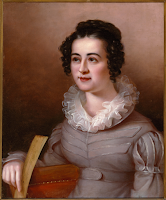
Pioneer Missionary Ann Hasseltine Judson

Greetings All,

     In my last "thought" I shared about Adoniram Judson.  A couple days later I was asked to send one out highlighting the brave and heroic commitment of his wife -- Ann Hasseltine Judson.  This is her story (or at least part of it). Her profound influence in regard to the place of women in missions has few rivals.  As the first woman missionary sent out from the U.S., she set the standard for future generations.  This is by far the longest thought I've ever sent out (and it has been heavily redacted to shorten it to what it is)!  Yet, with Mothers Day fast approaching, I thought honoring her contribution as a wife, mother and missionary was warranted. Enjoy.

     "Two hundred and nine years ago in 1810, a young man named Adoniram Judson composed an extraordinary letter to the father of the young woman he wanted to marry. He wrote as follows: “I have now to ask, whether you can consent to part with your daughter early next spring, to see her no more in this world; whether you can consent to her departure for a heathen land, and her subjection to the hardships and sufferings of a missionary life; whether you can consent to her exposure to the dangers of the ocean; to the fatal influence of the southern climate of India; to every kind of want and distress; to degradation, insult, persecution, and perhaps a violent death. Can you consent to all this, for the sake of him who left his heavenly home and died for her and for you; for the sake of perishing immortal souls; for the sake of Zion, and the glory of God?” 
     At 21 years of age, her parents left the choice to Ann.  She decided to marry Adoniram and to leave everything behind for the unknown. She knew she would probably never see her family again. The voyage was far too long, perilous and expensive for the possibility of any visit from relatives or friends. Letters took months, and might well never arrive. There was no established mission network to give support or counsel. There was no American Embassy in Asia to give protection. There was no certainty that these pioneer missionaries would even find a place in which they could safely minister. Nothing was guaranteed – neither safety, health, toleration, and least of all success. But Adoniram, Ann, and the other young people with them understood that Christ did not issue the Great Commission on the condition that health, comfort and safety could be guaranteed. Christ had said simply, “GO.”  Therefore they married on February 5, 1812 and the very next day the newlyweds sailed from Salem, Massachusetts...
     The religion of Burma was Buddhism: a system of belief that arose in the sixth century BC with the enlightenment of Gautama, the Buddha The Buddha taught that all appearance is characterized by transience, that there is not really a soul, and no eternal God… Ann wrote bluntly in her journal of the emptiness of Buddhism: “The religion of Burmah, then, is, in effect, atheism; and the highest reward of piety, the object of earnest desire and unwearied pursuit, is annihilation. How wretched a system is this; how devoid of adequate motives to virtue; and how vacant of consolation!”  Consequently, the Burmese had no concept of an eternal God, and no means in their language to express such an idea. Ann and Adoniram worked hard studying up to 12 hours a day for two years learning the difficult language. Eventually Adoniram produced a gospel tract in Burmese and commenced working on a Burmese translation of the New Testament. Ann authored a Burmese language catechism, translated the books of Daniel and Jonah into Burmese, and began to teach women’s Bible classes. She was also the first person to translate Bible passages into Siamese. Ann also formed a society of native women who met together on Sundays to pray and read the Scriptures.
     By 1820, six years after their arrival in Burma, Ann was so seriously ill that she had to seek medical help in Calcutta. Two years later she was told that unless she returned either to Europe or America for treatment, she would die. She had previously consented to her husband accompanying her to Calcutta, but the longer voyage to England (and a possible further trip to America) would take at the least two years, and she refused to consider Adoniram abandoning the infant church and the crucial Bible translation for that long. As a result, in 1822, she made the long and difficult journey alone. She sailed first for England, and Christians there raised funds for her passage to America.  Back at home, she received skilled medical care and was reunited with her family and that of Adoniram. The whole trip took two years, and of this separation Adoniram said that it felt like cutting off his right arm and gouging out his right eye.
     Ann returned in 1824, but her reunion with her husband, though joyful, was pitifully brief.  War between Burma and England began, and all male foreigners fell under suspicion of being English spies. So Adoniram and his associate Mr. Price, were thrown into the notorious death prison from which few ever emerged alive. While in prison they awaited execution in the most filthy and sordid of conditions, weighed down with fetters so that they could not walk. Daily they observed the torture and execution of their fellow prisoners, not knowing when their time would come. Nightly they were placed in the stocks, and their legs and bodies raised so that only their head and shoulders remained on the ground. They remained incarcerated for one and a half years, during which time they were never able to wash, were often ill with no access to medical help, and had little contact with the outside world...
     During her husband’s imprisonment, Ann petitioned tirelessly on the prisoners’ behalf with no regard for personal risk. Daily she walked the two miles from their small home to the prison in hopes of supplying them with food and drink. Sometimes she was allowed to see them, but often they were forbidden to speak. She also visited every person of influence to whom she could gain access, trying to explain that as missionaries they had nothing to do with the English war effort. She was quite alone through this ordeal, and she was pregnant. Eight months after Adoniram had been arrested, in February 1825, she gave birth to little Maria, and was able to visit the prison with the infant, whom the father could only observe from afar. Their first baby had been stillborn, their second had died at eight months, and this child’s chances of survival seemed even more slender.  Of this terrible time she wrote:  “Sometimes for days and days together, I could not go into the prison till after dark, when I had two miles to walk, in returning to the house. O how many, many times, have I returned from that dreary prison at nine o’clock at night, solitary and worn out with fatigue and anxiety… My prevailing opinion was, that my husband would suffer violent death; and that I should, of course become a slave, and languish out a miserable though short existence in the tyrannical hands of some unfeeling monster. But the consolations of religion, in these trying circumstances, were neither `few nor small.’  It taught me to look beyond this world, to that rest, that peaceful happy rest, where Jesus reigns, and oppression never enter.”
     Eventually she had to set up a little shelter near the prison, as the daily four-mile-round-trip proved too much to walk in the blazing heat. As the weather brought unbearable heat, the conditions in the prison only worsened. Of this time her memoirs record: “The situation of the prisoners was now distressing beyond description. It was at the commencement of the hot season. There were above a hundred prisoners shut up in one room, without a breath of air excepting from the cracks in the boards. I sometimes obtained permission to go to the door for five minutes, when my heart sickened at the wretchedness exhibited. The white prisoners, from incessant perspiration and loss of appetite, looked more like the dead than the living…”
     It would seem that things could not get worse. But with the British troops advancing to the capital, the foreign prisoners were removed on a death march to a remote spot in the country some miles north of the capital, where rumor had it they were to be buried alive as an offering to the gods in the path of the advancing troops. Their sufferings on the march were indescribable, their survival remarkable. Even more remarkable was the determination of Ann to follow them. With her three-month-old infant, plus two little girls she was looking after, and a faithful Burmese helper, she immediately set out by boat, and then by rough cart, in pursuit of the prisoners. For the duration of their imprisonment outside of the capital she persuaded their jailer to let her and the children share his two-room hut. From there she continued to try to minister such help as she could to her husband and Price. During this appalling period she became so ill that she had no milk for the baby, and the only way Maria survived was by bribing the jailer to allow Adoniram out of prison to carry the baby round the local village, begging nursing mothers to let Maria have a little of their milk.
     When the Burmese realized how hopeless the struggle against England was, they decided they needed all the help they could get in negotiating the least humiliating peace settlement. Adoniram and Price were released to help with the peace negotiations, as they could speak both Burmese and English. Again Ann and Adoniram had a wonderfully happy but tragically brief reunion. They enjoyed two blissful weeks of freedom and comfort at the British base before Adoniram was summoned elsewhere for further negotiations. This was to be their final separation. Ann’s health had been broken by the sufferings of the previous two years, and her body, past the point of exhaustion, finally broke and succumbed to cerebral meningitis. Her final sufferings were to be endured without her husband. She was thirty-seven.
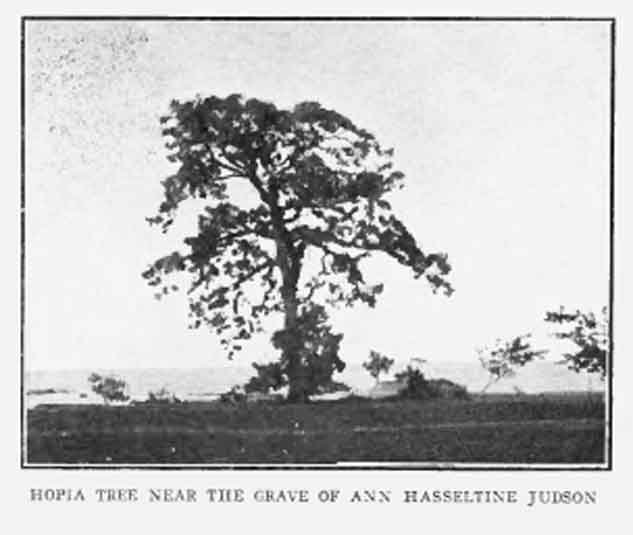
     Adoniram was shattered not only by her death, but by the knowledge he had not been able to support her at that time. Shortly thereafter, Maria also died.  Adoniram was left quite alone, and later wrote with the sad news to Ann’s mother telling her of the burial of his daughter: “The next morning we made her last bed in the small enclosure that surrounds her mother’s lonely grave. Together they rest in hope, under the hope tree, which stands at the head of the graves, and together, I trust, their spirits are rejoicing after a short separation of precisely six months. And I am left alone in the wide world. My own dear family I have buried; one in Rangoon, and two in Amhurst. What remains for me but to hold myself in readiness to follow the dear departed to that blessed world, “Where my best friends, my kindred dwell, Where God my Saviour reigns.” Adoniram was so grief-stricken at his loss that he suffered complete emotional breakdown.
     Ann Hasseltine Judson was converted at 17 during what has come to be called, "The Second Great Awakening."  She was a deeply dedicated Christ-follower, as well as a gifted teacher, linguist, preacher and author. She was instrumental in establishing a Christian church in Burma which, though heavily persecuted, still thrives to this day.  She championed the cause of female education, starting a Burmese girl’s school and tirelessly petitioning Christian sponsorship for her girls during her medical furlough in the United States.  It is generally agreed had it not been for Ann’s sacrificial efforts and representations to the governing authorities, Adoniram would not have survived his time in the death prison. It has been said of her: “She was a woman who loved intensely, loved her husband, loved her children, loved the people of Burma, but above all, she loved her God.”

     When I think of Ann one verse comes to mind: "Many women do noble things, but you surpass them all... let her works bring her praise at the city gates" (Prov. 31:29 & 31).


     If you would like to read a more full account (this was my primary though not sole source for this post) you can click here:  


In His Service, Pastor Jeff

2.11.2019

Who Is This That Cures The Sick?

Greetings All,


     Today I offer you a true story of healing found in the book, "He Touched Me" by John Powell (a professor of psychology and theology who also had his own counseling practice). The healing of a patient he had diagnosed as "neurotic" (always complaining, always indecisive, very egocentric, and forever absorbed in the memories of her painful past). Yet, much to his surprise she was delivered from that ailment through an encounter with Jesus -- an encounter with Jesus that not only changed her, but him. Much of the small book (95 pages) focuses on learning how to be completely open, honest and transparent with God in prayer. It was a point he learned from the Reformer, Martin Luther, whose first law of successful praying was: "Don't lie to God!"   He also notes that honest "self-disclosure" is imperative to any true praying and is the essence of true love. This story follows the heading in his book entitled: "Who Is This That Cures The Sick?"   Enjoy.
     "At the end of the summer just before our university classes were to begin, I answered the phone to hear the voice of a [woman I had counseled numerous times without any success]. I knew she would want another appointment and would want another to agonize along with her while she resurrected the same old problems...  But how the Spirit loves to surprise us!  The voice I heard on the phone was somehow the same, yet somehow different. My "keen diagnostic ear" said that there was a new peace in her. I had to ask several times, "Who is this?" She quietly and peacefully said that she did NOT want an appointment, that she knew I was busy and did not want to take any more of my time. The only purpose for the call, she said, was to thank me for my time and patience and the help I had given her over the last three years.  I couldn't believe what I was hearing.
     There was all the resonance of sincerity, but such abrupt personality changes just do not happen in real life. So I said: "You're different, aren't you?" And she replied, "Oh yes!" "What happened? I asked.  "I met Jesus Christ." 'You what?" I queried.  "I met Jesus Christ. Before this I knew about Him, but now I know Him."  "If you tell me you had a vision...," I started to say. "No, no vision. But I did meet Jesus Christ."  Then I told her, "I don't know whether you want to see me, but I want to see you."
     When she came to my office my eye confirmed what my ear had led me to suspect This was a "healed" person. I do not mean to detract one iota from the contribution they make to the lives of wounded human beings, but clinical psychology and psychiatry must not be allowed to pose as saviors or redeemers. Therapy can never be a substitute for a life of faith. I knew, from my training in psychology, that no reputable therapist could ever promise this kind of "cure," this new "wholeness." There is no plastic surgery to remove the psychological scars that all of us bear to some extent. By supportive psychotherapy we can be comforted, and by reconstructive psychotherapy we can be somewhat readjusted and develop new coping mechanisms, but... we cannot be healed or cured. This woman, seated before me, expressing gratitude and claiming to have met Jesus Christ, was "healed." She knew it and I knew it.
     Without overtones of pride or egotism, she told me of her experience. She was invited to a prayer meeting. She told me how she decided to go, not really to pray, but to be able to say later that she had, "tried everything, even prayer meetings."  However she was not prepared for the opening announcement of the leader of the prayer meeting.  He began: "We have come here tonight to pray. And if you can find it in your heart to join us, please stay.  We both need and want you.  But I have a feeling that some of you may have come out of curiosity, like spiritual Peeping Toms to see what goes on at prayer meetings. If this is why you came, and if you cannot find it in your heart to join us in reaching out to God, then I would like to ask you respectfully to leave."  O my God, she thought, decision number one!  She did decide to stay, trying to pry her mind away from the "exit" sign, to turn it to the Lord. Then she heard one of the leaders of the group urge the others to "open" themselves to the Lord. "Open all the doors and windows of your soul to the Lord. Don't keep any rooms locked or closed off to Him. Let Jesus take over. The depth of the faith that releases the power of God is measured by your willingness to let God direct your life... Surrender your life and your heart to Him." 
     She felt helpless to direct her own life successfully, and so, at the exhortation of one of the other people in the prayer group, she sincerely and almost desperately invited Jesus to come into her soul, her life, her world.  She offered God her unconditional surrender and He took her at her word, accepted her gift, became her Lord.  "For so many years," she told me, "there had been a high, hard, impenetrable wall between God and myself. I used to throw my little gifts over the wall and hope that someone was on the other side receiving them. It was impersonal, unsatisfying. But I thought it was the best I could do or even hope for. Somehow, in that moment -- perhaps it was due to all the other people in the room praying for each other -- the wall came down. Somehow Jesus was standing there with arms held out to embrace me. I knew Jesus as real for the first time."  While my friend continued to describe her moment of grace, God was somehow, strangely, having another moment with and in me. I was remembering hungrily all the things that had somehow slipped out of my hands, out of my life.  I was remembering the night He "touched" me...
     In the days that followed, I began to pray with a new intensity. From the early morning shower till the darkened moments while waiting for sleep, I kept inviting Jesus into my house of many rooms. I kept reassuring Him that I was ready to admit my own bankruptcy, my own helplessness to direct my life, to find peace and joy. I constantly invited the Holy Spirit to take down my walls, to destroy the barricades that were so many years in the building. I asked the Spirit to free me from the ingrained habit of competition, from the insatiable hunger for success, from the need for recognition and adulation.  What began to happen in me almost immediately can be compared only to springtime. It seemed as though I had been through a long, hard-frozen wintertime. My heart and soul had suffered all the barrenness, the nakedness of nature in winter. Now in the springtime of the Spirit, it seemed as though the veins of my soul were thawing, as though blood was beginning to course through my soul again, and new beauty began to appear in me and around me." 
     There is something about a person who has truly encountered Jesus, and been changed by the Holy Spirit, that makes us yearn to experience what they have.  In fact, this "thought" is dedicated to such an individual -- a good friend and true man of God from my church who passed away unexpectedly on Saturday -- Steve Reall.  His relationship with God (whom he always referred to as "Abba") was passionate, very real, honest, and transparent. Thank you Steve for your friendship, and prayers, and for being to me an example of a true committed soldier of Christ and lover of Jesus looks like.  Your example will not be forgotten. 

Living in the Grace of Jesus, Pastor Jeff

10.30.2018

What Does "Revival" Look Like?

Greetings All!

     Last week I sent out some thoughts on revival.  This morning I gathered with some other gentlemen from my church discussed those thoughts.  In our conversation we talked about what a revival is like and if we had ever witnessed or been part of a reviving move of God.  I will not share things from that discussion, but as a follow-up to it (and last week's thoughts on revival) I did want to share part of a message I once preached on the topic based on the text of Isaiah 57:15: "This is what the high and lofty One says -- He who lives forever, whose name is holy: "I live in a high and holy place, but also with him who is contrite and lowly in spirit, to revive the spirit of the lowly and to revive the heart of the contrite."   It contains more thoughts on revival from others (not just mine) and a factual account of the things that actually happened during the First Great Awakening in New England in the 1730's - 40's.  If nothing else, I hope it makes you think.  Better yet, I hope it makes you pray that we might soon see another expression of such divine, holy and reviving grace.  Where water has once flowed, it can flow again.  Enjoy.

What Does "Revival" Look Like?

     “John Babcock, writing of a service in his church during the revival that swept through Virginia in the 19th century could say:  “The death-like awe of silence and solemnity sometimes seemed as if it were the hem of the robe of His glory waxing all but visible in our midst.”  It’s an unfortunate misrepresentation to suggest that all revivals result in outbursts of excited fervor.  They do not.  When the presence of God comes upon a congregation, what often pervades it is a sense of His holiness and majesty.  One feels the eerie sense of a spiritual presence that is so awe-full, so holy, so Other, that a quiet hush comes over that place and people are glued motionless to their seats.  They can hear themselves breathe. They listen to the beating of their hearts.  Even their thoughts seem loud.  Soft weeping throughout the congregation is often the only sound heard.
     When the Spirit comes in power people often begin to weep as the God they have often maligned, taken for granted, and dishonored by their sin, apathy, and unbelief, enters the sanctuary in a tangibly sensed way.  The people feel it.  Many are overcome by a fear of the Lord and a deep conviction of sin as God fills that place with a conscious sense of His holy presence, power, purity, righteousness an soul-exposing light. That’s one of the ways you can tell when “God shows up” and His manifest presence fills a room to convict, convert, comfort, or bring people to earnest life-changing repentance.  It gets really quiet.  Things becomes very still.  Everyone is motionless.  People stop coughing, clearing their throats, and shifting in their seats. Why?  Because they sense the presence of God in a way they don’t (or haven’t) at any other time.
     And don’t get me wrong.  God is always present – at all times, and in all places, whether we sense it or not.  But sometimes, for reasons known only to Him, He chooses on certain occasions, or for certain seasons, to make His presence so tangibly known to us that we actually sense His presence in our midst in an undeniable way.  That’s what revival is.  A powerful visitation of the High and Lofty One Who inhabits eternity and whose name is Holy (Isaiah 57:15).  God, so to speak, rends the heavens and comes down to visit His people (Isaiah 64:1).
     George Whitefield on one such occasion wrote:  “I was so overpowered with a sense of God’s love, that it almost took away my life.”  The experience of God’s presence - His Holy Love was so powerful it almost killed him.  D. L. Moody testifies of a similar experience.  Jonathan Edwards called them, “special seasons of mercy” or “extraordinary effusions” or “outpourings of the Holy Spirit.”   That is the essence of revival  God comes in a new and fresh visitation of His presence, sometimes in unspeakable holiness resulting in a hushed death-like stillness; other times in love so consuming and overpowering that a person nearly loses consciousness; and still other times in joy so euphoric and captivating that we feel it will carry us up into paradise that very moment (and we wish it would)!  A joy so freeing, peaceful and pleasurable that the soul is enraptured - feeling spiritually ravished by God.
     “When people,” writes Iain Murray, “burdened with a sense of guilt, come to complete deliverance through faith in the atoning work of Christ, and when the love of God fills the hearts of believers, then joy is irresistible.  The greater his knowledge of the benefits purchased by Christ, the greater the degree of joy, liberation, and gratitude to God he receives.”  And what causes it?  The Holy Spirit comes upon a person and convinces them that the Gospel message is really true!  Not that it would simply be nice if it were true, but that it is true!  Christ purchased it all.  He lived the perfect sinless life we could never live, and died in our place as the substitute who took our punishment upon Himself, and on the basis of trusting in that Gospel and that Saving One, we are freely forgiven and put in right standing with God (Isaiah 53 & 55)
     Jonathan Edwards recorded this account of the revival that swept through Northampton, MA, at the start of the first great awakening in America in 1734.  He writes: “The Spirit of God began to set in in an extraordinary way... The news of it seemed to be almost like a flash of lightning upon the hearts of young people all over town... In time, a great and earnest concern about the great things of religion and the eternal world became universal among persons of all ages and degrees.  The noise among the dry bones waxed louder and louder.  All other talk but about spiritual things and eternal things was soon thrown by.  All the conversation, in all companies, and upon all occasions, was upon these things only, except for what was necessary to carry on ordinary secular business.  People’s only concern was to get into the Kingdom of God, and everyone appeared to be pressing into it. The work of conversion was carried on in a most astonishing manner, and... souls did, as it were, come by flocks to Jesus Christ...  In 1735 the town seemed full of the presence of God - never was it so full of love, nor of joy, and yet so full of distress (in the unbelievers) as it was then.   There were remarkable tokens of God’s presence in almost every house...  The Lord’s day was a delight.  Worship services were beautiful.   The congregation was alive... and every hearer was eager to drink in the words of the minister.  From time to time people were in tears as God’s Word was preached; some weeping with sorrow and distress, others with joy and love; and others out of concern for the souls of their neighbors.”
     It was a move of God’s Spirit so powerful it spread from Massachusetts to Connecticut and then clear down the east coast - all the way to Georgia.  Everyone sensed the presence of God as the High and Lofty and Holy One who inhabits eternity broke in upon the consciousness of people in a way so real and tangible that even unbelievers felt His presence in their midst.”

     I would love to share more historical accounts of revival. Like the Moravian revival of 1727, the Wesleyan revival in England around the same time, the revival among the Indians through David Brainerd, the 2nd Great Awakening in America, and many others, including the Azusa Street Revival and two others in more recent years at Asbury and Wheaton colleges. But time and space do not permit it.  That will be up to you to research n your own!

With continued prayers for you all, Pastor Jeff