Visitors

free counters
Showing posts with label Obedient. Show all posts

9.24.2019

What do you think?

Greetings All,

     Today I offer you some isolated quotes from four different authors and present them to you with this question: "What do you think?"
     When you read each one what is your initial response?  Do you agree or disagree?  And if so, why?  Are they clear or hard to understand?  I know most everyone is pretty busy, but if you did have a spare moment I would enjoy hearing your thoughts!  And if you do happen to respond, please note which comment you are responding to -- comment #1 by Richard Lovelace, comment #2 by William Carey, comment #3 by John Owen,  or comment #4 B.B. Warfield.  Enjoy.

     “Only a fraction of the present body of professing Christians are solidly appropriating the justifying work of Christ in their lives.  Many have so light an apprehension of God’s holiness and of the extent and guilt of their sin, that consciously they see little need for justification (little need for forgiveness and pardon through the substitutionary work of Jesus), although below the surface of their lives they are deeply guilt-ridden and insecure…  Many have a theoretical commitment to this doctrine [of justification by faith] but in their day-to-day existence they rely on their sanctification for justification, in the Augustinian manner, drawing their assurance of acceptance with God from their sincerity, their past experience of conversion, their recent religious performance, or the relative infrequency of their conscious, willful disobedience.  Few know enough to start each day with a thoroughgoing stand upon Luther’s platform: you are accepted, looking outward in faith and claiming the wholly alien righteousness of Christ as the only ground for acceptance, and relaxing in that quality of trust which will produce increasing sanctification as faith is active in love and gratitude.”                 
Richard Lovelace, “Dynamics of Spiritual Life.”


     On his 70th birthday, pioneer missionary William Carey, who translated the whole Bible (or large parts of it) into 23 Indian dialects and Persian; who wrote a Mahratta-English dictionary, a Bengali-English dictionary, a Bhotanta-English dictionary, and a Sanscrit-English dictionary; and who worked tirelessly as a missionary in India for 41 years (between 1792 and 1833) wrote to one of his sons these words:  “I am this day 70 years old, a monument of divine mercy and goodness, though on a review of my life I find very much for which I ought to be humbled in the dust. My direct and positive sins are innumerable. My negligence in the Lord's work has been great. I have not promoted His cause nor sought His glory and honor as I ought.  Notwithstanding all of this, I am spared till now and am still retained in His work, and I trust I am received into the divine favor through Him (Christ).” 
William Carey
“Believers obey Christ as the one by whom all their obedience is accepted by God. Believers know all their duties are weak, imperfect and unable to abide in God’s presence. Therefore, they look to Christ as the one who bears the iniquity of their holy things, who adds incense to their prayers, gathers out all the weeds from their duties and makes them acceptable to God... The actual aid and internal operation of the Spirit of God is necessary to produce every holy act of our minds, wills and emotions in every duty whatsoever.  Notwithstanding the power or ability that believers have received by the principle of new life implanted in salvation, they still stand in need of the divine enablement of the Holy Spirit in every single act or duty toward God.”
John Owen
     "It is the conviction that there is nothing in us, or done by us, at any stage of our earthly development which is the cause of our acceptance with God. We must always be accepted for Christ’s sake or we cannot ever be accepted at all. This is not true of us only when we initially believe, it is just as true after we have believed and it will continue to be true as long as we live. Our need of Christ does not cease with our believing, nor does the nature of our relation to Him or to God through Him ever alter regardless of our attainments in Christian graces or our achievements in Christian behavior. It is always on His "blood and righteousness” alone that we can rest. There is never anything that we are or have or do that can take His place or that takes a place along with Him. We are always unworthy, and all that we have or do of good is always of pure grace…  There is emphasized in this attitude the believer's continued sinfulness in fact and in act and his continued sense of his sinfulness. And this carries with it recognition of the necessity of unbroken penitence throughout life. The Christian is conceived fundamentally, in other words, as a penitent sinner.
     We are sinners, and we know ourselves to be sinners, lost and helpless in ourselves. But we are saved sinners, and it is our salvation which gives the tone to our life—a tone of joy which swells in exact proportion to the sense we have of how much we deserve just the opposite.  For it is he to whom much is forgiven who loves much and, who loving, rejoices much.  “It is a great paradox but glorious truth of Christianity,” says Thomas Adams, “that a good conscience may coexist with a consciousness of evil. Though we can have no satisfaction in ourselves, we may have perfect satisfaction in Christ.”
B. B. Warfield


     As I am sure you already know, I am in agreement with all the statements above and believe they accurately reflect the biblical teaching. But if you do not, or feel you would change them in any way, or feel they are out of sync with the message of the Bible I'd love to hear how you disagree or would alter them!

In His Grace, Pastor Jeff 

7.23.2019

The Pursuit of Holiness

Greetings All,

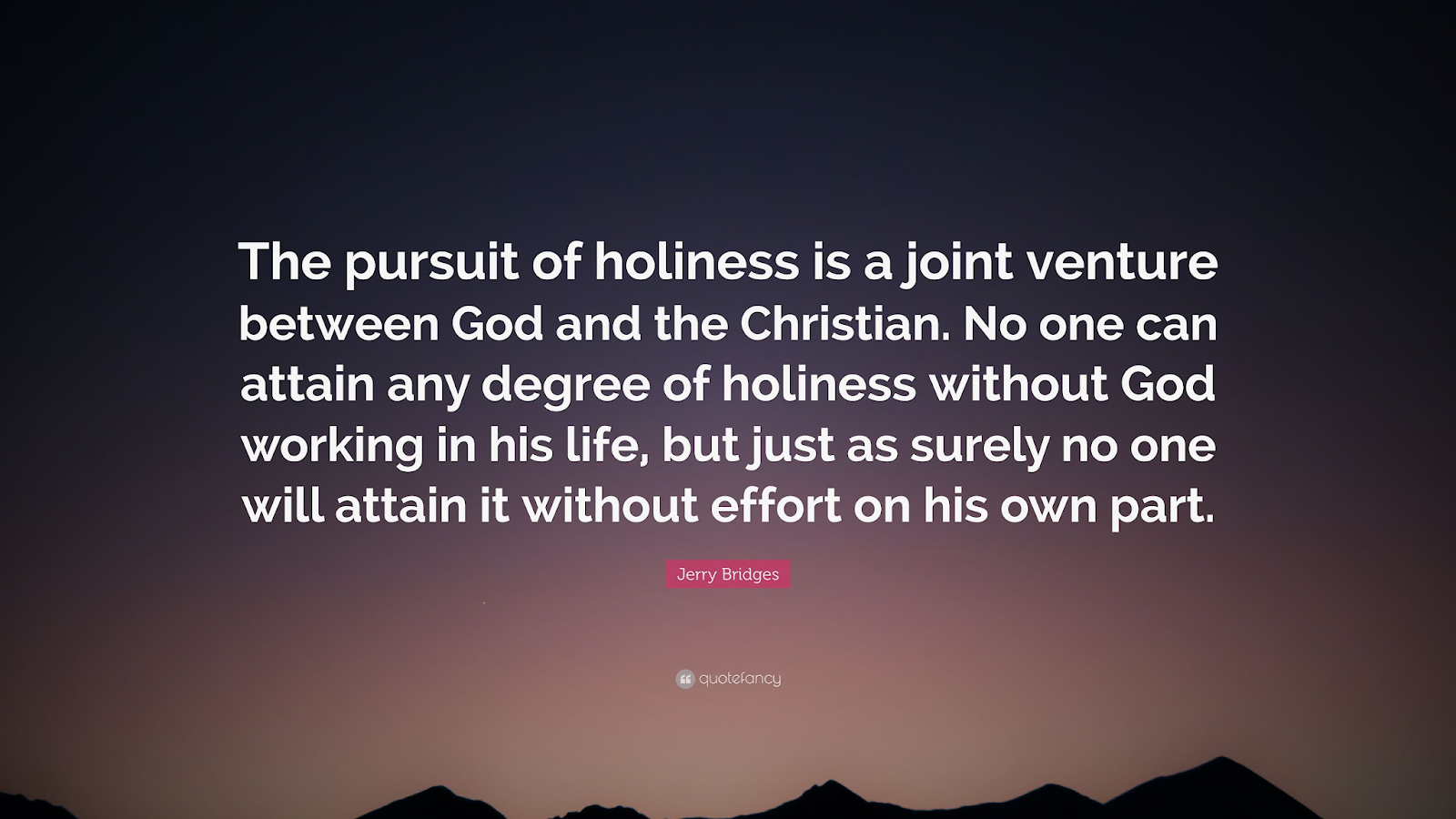
     This week's "thought" speaks of a topic which I don't hear much about any more -- holiness.  Therefore I thought it would be a good reminder for us all.  It is taken from Jerry Bridges book, "The Pursuit of Holiness."   I once had the privilege of hearing Mr. Bridges speak at a conference alongside John Piper, John MacArthur, and others. They were all good, but the one thing that struck me about Mr. Bridges (as opposed to the others, whose content was unquestionably superb) was his humility.  I can't remember all that he said, yet that was partly because I was so struck (distracted?) by the sense that here was a truly holy and humble man That's what stood out the most to me as I listened to him speak.  And it was confirmed a few years later when I took a class on "Grace and Discipline" with him while pursuing my doctorate. Thus I offer this selection on holiness from a humble man who took to heart the earnest pursuit of it.  Enjoy. 
     "God expects every Christian to live a holy life.  Holiness is not only expected; it is the promised birthright of every Christian.  Paul's statement in Rom. 6:14 is true: "For sin shall not be your master, because you are not under law, but under grace."  The concept of holiness may seem a bit archaic to our current generation. To some minds the very word holiness brings images of bunned hair, long skirts, and black stockings. To others the idea is associated with a repugnant "holier than thou" attitude.  Yet holiness is very much a Scriptural idea. The word "holy" in it's various forms occurs more than 600 times in the Bible.  One entire book, Leviticus, is devoted to the subject, and the idea of holiness is woven elsewhere throughout the fabric of Scripture.  More importantly, God specifically commands us to be holy (see Leviticus 11:44 / I Peter 1:16).
     The idea of exactly how to be holy has suffered from many false concepts.  In some circles, holiness is equated with a series of specific prohibitions -- no smoking, drinking, dancing, etc. The list of prohibitions varies depending on the group.  When we follow this approach to holiness, we are in danger of becoming like the Pharisees with their endless lists of trivial do's and don'ts, and their self-righteous attitude. For others, holiness means a particular style of dress and mannerisms. And for still others, it means unattainable perfection, an idea that fosters either delusion or discouragement about one's sin. All these ideas, while accurate to some degree, miss the true concept. To be holy is to be morally blameless. It is to be separated from sin and, therefore consecrated to God. The word signifies, "separation to God [to be set apart for God], and the conduct befitting those so separated."
     Perhaps the best way of understanding the concept of holiness is to note how writers of the New Testament used the word.  In I Thessalonians 4:3-7, Paul used the term in contrast to a life of immorality and impurity.  Peter used it in contrast to living according to the evil desires we had when we lived outside of Christ (I Peter 1:14-16).  John contrasted one who is holy with those who do wrong and are vile (Revelation 22:11).  To live a holy life, then, is to live a life in conformity to the moral precepts of the Bible and in contrast to the sinful ways of the world. It is to live a life characterized by the "[putting] off of your old self, which is being corrupted by its deceitful desires.... and [putting] on the new self, created to be like God in true righteousness and  holiness" (Ephesians 4:22-24)...
     At the risk of oversimplification, the lack of personal holiness can be grouped into three basic problem areas:

     1st) Our first problem is that our attitude toward sin is more self-centered than God-centered. We are more concerned about our own "victory" over sin than we are about the fact that our sins grieve the heart of God. We cannot tolerate failure in our struggle with sin chiefly because we are success-oriented, not because we know it is offensive to God.  W S. Plumer said, "We never see sin aright until we see it as against God...  All sin is against God in this sense: that it is His law that is broken, and His authority that is despised.... As the returning prodigal said, "I have sinned against heaven and before you," and David said to God (after his adulterous affair with Bathsheba), 'Against You, and You only, have I sinned."  God wants us to walk in obedience, not victory. Obedience is oriented toward God, victory is oriented toward self...
     2nd) Our second problem is that we have misunderstood "living by faith" (Galatians 2:20) to mean that no effort at holiness is required on our part. In fact, sometimes we have even suggested that any effort on our part is, "of the flesh." The words of J. C. Ryle are instructive to us at this point: "Is it wise to proclaim in so bold, naked and unqualified a way as many do, that the holiness of converted people is by faith only, without any personal exertion?  Is it according to the proportion of God's Word?  I doubt it. That faith in Christ is the root of all holiness, no well-instructed Christian will ever think of denying.  But surely the Scriptures teach us that in following holiness the true Christian needs personal exertion and work as well as faith."  We must face the fact that we have a personal responsibility for our walk of holiness...
     3rd) Our third problem is that we do not take some sin seriously.  We have mentally categorized sins into that which is unacceptable and that which may be tolerated a bit... But the Scripture tells us it is, "the little foxes that ruin the vineyards" (Song of Songs 2:15).  It is compromise on the little issues that leads to greater downfalls...   As Andrew Bonar said, "Is the Lord to be obeyed in all things whatsoever He commands? Is He a holy lawgiver? Are all His creatures bound to give implicit assent to His will?"  Are we willing to call sin "sin" not because it is big or little, but because God's law forbids it?  We cannot categorize sin (suggesting some sins are ok and others to be avoided) if we are to live a life of holiness... Will you begin to take personal responsibility for your sin, realizing that as you do, you must depend on God's grace?  And will you decide to obey God in all areas of life, however insignificant the issue may seem to you?"
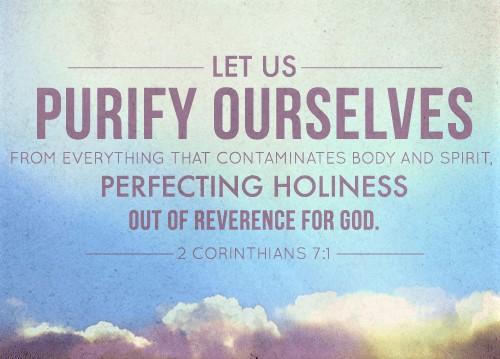
     When it comes to "holiness" most all people view it in slightly different ways.  Some as stern and joyless, others as restrictive and still others as refreshing.  And some, having been exposed to a counterfeit version of it (which was super-strict, joyless and judgmental) -- want nothing to do with it.  Yet, we are (as Bridges points out) called to pursue it, and to do something in our pursuit of it, for our struggle with sin does require resisting temptation, repenting of sin, clothing ourselves with Christ, putting to death the sinful nature, and so on. 
     We are often so afraid of hearing someone accuse us of being "legalistic" that we shy away from the pursuit of holiness, forgetting that what makes something "legalistic" is not personal effort, but the thought that by that effort we are earning salvific credits, or securing our justification with God. It is thinking our obedience earns us our salvation.
     Yet the pursuit of holiness is not like that. It is simply seeking to avoid that which grieves the heart of the God who has so loved us that He saved us.  It is working from grace, not for grace. It is working from the place of God's acceptance, not for a place in His acceptance.  And it must be said that just because we have God's acceptance through Christ, and the Gospel, doesn't mean we stop seeking to do what pleases Him. It simply means we are secure in His acceptance as we seek to please Him.  "Legalism" seeks to gain an acceptance it feels it doesn't have through it's efforts; a sanctified pursuit of holiness simply pursues godliness as it rests in the acceptance it knows by faith that it already has and can't lose -- that's why it can't be called legalism.

     Living in the Grace of Jesus as we pursue the holiness that is our Christian birthright, Pastor Jeff

7.16.2019

Devotions for Men on the Go


Greetings All,

     Today I found a book I had laid on my desk weeks ago. It was "Devotions for Men on the Go," by Stephen Arterburn.  I opened it and it randomly fell open to this devotion. It struck me as worthy of sharing. I hope it moves and challenges you as well. Enjoy.


"Even if my life is to be poured out like a drink offering 
to complete the sacrifice of your faithful service 
(that is, if I am to die for you), I will rejoice, 
and I want to share my joy with all of you." 
(Philippians 2:17)

A Matter of Honor
     "About an hour into United Flight 93 from Newark to San Francisco on September 11, 2001, terrorists commandeered the cockpit, herded the passengers to the back of the plane, and turned it back toward a target in Washington, D.C.  Among those passengers were four remarkable men who didn't much like being herded around. 
     One was 31 year old publicist Mark Bingham, who had helped the University of California win the 1991 and 1993 national collegiate rugby championships. He was six foot five, rowdy and fearless.  One was 38 year-old medical research company executive Tom Burnett, who told his wife over the phone, "I know we are going to die. Some of us are going to do something about it."  One was 31 year old businessman Jeremy Glick. He called his wife, Lyz, at her parents home in Windham, New York, to say good-bye to her and their twelve-week-old daughter, Emmy.  The other was 32 year-old sales account manager Todd Beamer, who had played third base and shortstop over three seasons for Wheaton College in Wheaton, Illinois.
     These four brave men apparently came up with a plan to storm the cock-pit and attempt to wrest control of the aircraft from the terrorists.  Flight 93 never made it to Washington. Instead, it crashed into a field eighty miles southeast of Pittsburgh. All passengers and crew perished.  Nobody on the ground was killed. 

     What will you do when it is your turn to be poured out for the sake of others?

     Dear God, may I value honor more than survival." 
     Jesus said, "Greater love has no man than this, that he would lay down his life for his friends" (John 15:13).  I wonder if it might not be just as hard (if not harder) to lay down your life for strangers you would never meet -- like these men who's heroic act saved the lives of countless many in whatever the target was to be in Washington, D.C.  All  on board did die, but if the terrorists were allowed to continue on unchallenged, it would have been all on board plus many more in D.C.
     Self-sacrifice is never easy. It goes against our survival instinct, and with few exceptions goes against the sway of our self-focused society.  Whether it be offering one's life up to death for others, or dying to self daily, by, "considering others better than yourself" (Phil. 2:3) it does not come easy.  Yet, it is an expression of imitating Christ in His condescension, sacrificial love, and self-emptying humility (Phil. 2:5-11).
     We admire such things in Jesus, but sometimes forget that, "our attitude should be the same as that of Christ Jesus: Who, being in very nature God, did not consider equality with God something to be grasped, but made himself nothing, taking the very nature of a servant and being made in human likeness. And being found in appearance as a man, he humbled Himself, and became obedient unto death -even death on a cross" (Phil 2:5-8).  Such humble and sacrificial love is part of following His command to, "love one another as He has loved us." 
     So, maybe I could put Mr. Arterburn's last prayer this way: "Dear God, may we value the opportunity to imitate Christ in His humility more than self-interest, self-protection and survival." 

Only as we lean on Him, Pastor Jeff

6.25.2019

Life Together


Greetings to All,

     Our “thought” for this week comes from Dietrich Bonhoeffer, the German pastor who was martyred by the Nazi's one month before the end of World War II.  Though his most famous book was, "The Cost of Discipleship" (where he warned people against adopting the unbiblical substitute for real grace which he called "cheap grace") this thought comes from ideas expressed in his superb book on Christian community entitled, "Life Together."   If you have never read it, it is well worth your time (and the price of the book)!   It's all about those things that are necessary for true Christian community to take place.  Enjoy.

     “Acknowledgement of sin in the presence of another brother is a safeguard against self-deception.  It is a curious fact that many people find it easier to confess their sins privately to a holy and sinless God than to openly confess them to an unholy and sinful brother.  If this is so, we must ask ourselves if we are really confessing our sins to God?  We must ask ourselves whether we have not been deceiving ourselves with our confession of sin to God – whether we have not, rather, been confessing our sins to ourselves, and also granting ourselves absolution.  Is this not perhaps the reason for our countless relapses and the feebleness of our Christian obedience?  Is it not to be found precisely in the fact that we are living on self-forgiveness and not a real forgiveness?
     When sin has been brought into the light and confessed it can be forgiven.  Its power can be broken.  It can no longer hold the believer in bondage or tear the fellowship apart.  The sinner can honestly be a sinner and still enjoy the grace of God and the love of the brethren.  This is the moment where fellowship in Christ becomes a profound reality. [When sin is openly confessed – even the worst of sins – and the love of our brethren continues to be extended to us in spite of it, we approach the profound and transforming reality of community.]
     Open confession of sin to another so crucifies one's pride that rarely ever occurs unless a person earnestly yearns to be rid of his sin.  By openly confessing his sin he breaks the habit of secretly cherishing, nurturing or refusing to let it go.  He becomes accountable.  He gains the support of his praying brothers in his fight to overcome its life-polluting influences.  In essence, he begins to live the life of discipleship." 

     Elsewhere Bonhoeffer equated sin with mold that grows in a damp, dark, cool basement.  How does one rid a basement of that growing mold? They open the windows, let the exposure to the air dry it out, and let the bright light of the sun shine upon it until it dries out and is easily brushed off. 
     Confession of sin is like that.  When we expose sin to the light through confession, in the presence of a brother (for me) or sister (for women), it begins to lose it's life or power, dry up and die.  But if we keep it hidden -- locked away in the dark and damp cellar of secret and repressed memories or emotions -- it will only fester and grow. There is healing, as James reminds us, in confession of sin accompanied by prayer for healing (James 5:13-16). 
     "Confession is good for the soul," as the old adage goes. (Yet one must be careful in their selection of a brother (for men) or sister (for women) to confess to. Trust, confidentiality and godliness would be essential traits.)  Hard as it is to expose some things to the light, it is much more harmful to our spirit to hold it in and keep it hidden and shut up in the dark basement of our emotions.

     In the Service of the Gospel and Church, Pastor Jeff

2.04.2019

Does This Truth Paralyze or Energize?

Greetings All,

     This past week I received a book in the mail that was printed in 1918 -- just a month and a week past being exactly one hundred years ago!  The book contains the addresses presented by various people at the Philadelphia Prophetic Conference in May of 1918.  As a lover of history I had to read through it to see if what was said then was relevant to today.  Much of it was, of course, since it centers around the Bible. Yet because it took place the year WWI ended, eleven years before the stock market crash of 1929 and the Great Depression, and about 20 years before the outbreak of WWII, some of the applications of the Bible were obviously dated.
     I particularly enjoyed the presentation of one Pastor Herbert Mackenzie, a former missionary to Africa who "retired" to take a church pastorate in Cleveland, Ohio.  This message, entitled, "Does This Truth Paralyze or Energize?"  focuses on Matthew 24:14, "This Gospel of the kingdom shall be preached in the whole world, as a testimony to all nations, and then the end shall come," and the command in II Timothy 4:1 to, "preach the word in season and out" in view of Christ's appearing and His kingdom.  I hope you might find encouragement through it as well. Enjoy. 

     "Jesus has said unto us, 'Go ye therefore into all the world and preach the Gospel to every creature.'  In light of this war, we all recognize our duty as citizens to to do our best for our country, and for the world in a crisis as grave as the one which we are now passing through. We also recognize we have a Leader (Jesus Christ) who is leading us on in a spiritual conflict; that we have a commission which must be obeyed and completed in order that He may come again and receive us unto Himself.
     Doctrine always decides duty.  It does matter what a man believes...  Doctrine is the plan of teaching that precedes the plan of duty... The doctrine is intended to be the inspiration that gives us the impulse and impetus to obey all the commands of our Lord... A man asked me not so long ago what was the greatest thing he could do for God.  I said, 'The greatest thing that you can do for Him is to do what He is doing.'  That is what God wants for you and me to do.  To long for that for which Christ is longing. And Christ is longing to see a completed body; a body that must be drawn out from all the people of the earth.  Those who know the Lord's purpose do not need to be given any personal appeals. I have never asked any individual for a dollar for missions in 20 years. Men whose hearts are touched by the promise of the Lord's return need only to be informed of the need and are satisfied to give their best to the Lord, for they live in the light of the gleams of the coming glory...
     The Word of God instructs us concerning the plan of God for our service. Somebody has said that Judaism and heathen religions have respect for boundaries and are content to leave everyone else alone. But the man who knows the plan of God is not willing to leave anyone alone.  It does not matter how near or far away the man may be who needs the Gospel. I have come to the conclusion (by examining my own heart) that we can never be like Christ until we love the world.  Christ loved the world, and no man can begin to be like Him until in some measure he too can say, 'I love the world'... 
     In the first chapter of Acts Jesus says to His disciples, "But you shall receive power after the Holy Ghost is come upon you, and you shall be witnesses to me in Jerusalem and Judea and Samaria and to the uttermost parts of the earth."  And those disciples knew what he meant by 'witnesses.'  For that word witness (marturos) means 'martyr-testifiers.'  Those men knew when He uttered that word that this testimony which they were called to give, this witness which was to be their work, was to be of more value to them than their own lives. There are boys, perhaps your boys, your brother, your friend, who will lay down their life, or are willing to lay down their life, for their country in this war. Yet there is something wrong with you, and with me, if our lives are worth more in our sight than the witness for Christ which He has left to our trust... 
     Years ago (in the early 1890's) I was traveling through Central Sudan.  I found that from the west coast clear up to Lake Chad about 40 tribes were waiting for the Gospel.  Only one tribe of the 40 had the complete record of the Scriptures.  Forty tribes in ignorance (of the Word), in idolatry, in superstition, steeped in paganism -- with a thousand Moslem teachers and traders sent out to convert them from paganism to Mohammedanism. All that in comparison to one Christian missionary sent out by the entire church of God.  I walked 17 miles a day for 7 days without finding a trace of any person who believed in the Lord Jesus Christ.  Scores of villages waiting, waiting, WAITING -- while you and I are enjoying the fullness of His blessing, sitting at His feet and looking into His blessed face.  My time (because of my age) has gone. I want, however, to say this. Somebody has spoken here about rewards. Somebody has said in this conference something about taking a crown and laying it at His feet. I know of no other way of securing a crown to lay at His feet than by gaining it in the work of soul winning; of making known to the world the glories of His cross. 
     There was a moment in the life of the Lord Jesus when He stood before that earthly judge, took the curse from beneath our feet, and permitted His enemies to take those thorns and entwine them into a crown and place it on His brow. He loved us enough to take earth's curse from beneath our feet and to lift it to His blessed brow.  Oh, what a delight that some day we may be able to take the crown which He has placed upon our heads and consider that the highest that He can give to us for our service, is only worthy to be placed at the feet of Him whose shoe latchet John tells us we are unworthy to loosen."
     Sudan is still a place which needs to be reached with the Gospel, as are many other places in Africa, the Middle East, and Asia -- not to mention (due to the changes in the spiritual climate since this book was published in 1918) the former strongholds of the Christian faith -- Britain, Continental Europe, Canada and the U.S.   What he pointed out then is still true today -- "there is something wrong with you, and with me, if our lives are worth more in our sight than the witness for Christ which He has left to our trust..."   If we would be willing to die in the service of our country, but not in the service of our Lord, something is terribly wrong deep in the recesses of our soul.
     The truth of Matthew 24:14 still stands before us: "This Gospel of the kingdom shall be preached in the whole world, as a testimony to all nations, and then the end shall come."  Will the hope of seeing His appearing, and His kingdom, motivate you to do all you can to join with Him in doing what He is doing? Will it move you to share the Gospel and carry out the task laid upon the whole church -- the task of taking the Gospel to the world we are called to love as Jesus loves it?

Living in the Grace of Jesus, Pastor Jeff

10.16.2018

Holiness By Grace - Delighting In The Joy That Is Our Strength

Greetings All!

     This week's "thought" comes from a book well worth the time it takes to read: "Holiness By Grace - Delighting In The Joy That Is Our Strength" by Bryan Chapell.  It has to do with God's grace and favor toward us, and the common misconceptions we often have about what it is that causes that grace to come our way.  There are very few who do not desire God's grace.  Few who do not yearn for His favor.  Yet, as Chapell points out, in our attempts to attain it, we often drive it further from us.  We often go astray in the ways we seek to become recipients of it.  I found his instruction in this regard helpful.  I pray that you might also.  Enjoy.
     "Despite the teaching of Scripture, I am at times no less troubled than Christ's disciples were with God's determination to resist human efforts to purchase his love.  I want to believe that God must be good to the organizations I serve, to the family I love, and the career in which I seek to advance, because I have tried to be good. Such reasoning abandons me, however, when I honestly compare my righteousness to Christ's standards... When I face the reality of the inadequacy of my works to merit God's favor, then I recognize that I must depend on his goodness and not my own. At times this dependence (on his goodness) is scary because it lifts control from me, but there is no other choice when I recognize the true character of my good works. For according to Scripture, even my best works are only "filthy rags" (Isaiah 64:5). There is too much human imperfection and mixed motives in my best deeds to have them obligate God to do as I wish...
     That does not mean, however, that God never desires or blesses our goodness.  Walking in God's ways is itself a blessing (Ps. 1, Matt. 5:3-10). For example, being faithful to one's spouse brings integrity to a marriage that is a blessing.  Speaking honestly can enhance one's reputation and help secure faltering relationships... Still, no degree of human goodness will lock God into a pah of blessing according to our choosing, as though we have become his master through our merit.  God promises to bless obedience by using it for his purposes, but the blessings that result should be seen less as credit for our goodness, and more as evidence of his faithfulness to his purposes... Divine blessing flows from God's mercy rather than from our merit. Thus, we cannot guarantee that his care will flow according to our plans simply because we conform in some degree to biblical standards. Our works do not obligate God to care for us in the way WE think is best... God blesses according to the wisdom of his eternal mercy rather than in proportion to our works of earned merit...
     [In Luke 17:11-19 ten lepers cry out to Jesus in desperation, "Jesus, master, have mercy on us!"]... What does Jesus do when these desperate people plead with him for mercy? He shows them mercy.  Jesus shows pity to those who have nothing to claim but desperation.  He is moved by their desperate cry for help.  What is the message to us?  Our God is not moved by the deeds we trophy, but by the desperation we acknowledge as our own....
     God's heart is moved, not when we protest our innocence by pointing to our inadequate good deeds, nor when we promise that we will do better in the future. Though there is no reason for God to love us, yet he does.  This is the nature of grace that we must treasure to know the joy that God wants for our lives. Until we recognize that there is no reason God will be moved to love us other than the spiritual need we acknowledge, we have no good news to tell others or ourselves. How could it be good news that God waits to love us until we reach an unattainable standard of righteousness, or that he counts our "filthy rags" as meritorious?  Biblical faith is most evident not when we demand that God honor our flawed deeds, but when we trust that he will mercifully respond when we humbly and helplessly cry out, "Jesus, Master, have pity on us!"
     Those who cry out in desperation have more hope of moving God's heart than any who would trophy their own righteousness before him.  Those who face the hopelessness of their spiritual condition apart from God's mercy are nearer to experiencing his grace than those who pride themselves on their goodness. Not beyond God's mercy is the homosexual dying of AIDS, who says in a broken spirit, "People may condemn me for a life they do not approve, but to tell you the truth, I would have loved anyone that loved me back."  In fact, such a man may be nearer to expressing what melts the heart of heaven, than I am on the days that my preaching, my position (as a seminary president), and my righteousness, swell my pride to make me think I am deserving of God's blessing.
     To experience God's blessing I must readily and repeatedly confess my own hopeless condition. What makes me willing to do this is the knowledge that it is my desperation that inclines God's heart toward my own.  The awareness that he does not turn away from my desperation will actually draw me to confession and deep repentance. The assumption that God only loves the righteous will tempt me to hide from him (and myself) the flaws under the public veneer of my character and my fears of deeper failures... 
     Our Lord's response to the leper's cry for mercy should compel us to confess our sin to him no matter its degree or persistence. We need not have corrected the wrong in our lives to ask him to forgive us We should not attempt to try and compensate for our sin before we ask him to love us. Remember that Jesus cleansed all the lepers when they cried out for his mercy, even though in his divine nature he could have known that only one would return to thank him.  Neither past failing nor future weakness will dissuade our Savior from showing us mercy when we honestly acknowledge our desperate need for his grace."
     One only needs to glance at the any of the four Gospels to see the truth of what Chapell says.  God inclines his ear and opens his heart to the desperate, but resists the proud. He embraces the sinful man who won't even look up to heaven but in shame cries out, "Lord be merciful to me a sinner," yet refuses to listen to the Pharisee who looks down on that heart-broken man and brags inwardly that he is so much better and thanks God he is not like him.  Pride and self-righteousness (that is, thinking we can make ourselves acceptable to God by our personal deeds and efforts) pushes the divine hand of grace away, it does not (as many curiously think) bring God's favor and blessings near.  We must always remember: "God resists the proud but gives grace to the humble."   It is the acknowledgment and confession of our sin, deep need, and personal inadequacy that draws close the grace and mercy of God, and the vain illusion that we have all our moral and spiritual ducks in a row that drives it away.
     If you would like to pray for grace, here is a simple prayer I often use: "Lord Jesus Christ, Son of the Eternal God, be merciful to me a sinner." 
For His name's sake,  Pastor Jeff 


8.15.2017

Springs in the Valley

Greetings All!

     This week's "thought" comes to you from a devotional named, "Springs in the Valley," by L. B. Cowman (also the author of "Streams in the Desert" from which I quoted not long ago).


     I chose to share this particular selection because it displays such a profound understanding of God's personal intervention in our lives. In the age we live in, which loves formulas, and thinks we can duplicate the results of others simply by duplicating their methods, God often has a surprise for us.  For as many who have tried will testify, we can duplicate everything others do and still not get the same results.  Why? Because a sovereign God reigns over the universe who moves uniquely in each person, place, and situation -- a God who is intensely personal and isn't into cloning or copycat ministries.  In fact, the desire to duplicate the life and experience of others not only takes God's unique plan for each of us far too lightly, it also disavows the working of grace, and the richness of diversity within the Church -- the unique path to maturity that God has ordained for each individual believer.
     That's why I so enjoyed this entry.  It displays a profound understanding of God's unique care and work in the life of each believer.  If you have sought to do ministry at all, you have surely thought, or wrestled internally, with some of the things he speaks of here.  I know I have. 
     The only thing I might have changed would be the verse she uses for this entry.  She used Philippians 3:7, I would have used Matthew 20:1-16. Enjoy.

     "If God has called you to be really like Christ, He may draw you into a life of crucifixion and humility and put on you such demands of obedience that He will not allow you to follow other Christians, and in many ways will let other good people do things which He will not let you do.
     Other Christians, who seem very religious and useful, may push themselves, pull wires, and work schemes to carry out their plans, but you cannot do it. And if you attempt it you will meet with such failure and rebuke from the Lord as to make you sorely penitent.
     Others may boast of themselves, of their work, of their success, of their writing, but the Holy Spirit will not allow you to do any such thing. And if you begin to, He will lead you into some deep mortification that will make you despise yourself and all your good works.
     Others will be allowed to succeed in making money... but it is likely God will keep you poor, because He wants you to have something far better than gold, and that is a helpless dependence on Him, that He may have the privilege of supplying your needs day by day out of an unseen treasury.
     The Lord will let others be honored and put forward, but keep you hidden away in obscurity because He wants to produce in you some choice fragrant fruit for His coming glory. He will let others be great, but keep you small. He will let others do a work for Him and get the credit for it, but you He will make to work and toil without knowing how much fruit your efforts are bearing. The Holy Spirit will put a strict watch over you... rebuking you for little words and feelings or for wasting time.
     God is an Infinite Sovereign! He has the right to do as He pleases with His own.  Settle it forever, then, that you are to deal directly with the Lord Jesus -- that He is to have the privilege of tying your tongue, chaining your hand, or closing your eyes in ways that He does not deal with others.  Then you will have found the vestibule of heaven.  Others may, you cannot."
     In the parable of the kingdom in Matthew 20 Jesus speaks of hiring workers to tend His field for a denarius a day (the typical work day being 12 and not 8 hours)!  Yet as the story goes on, we see one worker works 12 hours, one works 9 hours, one works 6 hours, one works 3 hours, and one works only 1 hour -- but they all get the same pay!   And when they complain about the "unfairness" of this policy, Jesus (speaking as the landowner) responds, "Don't I have the right to do what I want with my own money? Or are you envious because I'm generous."
     The "pay" is obviously salvation, and its the same for those who follow Christ all their lives as it is for the person who comes to Christ in the last hour, on their deathbed. It's something Jesus sees as displaying God's uncanny generosity, though some see it as God being "unfair."
     Yet the same phrase the landowner uses to refer to money could also refer to the way God moves through all the varied details of our individual lives: "Doesn't He have the right to do what He wants with my own..."  Doesn't God have the right to deal with each of His grace-chosen children as He chooses?  And when He does, should we complain that we are not being treated as "fairly" as others (whose lives we envy)?  Should we not rejoice that the path He leads us on is one He designed specifically for us, in light of our unique makeup and personality, and the special work He desires us to carry out for His glory?
     You see, it is true -- God is an Infinite Sovereign!   And because He is, and deals with each of us uniquely, it can be said: Other may do what He will not permit us to do. He may even call us to do some difficult thing that others are not called to do.  He has the right to do as He pleases with His own.  No clones or formulas, just a sovereign God who as the divine Potter does what He desires with each unique and individual lump of clay.
In the Name of Him who is in Control, Pastor Jeff