Visitors

free counters
Showing posts with label Struggle. Show all posts

10.29.2019

The Power of Prayer in a Believer's Life

Greetings All,

I didn't get a chance to post a "thought" last week, so I wanted to rectify that this week!   This one is by Charles H. Spurgeon and has to do with prayer.  Actually, it has to do with the Bible's command for us to pray.  Many see prayer as an optional practice one can engage in if, or when, they choose.  But the Bible sees it differently.  Thus, I offer you Spurgeon's insights on the matter, which come from the book, "The Power of Prayer in a Believer's Life," compiled and edited by Robert Hall.   Enjoy!
Prayer is Commanded 

     "We are not merely counselled or advised to pray, we are commanded to pray. This is a great condescension to our needs, weaknesses, and struggles. When a hospital is built, it is considered sufficient that the doors are open for the sick when they need help.  But no order is given that the sick must enter the hospital's care.  It is thought to be enough to offer its services without issuing a mandate that people must take advantage of them.  It seems somewhat strange, therefore, that where prayer is concerned, people need to be commanded to be merciful to their own souls.
     So marvelous is the condescension of our gracious God that He issues a command of love without which the sons of Adam would rather starve (or remain sick) than come and partake of the Gospel feast or services to help cure their soul.  God's own people need -- or else they would not have been given it -- a command to pray. Why?  Because we are very subject to periods of worldliness.  We do not forget to eat, or go to work, or go to our beds to sleep, but we do often forget to wrestle with God in prayer and spend long periods in consecrated fellowship with our Father and our God.  With many believers, the worldly ledger is so large and bulky that you cannot move it, and the Bible -- representing their devotion -- is so small that you could fit it in the pocket of their coat. Hours for the world, minutes for Christ! The world gets the best, while prayer gets the leftovers of our time.  We give our strength and freshness to the ways of making money and our tiredness to the ways of God.


     Hence it is that we need to be commanded to attend that that very act that should be our greatest joy and happiness and highest privilege to perform -- to meet with our God.  "Call upon me," He says, for He knows we are prone to forget.  "How can you sleep? Get up and call on your God!"(Jonah 1:6) is an exhortation we need to hear as much as Jonah did in the storm...
     It may be helpful for some of you to find out how often in Scripture you are told to pray. "Call on me in the day of trouble and I will deliver you" (Psalm 50:15). "Trust in Him at all times, you people, pour out your hearts to Him" (Psalm 62:8).  "Seek the Lord while He may be found; call upon Him while He is near" (Isaiah 55:6).  "Ask and it will be given to you; seek and you shall find; knock and the door will be opened to you" (Matt. 7:7).  "Watch and pray, that you do not fall into temptation" (Matt. 26:41).  "Pray without ceasing" (I Thess 5:7). "Let us therefore come boldly before the throne of grace" (Heb. 4:16).  "Draw near to God and He will draw near to you" (James 4:8).  "Devote yourselves to prayer, being watchful and thankful" (Col. 4:2). I need not multiply texts on the need for prayer when I could not exhaust them.  I have picked only a few from this great bag of pearls...
     There are also times when God commands His people to pray not only in the Bible, but directly in their hearts by the motions of His Holy Spirit. You who know the inner life understand my meaning. You suddenly feel the pressing sense that you must pray.  It may be that you do not at first take particular notice of the inclination, but it comes again, and again, and again -- "Pray!"  I find that in the matter of prayer I am like a water wheel that runs well when there is plenty of water pouring over it, but turns with very little force when the brook grows shallow. Whenever our Lord gives us the special inclination to pray, we should double our diligence. Scripture says we should pray always and never give up" (Luke 18:1), yet when God gives us the special longing and compulsion to pray, you have another command that should compel you to cheerful obedience...  See to it that you use the golden hour and reap a harvest while the sun shines. When we enjoy visitations from on high, we should be particularly constant in prayer.  If some other pressing duty comes our way, let it pass.  When God in a special way bids us to pray by the motions of His Holy Spirit, we should obey and pray." 
     It may come as a surprise to hear that God commanding us to pray is part of His condescension (in a good sense) to our struggles and weaknesses. He knows we struggle to pray. He knows we are distracted. He knows other things nudge it out. He knows we have sinful inclinations that encourage us not to pray. Therefore, out of a grace that pushes us to do those things that are good for us, He commands us to pray.  And He does so not only through the written and recorded Word in Scripture, but even more personally in our hearts by His Spirit. Spurgeon is right. Those who know the Lord know that He frequently moves us internally to pray, or want to pray, or feel we must pray, and that if we don't we will be defying Him!

Just some thoughts to ponder, Pastor Jeff 

8.27.2019

The Mystery of Prayer

Greetings All,

     After two weeks away I am back from a relaxing vacation! Time spent in nature, in the woods and mountains of New England, has its benefits in refreshing the soul!
     This morning a friend asked a question about prayer.  It was a question many ask, since prayer is something that takes time to understand, even though we will never fully comprehend the mystery of it. After all, there are so  many different views and opinions and approaches people have toward praying.  Therefore, I decided I would send out this "thought" on prayer by Gary Thomas, entitled: "The Mystery of Prayer."  It is found in his book, "Sacred Pathways."  It does not address the question asked this morning, but given the fact that most all people struggle at one time or another in their prayer life, I thought some might find it helpful and encouraging -- especially those who have encountered the often confusing dilemma called "unanswered prayer."  Enjoy.

The Mystery of Prayer

     "Is there anything more mysterious than prayer? Prayer moves us to call on a Being we cannot see and ask him to altar that which we can see.  Formulas do not work; rituals cannot guarantee success. Neither the length nor the form of prayer makes the prayer potent. This is why we need to create pockets of prayer in our lives, learning to trust God to come through in unexpected ways. There is an element of mystery, however, against which we sometimes rebel -- the mystery of unanswered prayer, or, perhaps more appropriately stated, prayers that receive the answer "no." 
     Because God sometimes answers our prayers with a yes, it can become intoxicating, and this intoxication can become so addicting that we begin to demand that God answer every prayer with a yes When a prayer doesn't get answered in the way we want it to be, we may mistakenly assume there must be hidden sin, lack of faith, or some other buried obstruction, which then sends us into hours of fruitless introspection.  But to demand that God answer all our prayers with a yes is to ask for his omnipotence (power) without having the benefit of his omniscience (knowledge).
     Looking back, I'm thankful that God said no to some of my prayers. The mystery of faith calls us to love and serve a God whom we can't always understand. We love this when the result satisfies us and God answers in ways that make our knees weak. It is much less exciting, however, when the mystery leads us to believe that God is silent, indifferent, or even cruel. Mystery is mystery. It has its exhilarating elements as well as frustrating ones, and we can't expect one without the other.
     The pursuit if maturity will lead virtually every one of us through this canyon of unanswered prayer, where expectancy runs dry and the only mystery seems to be where God is hiding. Understand that this is a necessary avenue on the destination to holiness and that it usually has an end -- in God's timing however."

     Some thoroughly enjoy prayer.  Some struggle with snags and disappointments in prayer.  And some have dispensed with prayer -- at least in the more formal sense -- though I do not believe it's possible for the true believer to dispense completely with conversational interaction with God. Few will go an entire lifetime without the "why's" of both answered and unanswered prayer, yet there is blessing in persevering. Just as a child passes through phases of equilibrium and disequilibrium in their trek to maturity, so also the person maturing in prayer goes through such phases. The key, in the famous words of Winston Churchill, is to, "Never, never, never give up." 
     With you in what is often the struggle to find God, and the pathway to the throne of His grace, in prayer, Pastor Jeff

5.28.2019

When I Don't Desire God


Greetings!

For over a year I've been engaging numerous young people in conversations about God, church, and simply life in general.  In the process one major theme has repeatedly come up: Many young people are struggling to experience joy in God.  As a result some gave given up on God.  Many say their friends are depressed and struggle to find meaning and motivation in life.  I know there are various reasons for this, but I send out this week's "thought" because it offers at least one possible remedy for the problem.  It's found in John Piper's book, "When I Don't Desire God," the sequel to his best-selling book "Desiring God - The Confessions of a Christian Hedonist."  Both books are well-worth reading if you have not yet done so.  Enjoy.
     "One of the greatest witnesses I know of to the power of regular disciplined reading of the Bible for the sake of love-producing joy is George Mueller (1805-1898), who is famous for founding orphanages in Bristol, England, and for depending on God for meeting all his needs.  He asked the very question this book is asking: "In what way shall we attain to this settled happiness of soul? How shall we learn to enjoy God? How shall we obtain such an all-sufficient soul-satisfying portion in him as shall enable us to let go of the things of this world as vain and worthless in comparison? I answer: This happiness is to be obtained through the study of the Holy Scriptures. God has therein revealed Himself unto us in the face of Jesus Christ."  
     That's what we have seen so far in this book: Happiness in God comes from seeing God revealed to us in the face of Jesus Christ through the Scriptures.  Mueller says, "In them...we become acquainted with the character of God. Our eyes are divinely opened to see what a lovely Being God is!  And this good, gracious, loving, heavenly Father is ours -- our portion for time and for eternity."  Knowing God is the key to being happy in God.  "The more we know God," says Mueller, "the happier we are... When we became a little acquainted with God... our true happiness... commenced; and the more we become acquainted with him, the more happy we become.  What will make us exceedingly happy in heaven?  It will be the fuller knowledge of God."  Therefore the most crucial means of fighting for joy in God is to immerse oneself in the Scriptures where we see God in Christ most clearly.
     When Mueller was seventy-one years old, he spoke to younger believers: "Now...I would give a few hints to my younger fellow-believers as to the way in which to keep up spiritual enjoyment. It is absolutely needful... we should read regularly through the Scriptures, consecutively, and not just pick out here and there a chapter.  If we do, we remain spiritual dwarfs. I tell you so affectionately. For the first four years after my conversion I made no progress, because I neglected the Bible. But when I regularly read on through the whole Bible with reference to my own heart and soul, I directly made progress. The my peace and joy continued more and more. Now I have been doing this for 47 years. I have read through the Bible about 100 times and I always find it fresh when I begin again. Thus my peace and joy have increased more and more.
     He would live and read his Bible for another twenty-one years. But he never changed his strategy for satisfaction in God. When he was seventy-six, he wrote the same thing he had learned for over fifty years: "I saw more clearly than ever, that the first and primary business to attend to every day was, to have my soul happy in the Lord."  And the means stayed the same: "I saw that the most important hing I had to do was to give myself to the reading of the word of God, and to meditation upon it... What is the food of the inner man?  Not prayer, but the word of God; and... not the simple reading of the Word of God, so that it only passes through our minds like water runs through a pipe, but considering what we read, pondering over it, and applying it to our hearts.""
     In a society that tries to get us to question the uniqueness, validity, authority and divine origin of the Scriptures as being "God-breathed" revelation (II Timothy 3:16-17), it is not unusual to see people laying aside the priority of Bible reading, Scriptural meditation and Bible memorization.  Yet they do it to their own peril and the impoverishment of their own soul. They rob themselves of the possibility of the peace and joy that come from knowing God.  For as both Mueller and Piper note: "This happiness is to be obtained through the study of the Holy Scriptures...." "Happiness in God comes from seeing God revealed to us in the face of Jesus Christ through the Scriptures...."  "Knowing God is the key to being happy in God."  "The more we know God the happier we are."
     Did not Jesus essentially tell us the same thing regarding the soul-feeding and soul-satisfying function of God's Word in the Scriptures?  Is He not looking out for our greatest good -- our spiritual happiness, contentment and satisfaction in God -- when He says:  "Man does not live by bread alone, but by every word that proceeds from the mouth of God."  And as we know, by the word "live" he is not simply speaking of physical life as opposed to death, He's speaking of being alive inwardly, or thriving spiritually, of finding our soul-sustaining nourishment in the Scriptures.
     With prayers that you may seek to feast more earnestly and consistently upon the Word that was given to sustain your happiness in God, Pastor Jeff

4.30.2019

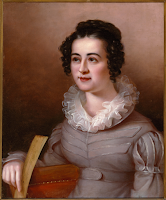
Pioneer Missionary Ann Hasseltine Judson

Greetings All,

     In my last "thought" I shared about Adoniram Judson.  A couple days later I was asked to send one out highlighting the brave and heroic commitment of his wife -- Ann Hasseltine Judson.  This is her story (or at least part of it). Her profound influence in regard to the place of women in missions has few rivals.  As the first woman missionary sent out from the U.S., she set the standard for future generations.  This is by far the longest thought I've ever sent out (and it has been heavily redacted to shorten it to what it is)!  Yet, with Mothers Day fast approaching, I thought honoring her contribution as a wife, mother and missionary was warranted. Enjoy.

     "Two hundred and nine years ago in 1810, a young man named Adoniram Judson composed an extraordinary letter to the father of the young woman he wanted to marry. He wrote as follows: “I have now to ask, whether you can consent to part with your daughter early next spring, to see her no more in this world; whether you can consent to her departure for a heathen land, and her subjection to the hardships and sufferings of a missionary life; whether you can consent to her exposure to the dangers of the ocean; to the fatal influence of the southern climate of India; to every kind of want and distress; to degradation, insult, persecution, and perhaps a violent death. Can you consent to all this, for the sake of him who left his heavenly home and died for her and for you; for the sake of perishing immortal souls; for the sake of Zion, and the glory of God?” 
     At 21 years of age, her parents left the choice to Ann.  She decided to marry Adoniram and to leave everything behind for the unknown. She knew she would probably never see her family again. The voyage was far too long, perilous and expensive for the possibility of any visit from relatives or friends. Letters took months, and might well never arrive. There was no established mission network to give support or counsel. There was no American Embassy in Asia to give protection. There was no certainty that these pioneer missionaries would even find a place in which they could safely minister. Nothing was guaranteed – neither safety, health, toleration, and least of all success. But Adoniram, Ann, and the other young people with them understood that Christ did not issue the Great Commission on the condition that health, comfort and safety could be guaranteed. Christ had said simply, “GO.”  Therefore they married on February 5, 1812 and the very next day the newlyweds sailed from Salem, Massachusetts...
     The religion of Burma was Buddhism: a system of belief that arose in the sixth century BC with the enlightenment of Gautama, the Buddha The Buddha taught that all appearance is characterized by transience, that there is not really a soul, and no eternal God… Ann wrote bluntly in her journal of the emptiness of Buddhism: “The religion of Burmah, then, is, in effect, atheism; and the highest reward of piety, the object of earnest desire and unwearied pursuit, is annihilation. How wretched a system is this; how devoid of adequate motives to virtue; and how vacant of consolation!”  Consequently, the Burmese had no concept of an eternal God, and no means in their language to express such an idea. Ann and Adoniram worked hard studying up to 12 hours a day for two years learning the difficult language. Eventually Adoniram produced a gospel tract in Burmese and commenced working on a Burmese translation of the New Testament. Ann authored a Burmese language catechism, translated the books of Daniel and Jonah into Burmese, and began to teach women’s Bible classes. She was also the first person to translate Bible passages into Siamese. Ann also formed a society of native women who met together on Sundays to pray and read the Scriptures.
     By 1820, six years after their arrival in Burma, Ann was so seriously ill that she had to seek medical help in Calcutta. Two years later she was told that unless she returned either to Europe or America for treatment, she would die. She had previously consented to her husband accompanying her to Calcutta, but the longer voyage to England (and a possible further trip to America) would take at the least two years, and she refused to consider Adoniram abandoning the infant church and the crucial Bible translation for that long. As a result, in 1822, she made the long and difficult journey alone. She sailed first for England, and Christians there raised funds for her passage to America.  Back at home, she received skilled medical care and was reunited with her family and that of Adoniram. The whole trip took two years, and of this separation Adoniram said that it felt like cutting off his right arm and gouging out his right eye.
     Ann returned in 1824, but her reunion with her husband, though joyful, was pitifully brief.  War between Burma and England began, and all male foreigners fell under suspicion of being English spies. So Adoniram and his associate Mr. Price, were thrown into the notorious death prison from which few ever emerged alive. While in prison they awaited execution in the most filthy and sordid of conditions, weighed down with fetters so that they could not walk. Daily they observed the torture and execution of their fellow prisoners, not knowing when their time would come. Nightly they were placed in the stocks, and their legs and bodies raised so that only their head and shoulders remained on the ground. They remained incarcerated for one and a half years, during which time they were never able to wash, were often ill with no access to medical help, and had little contact with the outside world...
     During her husband’s imprisonment, Ann petitioned tirelessly on the prisoners’ behalf with no regard for personal risk. Daily she walked the two miles from their small home to the prison in hopes of supplying them with food and drink. Sometimes she was allowed to see them, but often they were forbidden to speak. She also visited every person of influence to whom she could gain access, trying to explain that as missionaries they had nothing to do with the English war effort. She was quite alone through this ordeal, and she was pregnant. Eight months after Adoniram had been arrested, in February 1825, she gave birth to little Maria, and was able to visit the prison with the infant, whom the father could only observe from afar. Their first baby had been stillborn, their second had died at eight months, and this child’s chances of survival seemed even more slender.  Of this terrible time she wrote:  “Sometimes for days and days together, I could not go into the prison till after dark, when I had two miles to walk, in returning to the house. O how many, many times, have I returned from that dreary prison at nine o’clock at night, solitary and worn out with fatigue and anxiety… My prevailing opinion was, that my husband would suffer violent death; and that I should, of course become a slave, and languish out a miserable though short existence in the tyrannical hands of some unfeeling monster. But the consolations of religion, in these trying circumstances, were neither `few nor small.’  It taught me to look beyond this world, to that rest, that peaceful happy rest, where Jesus reigns, and oppression never enter.”
     Eventually she had to set up a little shelter near the prison, as the daily four-mile-round-trip proved too much to walk in the blazing heat. As the weather brought unbearable heat, the conditions in the prison only worsened. Of this time her memoirs record: “The situation of the prisoners was now distressing beyond description. It was at the commencement of the hot season. There were above a hundred prisoners shut up in one room, without a breath of air excepting from the cracks in the boards. I sometimes obtained permission to go to the door for five minutes, when my heart sickened at the wretchedness exhibited. The white prisoners, from incessant perspiration and loss of appetite, looked more like the dead than the living…”
     It would seem that things could not get worse. But with the British troops advancing to the capital, the foreign prisoners were removed on a death march to a remote spot in the country some miles north of the capital, where rumor had it they were to be buried alive as an offering to the gods in the path of the advancing troops. Their sufferings on the march were indescribable, their survival remarkable. Even more remarkable was the determination of Ann to follow them. With her three-month-old infant, plus two little girls she was looking after, and a faithful Burmese helper, she immediately set out by boat, and then by rough cart, in pursuit of the prisoners. For the duration of their imprisonment outside of the capital she persuaded their jailer to let her and the children share his two-room hut. From there she continued to try to minister such help as she could to her husband and Price. During this appalling period she became so ill that she had no milk for the baby, and the only way Maria survived was by bribing the jailer to allow Adoniram out of prison to carry the baby round the local village, begging nursing mothers to let Maria have a little of their milk.
     When the Burmese realized how hopeless the struggle against England was, they decided they needed all the help they could get in negotiating the least humiliating peace settlement. Adoniram and Price were released to help with the peace negotiations, as they could speak both Burmese and English. Again Ann and Adoniram had a wonderfully happy but tragically brief reunion. They enjoyed two blissful weeks of freedom and comfort at the British base before Adoniram was summoned elsewhere for further negotiations. This was to be their final separation. Ann’s health had been broken by the sufferings of the previous two years, and her body, past the point of exhaustion, finally broke and succumbed to cerebral meningitis. Her final sufferings were to be endured without her husband. She was thirty-seven.
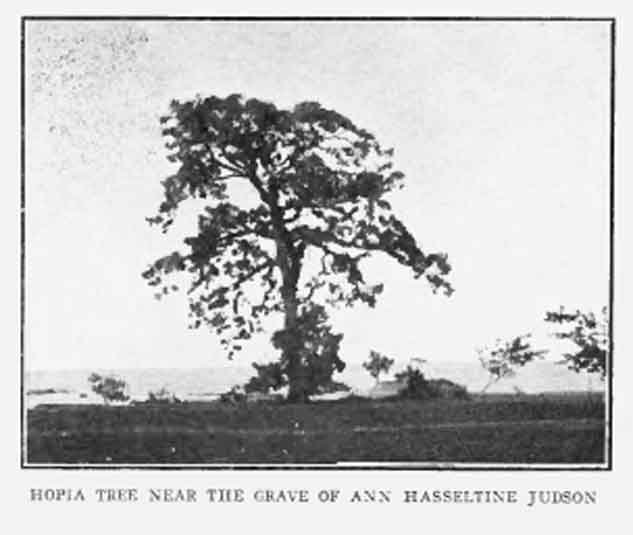
     Adoniram was shattered not only by her death, but by the knowledge he had not been able to support her at that time. Shortly thereafter, Maria also died.  Adoniram was left quite alone, and later wrote with the sad news to Ann’s mother telling her of the burial of his daughter: “The next morning we made her last bed in the small enclosure that surrounds her mother’s lonely grave. Together they rest in hope, under the hope tree, which stands at the head of the graves, and together, I trust, their spirits are rejoicing after a short separation of precisely six months. And I am left alone in the wide world. My own dear family I have buried; one in Rangoon, and two in Amhurst. What remains for me but to hold myself in readiness to follow the dear departed to that blessed world, “Where my best friends, my kindred dwell, Where God my Saviour reigns.” Adoniram was so grief-stricken at his loss that he suffered complete emotional breakdown.
     Ann Hasseltine Judson was converted at 17 during what has come to be called, "The Second Great Awakening."  She was a deeply dedicated Christ-follower, as well as a gifted teacher, linguist, preacher and author. She was instrumental in establishing a Christian church in Burma which, though heavily persecuted, still thrives to this day.  She championed the cause of female education, starting a Burmese girl’s school and tirelessly petitioning Christian sponsorship for her girls during her medical furlough in the United States.  It is generally agreed had it not been for Ann’s sacrificial efforts and representations to the governing authorities, Adoniram would not have survived his time in the death prison. It has been said of her: “She was a woman who loved intensely, loved her husband, loved her children, loved the people of Burma, but above all, she loved her God.”

     When I think of Ann one verse comes to mind: "Many women do noble things, but you surpass them all... let her works bring her praise at the city gates" (Prov. 31:29 & 31).


     If you would like to read a more full account (this was my primary though not sole source for this post) you can click here:  


In His Service, Pastor Jeff

3.26.2019

Addiction and Grace

Greetings All!

Sitting in my office, my eyes scanned the book shelves and fell upon one particular book: "Addiction and Grace" by Gerald G. May, M.D.  It's an intriguing title, because those two words describe the universal struggle and only remedy for humanity.  Don't let the length deter you!  Some spiritual journeys can't be condensed to a paragraph or two!   It's a worthwhile read for anyone, but especially for those trying to help and love people trapped by addictions -- which as he points out, includes all of us to varying degrees.  The "Introduction" is from years of study, experience and reflection.  It is followed by his own "Personal Testimony."  I found what he says very helpful.  Enjoy.

Introduction:
     "After many years of listening to the yearnings of people's hearts, I am convinced that all human beings have an inborn desire for God. Whether we are consciously religious or not, this desire is our deepest longing and our most precious treasure. It gives us meaning. Some of us have repressed this desire, burying it beneath so many other interests that we are completely unaware of it.  Or we may experience it in different ways -- as a longing for wholeness, completion, or fulfillment. Regardless of how we describe it, it is a hunger to love, to be loved, and to move closer to the Source of love...  Modern theology describes this desire as God-given. In an outpouring of love, God creates us and plants the seeds of this desire within us. Then, throughout our lives, God nourishes this desire...
     But something gets in the way...  We become addicted to other things....  A self-defeating force that abuses our freedom makes us do things we really do not want to do (Romans 7:15)... Moreover, our addictions are our own worst enemies. They enslave us with chains that are of our own making and yet paradoxically, are virtually beyond our control.  Addiction attaches to desire and enslaves the energy of desire to certain specific behaviors, things or people. These objects of attachment then become preoccupations and obsessions They come to rule our lives. The word "attachment"... comes from the old French "atache" meaning, "nailed to."  Attachment "nails" our desires to specific objects or things -- alcohol, narcotics, ideas, work, relationships, power, fantasies, money, moods, and an endless variety of other things...  Addiction makes idolaters of all of us, because it forces us to worship objects of attachment, thereby preventing us from truly loving God and one another... It is the absolute enemy of human freedom and the antipathy of love.  Yet, in still another paradox, our addictions can lead us to a deep appreciation of grace. They can bring us to our knees....

Personal Testimony:
     It was in working with some of the most tragically addicted people -- those enslaved to narcotics and alcohol -- that I began wondering about addiction and grace. It was there also that I began to recognize my own addictedness. Most importantly, it was in the course of that work that I reclaimed my own spiritual hunger, a desire for God, and for love that many years had tried to repress.
     As nearly as I can recall, the repression of my spiritual desire began shortly after my father died. I was nine at the time.  Prior to that, I had had a comfortable relationship with God. As with all children, the earliest years of my life were "simply religious." In the innocent wonder and awe of early childhood awareness, everything just is "spiritual."  My religious education had given me a name for God, but I hardly needed it. I prayed easily; God was a friend.  In a reaction typical for a nine year old, I expected God to somehow keep me in touch with my father after his death. I prayed for this, but of course it did not happen. As a result, something hurt and angry in me, something deeper than my consciousness, chose to dispense with God. I would take care of myself. I would go it alone. My wanting -- my love -- had caused me to be hurt, and something in me decided not to want so much. I repressed my longing. Just as my father faded from my awareness, so did God, and so did my desire for God.
     During college, I fell in love with literature and philosophy. In retrospect, I think this was my desire for God resurfacing again as a search for beauty and truth. I even tried to go to church on occasion, but I wasn't consciously looking for God. By then I was searching for something that I could use to develop a sense of mastery over my life, something that would help me go it alone. In medical school and psychiatric training, I tried to make a god out of science. Science seemed learn-able, master-able, and controllable.  Throughout, I resisted prayer and rebelled at religiosity in others. Such things seemed immature; they were signs of weakness. I wanted to be autonomous, although I wasn't completely sure what that word meant. 
     I was in the Air Force during the Vietnam War.  Much in the Vietnam experience I had to repress. But much of it I could not repress. In a way, the tragedy of Vietnam woke me up a little.  Afterward, I took a position as director of a community drug abuse clinic.  With all the energy that might be expected of a young doctor, I applied my best psychiatric methods to the treatment of addictions. None of them worked. I was able to help people with their emotional and social problems, but but they remained addicted to chemicals. Since so much of my desire for meaning and wholeness had become attached to professional success, and I was not being successful, I started to become depressed. A colleague called it, "a normal professional depression."  He went on to say, "All decent psychiatrists experience such depressions when they can't cure the people they treat.  If you didn't feel depressed, it would mean you didn't care enough."  It was some consolation. But not much.
     Then one day in the middle of this depression I was casually introduced to a faith healer at a conference in a nearby town.  I did not believe in faith healers, but as we shook hands she paused, holding my hand, and told me she thought I was meant to be a healer too, but, "I wouldn't take my dog to you, because you think you are the one that has to do the healing."  These are not words one might expect to be helpful for a depressed person.  But they struck me deep and well.  In my search for self-determination, I had also been trying to command the very process of healing. It was obvious that some change in attitude was called for. I still wasn't certain, however, what form that change should take.
     At about that same time, I embarked on a little informal research. I identified a few people who seemed to have overcome serious addictions to alcohol and drugs , and I asked them what had helped them turn their lives around so dramatically. All of them described some sort of spiritual experience. They kindly acknowledged their appreciation for the professional help they had received, but they also made it clear that this help had not been the source of their healing.  What had healed them was something spiritual. They didn't all use religious terms, but there was no doubt in my mind that what they spoke of was spiritual.
     Something about what they said reminded me of home. It had something to do with turning to God.  As a result I relaxed a little. I honestly considered there might be some power greater than myself involved in healing, and that I might be better off cooperating with that power instead of trying to usurp it.  I also set about trying to understand more of what constituted "spiritual experience" and why it had been so helpful to these addicted people... I described these spiritual experiences to some clergy friends. Most of them didn't seem to understand what I was talking about. The least helpful friends tried to give me Freudian explanations.  "Why, it's simply a narcissistic regression of the ego to a state of infantile dissociation in order to avoid reality issues that have stimulated unacceptable libidinous impulses."  They said such things as if I should have known them already. But the problem was I did know them already, and knowing them didn't help... 
     I studied Eastern religions, psychic phenomena, psychedelic drugs, biofeedback, all the great stew of psychological pop and pap that was percolating across the nation at the time. I read Alan Watts and Baba Ram Dass. I mediated every day. From a comfortable distance I watched the charismatic renewal in Christian churches, and from an equal distance, I sensed something powerful I couldn't understand in Alcoholics Anonymous. One evening about six months after my quest began, I was diligently practicing a form of Yoga meditation that encouraged the free coming and going of all thoughts. It is a method that might be described as the opposite of repression. In the freedom I gave to my mind, one of the thoughts that came was prayer. It was, in the beginning, the prayer of a nine year old, embarrassingly immature. "Dear Jesus, help me." I would have stifled it immediately had   it not been dutifully allowing all my thoughts to come and go. It was a sad and painful thing just to let that prayer happen, but it did. 
     As months and years passed, the prayer grew, and with it, my awareness of my desire for God.  I realized my exploration was less a professional research project and more a personal spiritual journey. I was not in control of my life. I needed as much of God's grace as any of my patients did.  With that growing realization, my spiritual desire seemed to pick up where it had left off some 20 years earlier.  Now it was out in the light again, and I gradually became able to reclaim it as my true hearts desire and the most precious thing in my life." 
     When I read testimonies, I seek to compare my own journey to the paths others followed.  There were places where my path crisscrossed that of Gerald May.  That may be true for others who were children of the 60's, 70's and early 80's.  The tendency to look to other "saviors" before we return to the One who truly is, is not uncommon.  How right he is when he says, "Addiction attaches to desire and enslaves the energy of desire to certain specific behaviors, things, or people. These objects of attachment then become preoccupations and obsessions. They come to rule our lives."   And once they do, only God's all powerful and relentless grace can liberate us from those addictions and restore us to sanity and the freedom to follow Him. To root out those idols which are, "the absolute enemy of human freedom and the antipathy of love."      

Living in the Grace of Jesus, Pastor Jeff

1.02.2019

Attitude Adjustment

Greetings All!

     What does one do when they find their job unfulfilling?  One answer?  Try looking at their job in a different light.
     I was searching through my documents (looking for something else) when I found this "thought" which I saved over a year ago. It was written by Gene Twilley, who works for CCO (Coalition for Christian Outreach) and oversees CCO staff who work on college campuses doing outreach in the Philadelphia area.  I felt his insights could help those caught is a similar predicament, so I thought I would pass it along as we begin 2019.  It is entitled "Attitude Adjustment."  Most all of us could use that on one occasion of another!  Enjoy.


Attitude Adjustment

     "Eight months after finishing my undergraduate studies, I started working as an auto liability claims adjuster for a very large insurance company. There were ample benefits with the job—from day one, I was vested in a matched 401k; I had a pension, nearly a month of vacation per year, and great health benefits.  I loved the people I worked with An older African-American woman called me her newly adopted son. We worked in collaborative cubicles—four to a large cube—and laughed a lot.
     But I hated the work.  In a claims environment, every call is a complaint The workload is heavy. I was threatened with physical violence over the phone, bullied with potential lawsuits, and accused of all sorts of character flaws.  There were and are far worse places to be employed. But in the moment of any sort of seemingly bad circumstance, we don’t usually think about what could be worse. We long for something better.
     Then my wife and I attended a wedding for one of her co-workers, and I was making small talk with a woman I didn’t know, and who I probably wouldn’t recognize if I saw her today.  In the midst of conveying to her what I did, before I had the opportunity to complain about my job, she exclaimed, “How exciting! You have the opportunity to help put people’s lives back together every day.”

Sobering.
Clarifying.
Convicting.
     I was willing to approach my work as a Christian who had hope in Jesus, but not as a Christian who had hope that my work actually mattered.  I don’t know where this woman was in terms of faith, but she pointed out something that I was completely missing.
     Isaiah 61 is a messianic prophetic utterance. Jesus took up this section, read it in a synagogue in Nazareth, and explained, “Today this Scripture has been fulfilled in your hearing” (Luke 4:21).

     He was anointed to preach good news to the poor.
     He was sent to proclaim liberty to captives.
     He was sent to give sight to the blind
     He came to release the oppressed.

     In all of that, Jesus was announcing the “year of the Lord’s favor.” In the broader context of Isaiah 61, we see other really good things too! There is comfort for those who mourn. Those who sit in shame and in repentance are made beautiful. They are planted deeply into God’s grace, that they might praise rather than mourn. The people of God are called by the Servant of God to be re-creators of things that are broken… All that hope, that expectation, that rebuilding of the things that have been broken—it’s in Isaiah 61. It all finds its beginning, current, and end in Jesus.
     And this is the kind of hope that can lift me out of myself and all my meandering thoughts about greener pastures. I start to ask different questions.  After all, aren’t we called to care about the situations that God has placed us in, the broken places already in our midst? How can we make the most of our God-given opportunities today? How might we redeem the time that he’s given into our possession?
     As a claims adjuster, I was occupied with my work—getting through the day, looking for the next best thing. It was a job, not a calling.  Or was it?  What if every opportunity to serve others is a calling from the Lord?  Tim Keller explains, “our work can be a calling only if it is re-imagined as a mission of service to something beyond merely our own interests. Thinking of work mainly as a means of self-fulfillment and self-realization slowly crushes a person.”
     Calling is found at the sweet spot where my vertical and horizontal relationships meet—where I love the Lord and where I love my neighbor. Too often, maybe we’re disappointed with where we are because we simply don’t see the potential of the work ahead of us. But what if some of us are so concerned with our own emptiness that we don’t see the joy set before us?  Isaiah 61 tells a bigger story, and in this story, work becomes service, pain becomes joy, and despair becomes hope.  Come, Lord Jesus. Give us eyes to see." 
     Where might an "attitude adjustment" (or simply looking at something from a different perspective) help you in your struggle to find fulfillment in something which is not at present?  Only you can know. But it is worth pondering!

Living in the Grace of Jesus, Pastor Jeff