Visitors

free counters
Showing posts with label Freedom. Show all posts

4.30.2019

Pioneer Missionary Ann Hasseltine Judson

Greetings All,

     In my last "thought" I shared about Adoniram Judson.  A couple days later I was asked to send one out highlighting the brave and heroic commitment of his wife -- Ann Hasseltine Judson.  This is her story (or at least part of it). Her profound influence in regard to the place of women in missions has few rivals.  As the first woman missionary sent out from the U.S., she set the standard for future generations.  This is by far the longest thought I've ever sent out (and it has been heavily redacted to shorten it to what it is)!  Yet, with Mothers Day fast approaching, I thought honoring her contribution as a wife, mother and missionary was warranted. Enjoy.

     "Two hundred and nine years ago in 1810, a young man named Adoniram Judson composed an extraordinary letter to the father of the young woman he wanted to marry. He wrote as follows: “I have now to ask, whether you can consent to part with your daughter early next spring, to see her no more in this world; whether you can consent to her departure for a heathen land, and her subjection to the hardships and sufferings of a missionary life; whether you can consent to her exposure to the dangers of the ocean; to the fatal influence of the southern climate of India; to every kind of want and distress; to degradation, insult, persecution, and perhaps a violent death. Can you consent to all this, for the sake of him who left his heavenly home and died for her and for you; for the sake of perishing immortal souls; for the sake of Zion, and the glory of God?” 
     At 21 years of age, her parents left the choice to Ann.  She decided to marry Adoniram and to leave everything behind for the unknown. She knew she would probably never see her family again. The voyage was far too long, perilous and expensive for the possibility of any visit from relatives or friends. Letters took months, and might well never arrive. There was no established mission network to give support or counsel. There was no American Embassy in Asia to give protection. There was no certainty that these pioneer missionaries would even find a place in which they could safely minister. Nothing was guaranteed – neither safety, health, toleration, and least of all success. But Adoniram, Ann, and the other young people with them understood that Christ did not issue the Great Commission on the condition that health, comfort and safety could be guaranteed. Christ had said simply, “GO.”  Therefore they married on February 5, 1812 and the very next day the newlyweds sailed from Salem, Massachusetts...
     The religion of Burma was Buddhism: a system of belief that arose in the sixth century BC with the enlightenment of Gautama, the Buddha The Buddha taught that all appearance is characterized by transience, that there is not really a soul, and no eternal God… Ann wrote bluntly in her journal of the emptiness of Buddhism: “The religion of Burmah, then, is, in effect, atheism; and the highest reward of piety, the object of earnest desire and unwearied pursuit, is annihilation. How wretched a system is this; how devoid of adequate motives to virtue; and how vacant of consolation!”  Consequently, the Burmese had no concept of an eternal God, and no means in their language to express such an idea. Ann and Adoniram worked hard studying up to 12 hours a day for two years learning the difficult language. Eventually Adoniram produced a gospel tract in Burmese and commenced working on a Burmese translation of the New Testament. Ann authored a Burmese language catechism, translated the books of Daniel and Jonah into Burmese, and began to teach women’s Bible classes. She was also the first person to translate Bible passages into Siamese. Ann also formed a society of native women who met together on Sundays to pray and read the Scriptures.
     By 1820, six years after their arrival in Burma, Ann was so seriously ill that she had to seek medical help in Calcutta. Two years later she was told that unless she returned either to Europe or America for treatment, she would die. She had previously consented to her husband accompanying her to Calcutta, but the longer voyage to England (and a possible further trip to America) would take at the least two years, and she refused to consider Adoniram abandoning the infant church and the crucial Bible translation for that long. As a result, in 1822, she made the long and difficult journey alone. She sailed first for England, and Christians there raised funds for her passage to America.  Back at home, she received skilled medical care and was reunited with her family and that of Adoniram. The whole trip took two years, and of this separation Adoniram said that it felt like cutting off his right arm and gouging out his right eye.
     Ann returned in 1824, but her reunion with her husband, though joyful, was pitifully brief.  War between Burma and England began, and all male foreigners fell under suspicion of being English spies. So Adoniram and his associate Mr. Price, were thrown into the notorious death prison from which few ever emerged alive. While in prison they awaited execution in the most filthy and sordid of conditions, weighed down with fetters so that they could not walk. Daily they observed the torture and execution of their fellow prisoners, not knowing when their time would come. Nightly they were placed in the stocks, and their legs and bodies raised so that only their head and shoulders remained on the ground. They remained incarcerated for one and a half years, during which time they were never able to wash, were often ill with no access to medical help, and had little contact with the outside world...
     During her husband’s imprisonment, Ann petitioned tirelessly on the prisoners’ behalf with no regard for personal risk. Daily she walked the two miles from their small home to the prison in hopes of supplying them with food and drink. Sometimes she was allowed to see them, but often they were forbidden to speak. She also visited every person of influence to whom she could gain access, trying to explain that as missionaries they had nothing to do with the English war effort. She was quite alone through this ordeal, and she was pregnant. Eight months after Adoniram had been arrested, in February 1825, she gave birth to little Maria, and was able to visit the prison with the infant, whom the father could only observe from afar. Their first baby had been stillborn, their second had died at eight months, and this child’s chances of survival seemed even more slender.  Of this terrible time she wrote:  “Sometimes for days and days together, I could not go into the prison till after dark, when I had two miles to walk, in returning to the house. O how many, many times, have I returned from that dreary prison at nine o’clock at night, solitary and worn out with fatigue and anxiety… My prevailing opinion was, that my husband would suffer violent death; and that I should, of course become a slave, and languish out a miserable though short existence in the tyrannical hands of some unfeeling monster. But the consolations of religion, in these trying circumstances, were neither `few nor small.’  It taught me to look beyond this world, to that rest, that peaceful happy rest, where Jesus reigns, and oppression never enter.”
     Eventually she had to set up a little shelter near the prison, as the daily four-mile-round-trip proved too much to walk in the blazing heat. As the weather brought unbearable heat, the conditions in the prison only worsened. Of this time her memoirs record: “The situation of the prisoners was now distressing beyond description. It was at the commencement of the hot season. There were above a hundred prisoners shut up in one room, without a breath of air excepting from the cracks in the boards. I sometimes obtained permission to go to the door for five minutes, when my heart sickened at the wretchedness exhibited. The white prisoners, from incessant perspiration and loss of appetite, looked more like the dead than the living…”
     It would seem that things could not get worse. But with the British troops advancing to the capital, the foreign prisoners were removed on a death march to a remote spot in the country some miles north of the capital, where rumor had it they were to be buried alive as an offering to the gods in the path of the advancing troops. Their sufferings on the march were indescribable, their survival remarkable. Even more remarkable was the determination of Ann to follow them. With her three-month-old infant, plus two little girls she was looking after, and a faithful Burmese helper, she immediately set out by boat, and then by rough cart, in pursuit of the prisoners. For the duration of their imprisonment outside of the capital she persuaded their jailer to let her and the children share his two-room hut. From there she continued to try to minister such help as she could to her husband and Price. During this appalling period she became so ill that she had no milk for the baby, and the only way Maria survived was by bribing the jailer to allow Adoniram out of prison to carry the baby round the local village, begging nursing mothers to let Maria have a little of their milk.
     When the Burmese realized how hopeless the struggle against England was, they decided they needed all the help they could get in negotiating the least humiliating peace settlement. Adoniram and Price were released to help with the peace negotiations, as they could speak both Burmese and English. Again Ann and Adoniram had a wonderfully happy but tragically brief reunion. They enjoyed two blissful weeks of freedom and comfort at the British base before Adoniram was summoned elsewhere for further negotiations. This was to be their final separation. Ann’s health had been broken by the sufferings of the previous two years, and her body, past the point of exhaustion, finally broke and succumbed to cerebral meningitis. Her final sufferings were to be endured without her husband. She was thirty-seven.
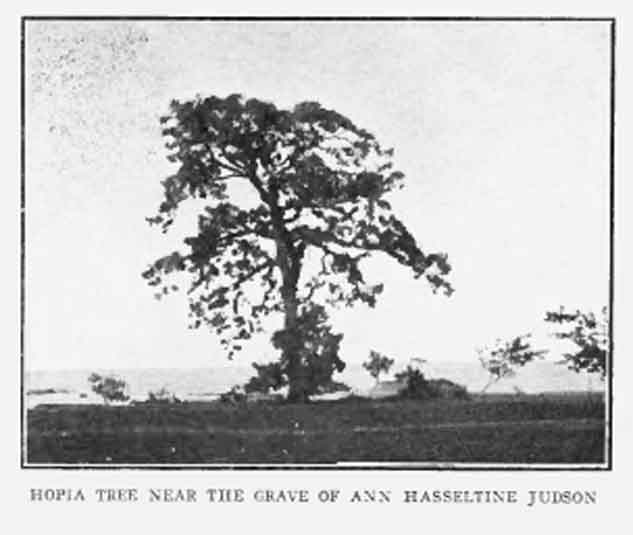
     Adoniram was shattered not only by her death, but by the knowledge he had not been able to support her at that time. Shortly thereafter, Maria also died.  Adoniram was left quite alone, and later wrote with the sad news to Ann’s mother telling her of the burial of his daughter: “The next morning we made her last bed in the small enclosure that surrounds her mother’s lonely grave. Together they rest in hope, under the hope tree, which stands at the head of the graves, and together, I trust, their spirits are rejoicing after a short separation of precisely six months. And I am left alone in the wide world. My own dear family I have buried; one in Rangoon, and two in Amhurst. What remains for me but to hold myself in readiness to follow the dear departed to that blessed world, “Where my best friends, my kindred dwell, Where God my Saviour reigns.” Adoniram was so grief-stricken at his loss that he suffered complete emotional breakdown.
     Ann Hasseltine Judson was converted at 17 during what has come to be called, "The Second Great Awakening."  She was a deeply dedicated Christ-follower, as well as a gifted teacher, linguist, preacher and author. She was instrumental in establishing a Christian church in Burma which, though heavily persecuted, still thrives to this day.  She championed the cause of female education, starting a Burmese girl’s school and tirelessly petitioning Christian sponsorship for her girls during her medical furlough in the United States.  It is generally agreed had it not been for Ann’s sacrificial efforts and representations to the governing authorities, Adoniram would not have survived his time in the death prison. It has been said of her: “She was a woman who loved intensely, loved her husband, loved her children, loved the people of Burma, but above all, she loved her God.”

     When I think of Ann one verse comes to mind: "Many women do noble things, but you surpass them all... let her works bring her praise at the city gates" (Prov. 31:29 & 31).


     If you would like to read a more full account (this was my primary though not sole source for this post) you can click here:  


In His Service, Pastor Jeff

4.09.2019

Modern Day Slavery

Greetings All! 

     I don't often urge people with great earnestness to read my posts. This one I will.  Please, read it!  It has to do with modern day slavery.  Most people believe slavery was done away with after the Emancipation Proclamation (Jan. 1, 1863) was put into effect in.  Sadly, this is not true.  In fact, slavery is on the rise.  According to the latest figures compiled by various organizations, there are more people in slavery today than ever before. "Estimates range from 25 to 27,000,000 people.
     Some pertinent facts include: Globally, the average cost of a slave is $90.  According to some estimates, approximately 80% of trafficking involves sexual exploitation, and 19% involves labor exploitation. Traffickers primarily force their victims into: 1.) Prostitution  2.) Involuntary servitude and 3.) Compel them to commit sex acts for the purpose of creating pornography.  80% of the victims are women or girls, while the other 20% are men or boys.  Half are children.  The average age a teen enters the sex trade in the U.S. is 12 to 14-year-old. Many victims are runaway girls who were sexually abused as children.  According to the U.S State Department, 600,000 to 800,000 people are trafficked across international borders every year, and the tally of victims brought into the U.S. by traffickers each year might be as high as 17,500 people." 

     This week's "thought" speaks out about this continuing and horrible injustice.  It is titled "Divine Interruptions."  It is written by Christine Caine (who runs shelters or safe houses for trafficked women).  It is found in the book, "Passion" which is edited by Louie Giglio.  After visiting Auschwitz, Christine was profoundly saddened by the thought that 6,000,000 people lost their lives while many (not all) idly sat by.  She left that place vowing: "If there is ever anything like this in my generation, I will not be silent."   She did not realize that just nine months later God would interrupt her life again, not with gross injustices from the past, but the present.  I sent it out early in 2016.  I send it out again as a way of asking,"When you read it, were you moved to do something about it?"  Will you now?  The problem is not going away.


     "I found myself speaking at a conference in Greece around the time that a little girl named Madeline went missing in Portugal.  Her picture was plastered across the TV, in airports and in magazines. Interpol was searching for this little girl, but I didn't know her.  I hadn't met her.  My sympathies were aroused, but what could I do?...  Then I saw a second poster for another girl that was missing. This child was named Sophia -- the same name as my second daughter.  Suddenly these missing children weren't simply numbers. They were real -- someone's daughters.  Someone's sisters and classmates.  I stopped and began to wonder what I would do if that were my Sophia on the poster.  What wouldn't I do to find her?  What wouldn't I give up to see her safe?...
     I found out later that these children were the alleged victims of human trafficking, something that at that time I didn't even know existed.  I assumed that the slave trade was abolished with William Wilberforce, but I was wrong.  On my watch, in my generation, the current state of slavery has been flourishing in the dark rooms of the world.  With all our great Christian gatherings, our tremendous churches, our wealth of worship songs and resources, right now in the 21st century, there are more slaves on earth than ever before. It was incomprehensible to me.  How could this be true?  How could this happen in our day?  How could the gospel have spread and flourished in so many areas, and yet not made a massive dent in something as simple and insidious as slavery?  Yet it is true. During our day, more people are being trafficked and sold for labor or sex than ever before in human history. This is unacceptable not merely from the standpoint of human rights; it's unacceptable from the standpoint of the teaching of Jesus. [The parable of the Good Samaritan in Luke 10:29-37 is a primary example, where we are shown that we should want to act on behalf of those who are hurt and wounded and victims of injustice, because compassion isn't compassion until it inspires action. It was the action of the Samaritan that separated him from the rest.]... 
     That being the case, here's the poignant question for all of us: What are you going to do?  Are you going to walk past on the other side, hurrying to your next event, or are you going to cross the street and actually get involved?  This was my moment to decide if these people, scattered throughout the world, were going to be people with names and faces, or if they were going to turn into just another pair of empty shoes (like the thousands I'd seen at Auschwitz).  With knowledge comes responsibility.  We know the slave trade is alive and well right now. We KNOW this, and because we do, we are responsible to do something about it.  In our choice about whether to cross the road, we must begin by realizing that at one point or another, we were the one lying in the ditch and Jesus crossed the road for us. I am a rescued person.
     I did not discover that I was adopted until I was thirty-three years old. Though our parents never told us the truth, on a single day we discovered this family secret and the truth was jarring to say the least. Suddenly I didn't know who I was anymore. I didn't know whether I was conceived in an adulterous affair or a one night stand. I didn't know if I was the result of a rape or an underage pregnancy.  As the panic started to set in though, the Lord reminded me that I didn't have to know those specific facts to know who I am. Because I encountered Jesus, I know something larger and more important than those circumstantial details. The Word of God tells me that I am not the result of a rape or the product of an affair, it tells me I am the workmanship of God, reborn in Christ Jesus, specifically for the good work he prepared for me beforehand to walk in (Ephesians 2:8-10). I may not know who I was, but I know who I am. I have been rescued by the grace of God in Jesus Christ. Jesus crossed the road between heaven and earth so that I might cross the road for the sake of others. I was saved by grace that I might walk in the way Jesus did in the world. This is the plan of God -- to use rescued people to rescue people... Jesus has set us free so that we might set others free.  He rescued us so that we might rise up, reach back, and rescue others...
     If I was not born in Australia, but had instead been born in Greece, Moldova, Romania, Bulgaria, Cambodia, Nepal, or any one of countless other countries, I could have been one of those girls. In fact, if you could see my birth certificate right now, all you would see is a number. I was number 2508 in 1966. That's it. It's just another number, just another statistic. I could be any one of the 27,000,000 slaves in the world right now.  But that 27,000,000 must cease to be a number. Just like you and me, these people are living, breathing human beings, created in the image of Almighty God -- full of God-given destiny and God-given promise. The same Jesus who set me free can set them free. But how will they hear those words if we do not go?  How will they ever know the truth if we, together, don't raise our voices and declare that we will not allow this injustice to prevail?  The Apostle Paul said that it is for freedom that Christ has set us free -- and we must take that declaration to the world
     Not long ago, I was sitting at one of our shelters with Sonia, one of fourteen rescued victims.  One of these young women, one that wasn't a statistic anymore began telling me about how she was shipped to Istanbul in a container with sixty other girls. During the trip the oxygen tank broke, and when the crate was actually opened, thirty of the sixty girls were dead. The ones left alive had no passports because the traffickers had taken them. They were locked in an apartment and then raped several times a day by men wearing law-enforcement uniforms so the girls would not trust the police. Then they were put in a little rubber dingy to be taken from Istanbul to Athens through the Greek Islands. While en route, the traffickers were spotted by a coast guard patrol, and so they threw the girls overboard. (Keep in mind these girls were from villages and had barely seen running water, let alone been in a body of water to swim. Only five survived.)  Sonia was one of them. She was eventually brought to our shelter when the police raided a brothel in Athens. 
     It was about this time in this unbelievable story that a Russian girl sitting near us, who had also been rescued only a day before Sonia, began to yell at me in broken Greek: "Why did you come?"  As best I could, I began to tell her about how Jesus had rescued me and so I wanted to help. I told her that God has a plan, a purpose, and a destiny for her life. That it didn't matter what she had gone through, God was big enough to redeem her past.  But it's what she said next that I'll never forget. As I was telling her this good news she yelled back at me, "If what you are telling me about your God is true, then why didn't you come sooner?" 
     Why hadn't I come sooner? Those are haunting words. What is so important in our temporal lives that it will distract us from the eternal purpose God put us on earth for?  What deserves more attention than the very people Jesus died for?  Safety, comfort, and security are not the goal of Christianity; freedom is. Because it is, we must rise together to declare that this will not happen on our watch.  Not today, not ever again."
     Hearing such facts and stories is unsettling I know. At least it should be to anyone with an ounce of love in their heart.
     Yet the question is not, "Did I feel a twinge of compassion when reading this?"  The two men who walked by the wounded, beaten and discarded man in Jesus parable -- the priest and the Levite -- surely felt a twinge of compassion for the man.  But as Christine points out, compassion isn't truly compassion until it inspires action.  The question we must ask in light of the Good Samaritan story, is will those feelings of compassion move me to some type of action on behalf of the suffering and exploited.  Is my faith all about me, or all about God and what He would have me do to bring the good news of my faith in Jesus to others?  Will it move me to action.  All who know their Bible's well know the answer.  If compassion (fed by the love of God poured into our hearts by the Holy Spirit) doesn't move us to any type of response, it is not true godly compassion but mere sentimentality -- and sentimentality (though possibly better than nothing) is not what God calls for from His people.  Those who have experienced His love are called to show that same type of love to others.
May God gracious move on our hearts (mine included) to do what we can, where we can, however we can,  Pastor Jeff

9.11.2018

The Moment The "Light Goes On"

Greetings All!

     This week's "thought" is the story of one man who met Jesus. It tells of the moment in that man's life when the "light went on," it all made sense, and by the Holy Spirit working through the Gospel he was made new.  The man's name is Max Lucado, the well-known and best-selling author of many Christian books.  As with many other believers, his conversion came at the most unexpected of times, in the most unexpected way, in a rather ordinary place, through a man of little or no renown.  It's yet another confirmation that when God calls people to Himself, he often uses the most ordinary and unexpected of people to do so. And He does it that way to assure us that our salvation comes through the powerful message of the Gospel, applied to the heart and mind by the Spirit, and not as the result of the abilities, charisma, or persuasiveness of any earthly messenger.  Enjoy. 

     Many believers can distinctly recall the events surrounding their conversion experience...  "Do you remember yours? Where were you the night the door was opened? Do you remember the touch of the Father?  Who walked with you the day you were set free? Can you still see the scene?  Can you feel the road beneath your feet?  I hope so. I hope that permanently planted in your soul is the moment the Father stirred you in the darkness and led you down the path.  It's a memory like no other.  For when he sets you free, you are free indeed.
     Ex-slaves describe well their hour of deliverance. Can I tell you mine?  It was a Bible class in a small West Texas town. I didn't know what was more remarkable, that a teacher was trying to teach the book of Romans to a group of ten-year-olds, or that I remember what he said.  The classroom was mid-sized, one of a dozen or so in a small church.  My desk had carvings on it and gum under it. Twenty or so others were in the room, though only four or five were taken by the message.  We all sat back, too sophisticated to appear interested. Starched jeans. High top tennis shoes.  It was summer.  The slow-setting sun cast the window in gold. 
     The teacher is an earnest man.  I can still see his flattop, his belly bulging from beneath his coat that he didn't even try to button. His tie stops midway down his chest. He has a black mole on his forehead, a soft voice, and a kind smile. Though he is hopelessly out of touch with the kids of 1965, he doesn't know it. His notes are stacked on a podium underneath a heavy black Bible. His back is turned to us and his jacket goes up and down his belt-line as he writes on the board. He speaks with genuine passion. He is not a dramatic man, but tonight he is fervent.
     God only knows why I heard him that night. His text was Romans six. The blackboard was littered with long words and diagrams. Somewhere in the process of describing how Jesus went into the tomb and came back out, it happened. The jewel of grace was lifted and turned and I could see it from a new angle... and it stole my breath. I didn't see a moral code. I didn't see a church. I didn't see ten commandments or hellish demons. I saw what one other ten-year-old in that class -- Mary Barbour -- saw.  I saw my Father enter my dark night, awaken me from my slumber, and gently guide me -- no carry me -- to freedom."
     So, I ask the same question Max Lucado started with: Do you remember your conversion?  Do you remember the time you were "awakened from your slumber" (or more in keeping with Scripture, do you remember when God "raised you to life when you were dead in trespasses and sins" - Ephesians 2:1 / Ephesians 2:4-5 / Colossians 2:13)?  Have you since come to reflect and realize it was not the doing of any person (including yourself), but the miraculous and supernatural work of a gracious God softening a heart of stone and making it a heart of flesh and tender toward Christ?  A gift to one who could NEVER be good enough, or worthy enough, to deserve it?  Do you remember that event in your life?  Does the memory of it still stir your soul?  Have you every truly come to Christ and received new birth through the Spirit?  Jesus came, lived, died, rose, and is coming again, says Scripture.  Do you believe it?  Has the Father entered into the darkness of your soul to raise you to life and carry you to freedom?  Oh, what a day that was!  Or for some others, oh what a day that will be...

In the Bonds of Gospel Grace, Pastor Jeff

8.15.2018

The Unity of the Bible

Greetings All!

     This week's "thought" will take some thought!  It's not your typical, casual, quickly processed quote.  It will require you to think. Hopefully you are up for the challenge!  It is the response I often give to those who say ask: "What proof we have for the existence of God?   Where did God come from?  And, "Did God create because He needed someone to love, or because He was lonely?
     The following quote seeks to address these three questions and explains why it is that God did not create out of a sense of need within himself.  Part of the answer to question 3 is taken from Daniel Fuller's book, "The Unity of the Bible" -- a must read, in my opinion, for any earnest believer.  Enjoy!


The God Who Has No Needs
     1.) "What Proof Do We Have for the Existence of God?" The best proof for the existence of God goes something like this:  Being cannot come from non-being.  That is, something cannot come from nothing.  Yet, most all scientists agree that at some point in the long-distant past the space now occupied by the physical universe was empty and void and consisted of "nothing."  But its precisely because something cannot come from nothing that helps us see that the creation itself is the greatest proof of the existence of God.  Since being cannot come from non-being, our existence as beings proves His existence.
     2.) "Where Did God Come From?" To answer this, we can take the previous argument a step further.  Because being cannot come from non-being, our existence as beings proves His existence, and His existence proves He always existed.  If God is, He must always have been.  Most all theologians have tended to agree on this, and Malachi 3:6 confirms it where it says, "I am the Lord, I do not change."  Change is part of that which is limited, lacking, or finite. A God who changes would be finite and limited and could not by definition be God. To be infinite is by nature to be changeless, immutable and everlasting -- none of which would be true of God if He had a beginning.  If being is, it must always have been, since being cannot come from non-being.  Even the fact that God is all-knowing demands that He must have existed forever, for if He was not an eternal Being, or came into being at some point in time (which is an impossibility since being cannot come from non-being), then He could not be omniscient, for He would not know what transpired before He came into existence.
     3.) "Did God Create Because He Needed Something to Love, or Because He Was Lonely?  The Christian answer, based on the fact that God is a Trinity, is best given by Daniel Fuller in his book "The Unity of the Bible," in the section entitled, 'Why Did God Wait So Long to Create the World?'  In this section of his book he points out: "The declaration in Psalm 90:2 that, 'Before the mountains were born or you (God) brought forth the earth and the world, from everlasting to everlasting you are God,' indicates that vast eons of time elapsed before God acted to establish the earth so it would reflect His glory.  But Irenaeus, Augustine, and Calvin -- some of the church's greatest leaders -- have sternly warned people not to ask what God was doing before he created, or to wonder why he waited so long to create...  I believe, however, that it is both lawful and expedient to ask why the Triune God waited a long time to create the world.  For from the very fact that God waited, we know that he did not create out of the necessity involved in need-love. [That is, he did not create because he was lonely, or needed someone to love, as many often suggest].
     Since God the Father found infinite happiness in Jesus, the Son, then it becomes clear that from all eternity God has enjoyed his Son's love and companionship, showing the creation of the world was NOT a necessary act that God undertook to overcome loneliness, but an act that flowed from the freedom involved in benevolent love. It would be threatening to our future happiness to know that God created us to meet some need in himself... Yet the moment we understand that all of God's need-love was met in being a Trinity, then we see that he was free to act toward us, his creation, solely in terms of the freedom of a benevolent love.  A striking way to represent the difference is to say that if God were to have created us out of need-love, it would be like inviting us to a banquet, only to inform us that we were one of the courses for the meal!  But when God invites us to a banquet out of benevolent love, he wants us to join with him as guests at his table, to enjoy the feast along with him – as the psalmist put it, to drink from the river of his delights (36:8).  So, God's having delayed creation for a long while makes it unmistakably clear that he created us not out of need, but in the freedom of his benevolent love – out of mercy and grace.”
     What a different view of God we have when we consider his eternality in light of his Triune nature.  If God created out of a "need" that was unmet for all those many millions and trillions of eons before He spoke things into existence out of nothing (as the Bible does state), then the only picture one can draw is of a God who was sad, frustrated, or unhappy until He created, due to the long-standing unmet need in himself.  But when we consider God as Trinity, and the love and delight that existed between the Father and the Son from all eternity, we see that the fellowship and love between the Father and the Son resulted in a God who was eternally contented and happy!  A God who created, not out of need, but out of the overflow of delight, love and happiness that existed within Himself.  To put it in human terms, the best of all scenarios is not when a husband and wife seek to have a child to meet a need in either one of them, or out of an attempt to "save the marriage," but when they so love each other that they choose to bring a child into the overflow of love and delight that already exists between them. Not when they create out of need, but out of a desire to share their overflowing love with another.  And not only does it give us a different view of God, but a whole different ground for relationship!  For when we know we were not created to meet a need in God, we are freed to walk and share in the overflow of God's infinite Self-adequacy and Self-completeness!
     At any rate, just something to think about!

Living in the Grace of Jesus, Pastor Jeff

3.27.2018

The Mind, the Spirit, and Power

Greetings All,

     This "thought" comes to you from the humble, devout, and godly British minister, statesman and scholar, John R. W. Stott, PhD.  I had the privilege of hearing him speak in person three times before he passed away in 2011. He was so well-respected at home and abroad that in 2005 Time Magazine listed him (at 86 years old) as "one of the 100 most influential people on the planet."  I have many of his books sitting on my shelves and can say without reservation that anything written by him is worth the read (I count his commentary on the New Testament book of Acts as among the best available).
     This excerpt is taken from the book, "Faith and Culture - The Guide to a Culture Shaped by Faith." by Kelly Monroe Kullberg and Lael Arrington.  Enjoy.


The Mind, the Spirit, and Power

     "I believe that anti-intellectualism and fullness of the Holy Spirit are mutually incompatible. And I dare say it because the Holy Spirit is the Spirit of Truth.  Jesus our Lord himself referred to the Holy Spirit as the Spirit of Truth, and therefore, it is only logical to say that wherever the Holy Spirit has given his freedom, truth is bound to matter.  So I have argued, and argue still, that a proper and conscientious use of our minds is an inevitable part and parcel our Christian life.
     FIRST, a proper use of our minds glorifies our Creator. We believe that God is a rational Being who has made us in his own image and likeness, as rational men and women. And has given us a rational revelation of himself. 
     SECOND, a proper use of our mind enriches our Christian discipleship. There is no aspect of our discipleship which can be developed without the use of our mind. Whatever part of discipleship your are reflecting on -- worship, faith, guidance -- the mind has an indispensable part to play.
     THIRD, a proper use of the mind strengthens our witness in the world. I am convinced that one of the major reasons people reject the gospel in the West today is not because they perceive it to be false, but because they perceive it to be trivial.  They think it is inadequate for the complexities and challenges of the world today.  We know, of course, that in evangelism, in conversion, and in regeneration (or the new birth), the Holy Spirit has an indispensable part to play. Only the Spirit can lead a sinner to Christ. But when he leads us to Christ, he does not do it in spite of the evidence, but because of the evidence, when he opens our minds to attend to it.
     To sum up, anti-intellectualism insults God, impoverishes us, and weakens our testimony in the world. A proper use of the mind glorifies God, enriches us, and strengthens our witness in the world."

     It is interesting to me (though I do not have the full manuscript of what he shared in this address presented to The London Institute of Contemporary Christianity in 2001) that Stott does not even allude to the primary biblical imperatives that call us to use all the powers of our God-given intellect in our worship and service to Him and others -- the Two Greatest Commandments.  As commands which most all Christian people have memorized at one time or another, it would seem that anti-intellectualism would be forever banished from the Church of God.  For in those commands we are told (as part of our love and adoration of Him) to use every part of every human faculty given to us in loving Him and our neighbor.  All our will and emotions and all the powers of our intellect, strength, energy or actions are to be used in sacred service to the one who gave them to us for the sake of His glory.
     It is beyond dispute that we are to, "love the Lord our God with all our heart, and with all our soul, with all our MIND (emphasis mine), and with all our strength," (Mark 12:30).  Or as Jesus affirms and summarizes it two verses later, "You are right in saying.that... To love Him with all your heart, with all your UNDERSTANDING (emphasis again is mine) and with all your strength, and to love your neighbor as yourself is more important than all burnt offerings and sacrifices."
     Therefore, it is an unbiblical and unsustainable assertion to suggest that one should avoid using their mind, reason or intellect in the defense and furtherance of the faith (as long as the mind is used in the service of God and not to oppose the purposes of God). Gordon Fee, my professor of N.T. at Gordon-Conwell was raised in a Pentecostal environment where it was not unusual to hear people exalt the place of the heart and soul, but put down the place of the mind. He said that growing up he would hear people in that environment say, "I'd rather be a heart on fire than a mind on ice."  But as he studied the Scriptures, and the place it gives to the mind, he realized that such an assertion resulted from an anti-intellectual, false and unbiblical dichotomy.  He came to see that what the Bible actually encourages is, "not only a heart on fire for the Lord, but a mind that is also on fire for the Lord."  The one does not negate the other. They actually compliment each other.
     Simple faith in the Lord Jesus is a gift.  But so also is a mind that uses all it's intellectual powers to love and serve God, as we see in such people as Blaise Pascal, Jonathan Edwards, C. S. Lewis, Ravi Zacharias, Deithrich Bonhoeffer, John Piper, Nancy Pearcy, Lee Stobel, Dallas Willard, Tim Keller, Os Guiness, and slews of other brilliant, God-loving and devout defenders of the faith. Such people have been blessings beyond description in being used of God to lead unbelievers to Christ, and encouraging believers to go deeper and deeper in the faith.

     He died. He rose. He is coming again.  Pastor Jeff


5.16.2017

What Path Do I Follow

Greetings Everyone!

     Today's "thought" took me back to the days just prior to, and shortly after becoming a follower of Jesus. I was 23 and could barely think of much other than Jesus -- who He was, what He had done, what His call on my life meant, and how obeying that call would change everything in my life.  I did lose friends.  One called me a "religious fanatic."  Others politely avoided me.  And, yes, I'm not faultless. I did suffer from earnest zeal without knowledge or the wisdom that comes from experience. It's not all that untypical for a person who finally discovers that Jesus is real and wants to make sure everyone else does too (mistakenly thinking it's totally up to them). Sometimes (I have to confess) I've wished I could go back in time and approach some people and situations a bit more wisely than I did, for in some cases I'm sure I did more harm than good to the cause of Christ.

Yet, in other ways I miss many aspects of that "first love" stage. That spiritual discovery stage where everything about the faith is so new and fresh!  A time when I was less "balanced,"  had not gotten into many of the burdensome or restricting routines and responsibilities of life, and was more of an adventurer and risk taker for Jesus.  Maybe some of you can remember that stage in your life.  And if it is merely a memory, with little of it remaining, maybe you need to ask what happened to make it fade?  Do you miss it?  Have you prayed for the Lord to restore it?  Have you followed Jesus' spiritual prescription for those who have "lost their first love"  where He says in Revelation 2:5: "Remember the height from which you have fallen! Repent (for letting it happen), and do the things you did at first."   Consider this excerpt from Kyle Idleman's book, "Not a Fan," and see if you (like me) might not need to repent and seek a new portion of God's ever-fresh and spirit-renewing grace. Enjoy.


     "In Matthew 19 we find a man whose name we don't know.  We learn enough from the Gospels to know he is referred to as the "Rich Young Ruler." He's followed a path that has led to wealth and power. (That's the path most of us are trying to find.) He comes to Jesus with a question. In verse 16 he asks: "Teacher, what good thing must I do to get eternal life?"
    You have to give him credit for asking the right question. He wants to know how to get to heaven. But even the way he asks it reveals the heart of a fan [and not a follower]. He asks, what must "I do"?  That word could be translated "acquire" or "earn." He thinks it's going to be an impressive resume that will get him in. Eventually Jesus tells him what he must do. In verse 21 he says: "Sell all your possessions and give to the poor, and you will have treasures in heaven. Then come, follow me."  Jesus invites the man to become his follower, but first the man is told to sell all his possessions and give to the poor. He's faced with the choice of following Jesus or keeping his stuff, but he couldn't do both. There is no way to follow Jesus without denying himself. Many people want to make this story about money, but it's not as much about money as it is about following Jesus. Jesus puts this man at a crossroads. He can follow the path that leads to money, or he can follow Jesus; but he can't follow both.
     So what does this mean for you and me? Is selling everything a requirement to follow Jesus? Well, it may be. In fact, I would say the more defensive you are of Jesus' words to this man, the more likely it is that Jesus might be saying them to you.  What is true is that everyone who follows Jesus will find himself or herself at a similar crossroads as this man in Matthew 19.  You won't be able to take the path of following Jesus without walking away from a different path. He wanted to follow Jesus, but when forced to choose between Jesus and his stuff, he chose his stuff. He wouldn't deny himself.  What choice will you make? 
     A few years ago I was pretty deep into some tribal areas of Africa. One night I finished preaching a message to a crowd of a few dozen people. I presented the gospel and the invitation of Jesus to follow him.  There were two young men, probably in their twenties, who accepted Christ and committed to follow him. The following afternoon these two men showed up at the house where we were staying. They each carried a good sized bag over their shoulder. I went over and asked the local missionary we were staying with why they had come. He explained that these two men would no longer be welcomed by their families or in their village. When I heard that, I was afraid that maybe this was going to be more than they would be willing to go along with.  About that time the missionary said to me, "They knew this would happen when they made the decision."
     They were choosing Jesus over their families. They were choosing Jesus over their own comfort and convenience, and "fans" don't do that. Only true followers are willing to deny themselves and say, "I choose Jesus. I choose Jesus over my family. I choose Jesus over money. I choose Jesus over career goals. I am his completely. I choose Jesus over looking at porn. I choose Jesus over a redecorated house. I choose Jesus over my freedom.  I choose Jesus over what other people think of me."  A follower makes a decision every day to deny himself and choose Jesus, even if it costs everything. When we sacrificially deny ourselves for Christ's sake it is the clearest evidence of our committed love. A committed love is best demonstrated through sacrifice. When we deny ourselves for another person it communicates true love."

     In light of what he says each one of us must ask: "What path do I follow?  If love is shown by sacrifice and self-denial for the sake of another, do I show such a love for Jesus in my life?  Since I cannot follow two paths (or two Masters), when given the option between family, money, career goals, porn, freedom, a redecorated house, what people think of me, or Jesus, what do (or will) I choose?  What have I chosen in the past? Am I still just a fan, or have I become a follower? Do I admire Jesus from a distance, sitting in the stands and cheering, or have I walked down onto the field of play to become a true, committed, disciple?"   Read Revelation 2:1-7.  Do you remember the heights from which you have fallen?  Has the Holy Spirit convicted you with the need to repent?  Will you take Jesus at His word and return to, "doing the things you did at first"?
In His Service, Pastor Jeff