Visitors

free counters
Showing posts with label Suffering. Show all posts

10.01.2019

It Is Well With My Soul

Greetings All,

     My daughter Bekah sent me the link to this devotional by Tori Kelly the other day, because she knows Horatio Spafford's hymn "It Is Well With My Soul" is one of my favorites. I opened it, read it, felt there was much honest transparency and biblical truth in it, and therefore thought I would pass it along to you. I trust it will encourage and speak to you as well.  Enjoy.

SOUL’S ANTHEM (IT IS WELL)

     Suffering is guaranteed in this life. The devil is always throwing fiery darts at us. Right now in this moment he’s trying to attack my family, my health, my relationships, and my peace. He’ll do anything to take my eyes off of Jesus.  He wants to take everything away from me, and most importantly, he wants to take my faith.
     Our faith is not grounded in our circumstances.  Neither can our joy in Christ be.  Recently, my grandfather passed away in the time I felt I needed him most.  I felt like I had lost my best friend. It was so painful to go through and I cried so much -- until my eyes had nothing left.  But through every tear, God was with me in those hard moments. I could still be in a dark and lonely place, and even be mourning, but my joy could not be stolen because it is secured in Jesus.  No matter what happens, no matter what arrows are thrown my way, no matter how dark it gets, I know I will be okay.  It’s not always easy to believe, but I know that when I remind myself that God is in control I find rest and am able to sing, “it is well with my soul.”
     Most importantly, I can always sing “it is well” because God spoiled the movie for us and we get to know how this story ends. “It is well with my soul” because there is a place called heaven where death will be no more, every tear will be wiped away, and any tears shed in this life will be redeemed (he has bottled each one).
     Maybe your suffering is different than losing a grandfather. Maybe it’s worse. Maybe it’s as bad as the writer of “It is Well” who lost his entire family in the days prior to when he penned this hymn.  Even still, God says all of it is not even worthy to be compared to the glory to come to us.  Like an adult reflecting on his experience in kindergarten, so believers in heaven will remember their suffering in this life, saying, “Oh yeah... I think I vaguely remember...”
     Suffering comes to each of us in a different way - broken relationships, physical illness, economic hardships, loss, crime, slander, betrayal, depression, humiliation, you name it. Scripture assures us of this. Jesus assures his disciples of this. "In this world you WILL have trouble (tribulations). But take heart!  I have overcome the world" (John 16:33).  Jesus never promises us a trouble-free life in this world. His promised overcoming of the world means, as Tori Kelly rightly points out, we already know how the story ends!  Jesus is the Victor!  It's already a done deal!  God has won!  The world loses!  And we get to be over-comers with him in the victory he's already won!
     John 16:33 was spoken prior to the cross and resurrection.  Yet it is spoken in the past tense - "I have overcome..."  It is spoken before the cross an resurrection, but with as much confidence and assurance in the promise as if those those things had already taken place!  (If only they had truly "heard" him!)  In fact, in a very real sense the cross had already taken place, as John assures us in Revelation 13:8, where it speaks of Jesus as, "the Lamb slain from the creation of the world."   Jesus' ultimate victory of overcoming the world had already been decreed and determined and worked out in the providence of God before God ever created the world!  And we get to rejoice and participate in many of the benefits of that victory in this life (not all of them just yet), remembering as Paul assures us,  "Our light and momentary trials are achieving for us an eternal glory that far outweighs them all" (I Corinthians 4:17).
     Resting in the victory of God until the promise becomes our experienced reality in eternity, Pastor Jeff


9.10.2019

Testimony of William Grimshaw

Greetings All!

     There comes a time in the life of every believer where they must wrestle with what they truly trust in; where their hope lies, and what the only true object of saving faith is. This week's "thought" is a true account of the one man's journey along that road -- a road that led from misplaced faith and depression, to true faith and joy!
     It is not unusual (at least at the beginning of our life of faith) to have a faith that when tested is found lacking or misplaced. Hopefully this testimony about William Grimshaw's journey from trusting in the wrong thing, to being led by a miraculous event to trust in the only true saving object of faith will be of help to all -- either as a guide that takes you to where you need to be, or a reminder not to stray from there. It comes from "The One Year Book of Christian History" by Michael and Sharon Rusten.  Enjoy.
     "William Grimshaw was born in Lancashire, England, in 1708. He went to Christ's College, Cambridge, intending to enter the ministry. During his third year he fell in with the wrong crowd, becoming, in his own words, "as vile as the worst."  Still, he chose to enter the ministry, finding no incongruity between his sinful lifestyle and his chosen profession.  Ordained in the Church of England in 1732, Grimshaw was assigned a church in West Yorkshire. He married a young widow, but within four years she tragically died, leaving him with two small children.
     Already a troubled soul, Grimshaw was plunged into a deep depression. He sent his children away to be raised by relatives. All he could think about was his own mortality and the necessity of making arrangements for his own funeral... In his written instructions for his funeral he specified: "To attend my funeral I desire that 20 persons be invited (of my next relations and intimatest acquaintances) and be entertained in the following manner: Let 5 quarts of claret (a red wine from Bordeaux) ... be put in a punch bowl and be drunk in wine glasses until it is all gone."
     At this time an itinerant preacher began rebuking Grimshaw for his legalistic view of salvation [a view whereby he encouraged people to trust in their own efforts, works, or aspects of their own performance for their acceptance with God]. He said to Grimshaw, "You are no believer in the Lord Jesus Christ. You are building on the sand."   Grimshaw tried to avoid the man, but the words "you are building on sand" kept haunting him.  In 1741, while visiting a friend, Grimshaw saw a book on the table and picked it up.  As he opened it, and discovered it was by John Owen, a Puritan theologian, a flash of heat flushed his face. Puzzled, he looked at the fireplace, wondering if the fire had caused his sudden flush of heat.  Opening the book again, he read the title: "The Doctrine of Justification by Faith."  Suddenly a second flash of heat swept over him. Astonished that it happened again, Grimshaw took it as a divine imperative that he was to read the book.
     Taking the book back home, Grimshaw noted in the preface that Owen had written the book for people suffering from the same anguish and distress of soul he was experiencing.  The book confronted the reader with the question of whether he would 'trust in his own personal inherent righteousness (his own efforts and religious or moral performances) or, in full renunciation of it, take to himself the grace of God and the righteousness of Christ alone.' To Grimshaw the choice was clear.  As he would later confide to a friend,  "I was wiling to renounce myself, every degree of fancied merit and ability, and to embrace CHRIST ONLY for my all in all.  O what light and comfort did I now enjoy in my own soul, and what a taste of the pardoning love of God!"
     His ministry immediately changed, and he found peace and joy in his heart as well as his soul. He fell in love with a local girl, married her, and brought his children back home...  He applied for a new parish and moved his family to nearby Haworth, where he ministered powerfully and effectively until his death in 1763 at the age of 55. Under his spiritual leadership the little-known village of Yorkshire became one of the leading centers of the Christian faith in all of England. His funeral was quite different from the one he had planned years before. Vast crowds of loving parishioners followed his coffin to its final resting place. The pastor who spoke summarized the faith of Grimshaw by saying, "Upon Christ's atoning blood and justifying righteousness alone, did EVERY HOPE of his soul's acceptance with God depend" 
     Upon what does your hope rest?  What is the object of your faith? What does your hope or trust for pardon and salvation rest upon?  Is it your efforts at trying to be a "good" person?  Is it a list of accomplishments or a resume of cataloged good works?  Is it a mix of faith in Jesus plus your attempts to be righteous? Here it helps to remember that when it comes to saving faith, Jesus plus anything nullifies Jesus. If you are trusting in anything of your own, you are trusting in you, and thus not fully (or for that matter, not at all) in Jesus.  The Gospel's message is clear: We are saved by grace alone, through faith alone, in Christ alone.  Add anything into the mix and you disbelieve the Gospel, negate Jesus, will struggle incessantly with emotional highs and lows, find the need to pretend, have a fear of being open, honest and transparent about your sins, wrestle with a sense of of frustration with God and self, fall into occasional depressions, and a lack of assurance of God's forgiveness and complete acceptance.
     Only when one's hope for acceptance with God is in CHRIST ONLY -- only when both eyes are glued on Jesus, instead of one on Jesus and the other on the sin-stained performances of the self -- are they liberated from all those afflicting things to experience peace, joy and release from the weight of burdens too heavy to carry.  John Owen was right in asking: "will you trust in your own personal inherent righteousness [which is always stained by sin and thus unrighteous or unacceptable righteousness], or in full renunciation of it, take to yourself the grace of God and righteousness of CHRIST ALONE."
     Blessed is the person who stops hoping and trusting in their own efforts, and looks instead to Christ alone for their pardon and acceptance with God.  As one who fell into this Grimshaw's mistake, I can tell you from personal experience what a blessed liberation comes as we get our eyes off us, and simply, "fix our eyes (of faith) on Jesus..." (Heb. 12:2).  And please notice it says "eyes" -- that is, both of them!  Not one eye of faith fixed on what you do, and the other one looking to what Jesus did, but BOTH OF THEM fixed on Jesus. For He is the only true object of saving faith, and faith in HIM ALONE is the only means of salvation or remedy for the countless malady's of the soul.

Living in the Grace of Jesus, Pastor Jeff

4.30.2019

Pioneer Missionary Ann Hasseltine Judson

Greetings All,

     In my last "thought" I shared about Adoniram Judson.  A couple days later I was asked to send one out highlighting the brave and heroic commitment of his wife -- Ann Hasseltine Judson.  This is her story (or at least part of it). Her profound influence in regard to the place of women in missions has few rivals.  As the first woman missionary sent out from the U.S., she set the standard for future generations.  This is by far the longest thought I've ever sent out (and it has been heavily redacted to shorten it to what it is)!  Yet, with Mothers Day fast approaching, I thought honoring her contribution as a wife, mother and missionary was warranted. Enjoy.

     "Two hundred and nine years ago in 1810, a young man named Adoniram Judson composed an extraordinary letter to the father of the young woman he wanted to marry. He wrote as follows: “I have now to ask, whether you can consent to part with your daughter early next spring, to see her no more in this world; whether you can consent to her departure for a heathen land, and her subjection to the hardships and sufferings of a missionary life; whether you can consent to her exposure to the dangers of the ocean; to the fatal influence of the southern climate of India; to every kind of want and distress; to degradation, insult, persecution, and perhaps a violent death. Can you consent to all this, for the sake of him who left his heavenly home and died for her and for you; for the sake of perishing immortal souls; for the sake of Zion, and the glory of God?” 
     At 21 years of age, her parents left the choice to Ann.  She decided to marry Adoniram and to leave everything behind for the unknown. She knew she would probably never see her family again. The voyage was far too long, perilous and expensive for the possibility of any visit from relatives or friends. Letters took months, and might well never arrive. There was no established mission network to give support or counsel. There was no American Embassy in Asia to give protection. There was no certainty that these pioneer missionaries would even find a place in which they could safely minister. Nothing was guaranteed – neither safety, health, toleration, and least of all success. But Adoniram, Ann, and the other young people with them understood that Christ did not issue the Great Commission on the condition that health, comfort and safety could be guaranteed. Christ had said simply, “GO.”  Therefore they married on February 5, 1812 and the very next day the newlyweds sailed from Salem, Massachusetts...
     The religion of Burma was Buddhism: a system of belief that arose in the sixth century BC with the enlightenment of Gautama, the Buddha The Buddha taught that all appearance is characterized by transience, that there is not really a soul, and no eternal God… Ann wrote bluntly in her journal of the emptiness of Buddhism: “The religion of Burmah, then, is, in effect, atheism; and the highest reward of piety, the object of earnest desire and unwearied pursuit, is annihilation. How wretched a system is this; how devoid of adequate motives to virtue; and how vacant of consolation!”  Consequently, the Burmese had no concept of an eternal God, and no means in their language to express such an idea. Ann and Adoniram worked hard studying up to 12 hours a day for two years learning the difficult language. Eventually Adoniram produced a gospel tract in Burmese and commenced working on a Burmese translation of the New Testament. Ann authored a Burmese language catechism, translated the books of Daniel and Jonah into Burmese, and began to teach women’s Bible classes. She was also the first person to translate Bible passages into Siamese. Ann also formed a society of native women who met together on Sundays to pray and read the Scriptures.
     By 1820, six years after their arrival in Burma, Ann was so seriously ill that she had to seek medical help in Calcutta. Two years later she was told that unless she returned either to Europe or America for treatment, she would die. She had previously consented to her husband accompanying her to Calcutta, but the longer voyage to England (and a possible further trip to America) would take at the least two years, and she refused to consider Adoniram abandoning the infant church and the crucial Bible translation for that long. As a result, in 1822, she made the long and difficult journey alone. She sailed first for England, and Christians there raised funds for her passage to America.  Back at home, she received skilled medical care and was reunited with her family and that of Adoniram. The whole trip took two years, and of this separation Adoniram said that it felt like cutting off his right arm and gouging out his right eye.
     Ann returned in 1824, but her reunion with her husband, though joyful, was pitifully brief.  War between Burma and England began, and all male foreigners fell under suspicion of being English spies. So Adoniram and his associate Mr. Price, were thrown into the notorious death prison from which few ever emerged alive. While in prison they awaited execution in the most filthy and sordid of conditions, weighed down with fetters so that they could not walk. Daily they observed the torture and execution of their fellow prisoners, not knowing when their time would come. Nightly they were placed in the stocks, and their legs and bodies raised so that only their head and shoulders remained on the ground. They remained incarcerated for one and a half years, during which time they were never able to wash, were often ill with no access to medical help, and had little contact with the outside world...
     During her husband’s imprisonment, Ann petitioned tirelessly on the prisoners’ behalf with no regard for personal risk. Daily she walked the two miles from their small home to the prison in hopes of supplying them with food and drink. Sometimes she was allowed to see them, but often they were forbidden to speak. She also visited every person of influence to whom she could gain access, trying to explain that as missionaries they had nothing to do with the English war effort. She was quite alone through this ordeal, and she was pregnant. Eight months after Adoniram had been arrested, in February 1825, she gave birth to little Maria, and was able to visit the prison with the infant, whom the father could only observe from afar. Their first baby had been stillborn, their second had died at eight months, and this child’s chances of survival seemed even more slender.  Of this terrible time she wrote:  “Sometimes for days and days together, I could not go into the prison till after dark, when I had two miles to walk, in returning to the house. O how many, many times, have I returned from that dreary prison at nine o’clock at night, solitary and worn out with fatigue and anxiety… My prevailing opinion was, that my husband would suffer violent death; and that I should, of course become a slave, and languish out a miserable though short existence in the tyrannical hands of some unfeeling monster. But the consolations of religion, in these trying circumstances, were neither `few nor small.’  It taught me to look beyond this world, to that rest, that peaceful happy rest, where Jesus reigns, and oppression never enter.”
     Eventually she had to set up a little shelter near the prison, as the daily four-mile-round-trip proved too much to walk in the blazing heat. As the weather brought unbearable heat, the conditions in the prison only worsened. Of this time her memoirs record: “The situation of the prisoners was now distressing beyond description. It was at the commencement of the hot season. There were above a hundred prisoners shut up in one room, without a breath of air excepting from the cracks in the boards. I sometimes obtained permission to go to the door for five minutes, when my heart sickened at the wretchedness exhibited. The white prisoners, from incessant perspiration and loss of appetite, looked more like the dead than the living…”
     It would seem that things could not get worse. But with the British troops advancing to the capital, the foreign prisoners were removed on a death march to a remote spot in the country some miles north of the capital, where rumor had it they were to be buried alive as an offering to the gods in the path of the advancing troops. Their sufferings on the march were indescribable, their survival remarkable. Even more remarkable was the determination of Ann to follow them. With her three-month-old infant, plus two little girls she was looking after, and a faithful Burmese helper, she immediately set out by boat, and then by rough cart, in pursuit of the prisoners. For the duration of their imprisonment outside of the capital she persuaded their jailer to let her and the children share his two-room hut. From there she continued to try to minister such help as she could to her husband and Price. During this appalling period she became so ill that she had no milk for the baby, and the only way Maria survived was by bribing the jailer to allow Adoniram out of prison to carry the baby round the local village, begging nursing mothers to let Maria have a little of their milk.
     When the Burmese realized how hopeless the struggle against England was, they decided they needed all the help they could get in negotiating the least humiliating peace settlement. Adoniram and Price were released to help with the peace negotiations, as they could speak both Burmese and English. Again Ann and Adoniram had a wonderfully happy but tragically brief reunion. They enjoyed two blissful weeks of freedom and comfort at the British base before Adoniram was summoned elsewhere for further negotiations. This was to be their final separation. Ann’s health had been broken by the sufferings of the previous two years, and her body, past the point of exhaustion, finally broke and succumbed to cerebral meningitis. Her final sufferings were to be endured without her husband. She was thirty-seven.
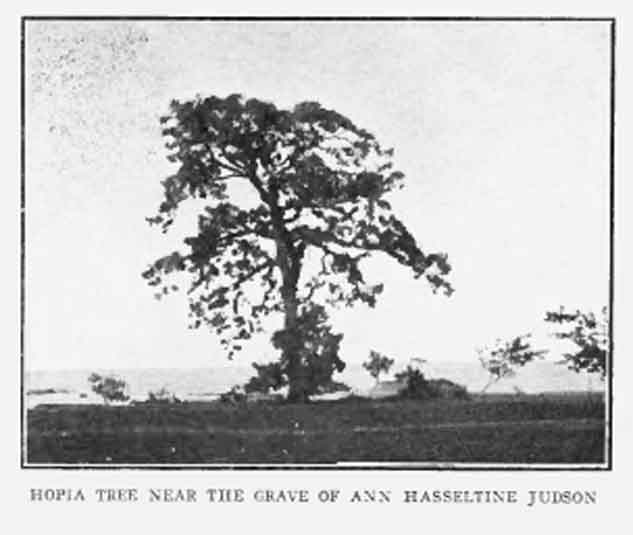
     Adoniram was shattered not only by her death, but by the knowledge he had not been able to support her at that time. Shortly thereafter, Maria also died.  Adoniram was left quite alone, and later wrote with the sad news to Ann’s mother telling her of the burial of his daughter: “The next morning we made her last bed in the small enclosure that surrounds her mother’s lonely grave. Together they rest in hope, under the hope tree, which stands at the head of the graves, and together, I trust, their spirits are rejoicing after a short separation of precisely six months. And I am left alone in the wide world. My own dear family I have buried; one in Rangoon, and two in Amhurst. What remains for me but to hold myself in readiness to follow the dear departed to that blessed world, “Where my best friends, my kindred dwell, Where God my Saviour reigns.” Adoniram was so grief-stricken at his loss that he suffered complete emotional breakdown.
     Ann Hasseltine Judson was converted at 17 during what has come to be called, "The Second Great Awakening."  She was a deeply dedicated Christ-follower, as well as a gifted teacher, linguist, preacher and author. She was instrumental in establishing a Christian church in Burma which, though heavily persecuted, still thrives to this day.  She championed the cause of female education, starting a Burmese girl’s school and tirelessly petitioning Christian sponsorship for her girls during her medical furlough in the United States.  It is generally agreed had it not been for Ann’s sacrificial efforts and representations to the governing authorities, Adoniram would not have survived his time in the death prison. It has been said of her: “She was a woman who loved intensely, loved her husband, loved her children, loved the people of Burma, but above all, she loved her God.”

     When I think of Ann one verse comes to mind: "Many women do noble things, but you surpass them all... let her works bring her praise at the city gates" (Prov. 31:29 & 31).


     If you would like to read a more full account (this was my primary though not sole source for this post) you can click here:  


In His Service, Pastor Jeff

12.04.2018

Tortured for Christ

Greetings All,

     This week’s “thought” comes from a man whose faith and commitment to Jesus I have admired for years.  Shortly after I came to Christ 38 years ago, I headed to the Dominican Republic as a short-term missionary.  At one point I came across a book in the mission’s library.  It was Richard Wurmbrand’s autobiographical sketch of the 14 years he spent in a Communist prison camp in Romania for being a Christian - “Tortured for Christ.” 


     It was the first Christian book I ever read cover to cover in one sitting, and I have given out many copies to friends ever since! The two stories I share today were related by Wurmbrand to a friend, and are samples of what you will find in that book.  They come from the most recent “Voice of the Martyr’s” magazine.   Enjoy.

     Story #1:

     “Richard once overheard a conversation between a pastor named Simeon and a thief named Cunia.  Every day Cunia stole Simeon’s eyeglasses and then offered to return them in exchange for the pastor’s supply of sugar. Pastor Simeon never complained, and then one day he said to the thief, “I will give you the sugar gladly. You don’t need to blackmail me by taking my glasses.”  “Why don’t you get angry with me and report me?” Cunia asked.  “Because I want you to become a better man,” Simeon replied, “I love you.”
     “Nobody loves me,” Cunia said.  “I am a thief.”  “It is Christmas -- Jesus’ birth,” Simeon continued.  “He loved thieves so much that He likened Himself to a thief who comes in the night.  I too have learned much from thieves.  You are passionate in your trade. You go to great lengths to get money. You suffer repeatedly, but, once freed, you revert to stealing. You are a model of perseverance.  Like you, I too like gold. I have chosen as my eternal abode a city where even the streets are paved with gold. Jesus came from there to enrich us. There is no need to steal anymore.”  He went on to tell Cunia about the Son of God who was born in a stable to save us...
     Wurmbrand said of Pastor Simeon, “On Christmas the Son of God was made a man that we might become children of God. His aim has been fulfilled. There are real children of God.”

     Story #2:

     “On Christmas Eve, while Richard lay in bed, an abbot named Iscu lay in another bed on his right, awaiting death from the tortures he received. The abbot was serene knowing he would soon be with Jesus in heaven…  On Richard’s left was another prisoner – the man who had tortured Iscu.  His comrades had turned on him and he too had been imprisoned and tortured.  Distraught by his deeds, this man woke Richard during the night.  “I have committed horrible crimes,” he confessed. “I can find no rest. Help me,” he pleaded.
     Just then, Iscu called two other prisoners to his side to help him. Leaning on them, he slowly walked to his former torturer and sat down on his bedside. “You were young and did not know what you were doing,” he said, caressing the man’s head. “I forgive you and love you, as do all the other Christians you have mistreated. And if we sinners who have been saved by Jesus can love like this, how much more is He ready to erase all the evil you have done, to cleanse you fully. Only repent.”
     In that common cell in which there was no privacy, Richard heard the torturer confessing his crimes to the one he had tortured…  Both men died that night, on Christmas Eve.  It was not simply a commemoration of the event in Bethlehem. It was Jesus being born in the heart of a criminal.”

     Such a degree of love really is amazing.  Who could explain it except as the fruit of a very real and true faith in Jesus Christ.  And what a blessing it is for those who have messed up so badly to discover that salvation is by the grace of Jesus, and therefore no one is too far gone to be beyond the reach of God’s power to redeem. Not even a man who had tortured and brought great pain and suffering to many.
     It is a matter for great praise that forgiveness is not earned, but as the Gospel proclaims, is a free gift of grace to those who cast themselves upon the mercy of Jesus and take eternal refuge in the blood that was shed to satisfy God’s just wrath against sin.  A Gospel promise that is to all who will turn in faith to Jesus and leave their life of sin behind -- regardless of how terrible that past life of sin may have been.

     Blessing the Name of him who came and took on flesh that first Christmas, Pastor Jeff

7.17.2018

Little Faith

Greetings Everyone!

     Today's "thought" addresses the question: "How much faith is necessary?" 
     On two occasions I have heard preachers speak on Jesus' words that, "faith the size of a mustard seed can move mountains."  And in each case both of those preachers went on to speak of wanting to exercise a far greater quantity of faith than Jesus said is necessary.  One of the preachers even said, "some people are content with a thimble full of faith, I want a swimming pool full of faith -- faith I can swim in!"
     Yet, I believe both of them missed Jesus point.  For Jesus tells us that faith the size of a mustard seed is far more than anyone will ever need!   With that much, says Jesus, "Nothing will be impossible for you."  In other words, we don't need tons of faith to see impossibilities become possible, we simply need that small amount and we will see miracles happen.  As R.T. France says in his commentary on Jesus words: "It is not the 'amount' of faith which brings the impossible within reach, but the power of God, which is available to even the 'smallest faith.' " 
     That's what today's thought is about: "Little Faith."   It comes to us from a book entitled, "Day by Day with the English Puritans" by Randall J. Pederson.  This particular entry was written by John Rogers, a Puritan pastor from Essex, England, back in the 1620's.  I trust you will find it helpful and encouraging. Enjoy.

Little Faith

"If you have faith as a grain of mustard seed, you shall say unto this mountain,
'Move from here to there,' and it will move. Nothing will be impossible for you."
Matthew 17:20b
     "Little faith is true faith, as well as great faith.  A little man is just as much a man as a large man; a little water is just as truly water as the ocean seas. The disciples had true faith, yet very weak faith, weak in knowledge. Though they believed that Jesus was the Messiah come to save the world, yet they did not know how.  They were ignorant of His death, for when He told them of His coming sufferings, it is said that they did not understand what He was saying (Luke 18:31-34). Peter took Jesus aside and counseled Him not to go to Jerusalem to die (Matthew 16:22). They were ignorant also of His resurrection also, for when Mary told them of it, they did not believe her (Luke 24:11).  And of His ascension, when He spoke of going away, they understood it not, neither did they know where He was going, or the way to get there (John 14:1-31).  Their knowledge was very weak to be ignorant of such important things...
     But weak faith may prove strong in time. The most learned clerk was once in school studying his grammar book. The greatest giant was once in swaddling clothes. The tallest oak was at one time a twig. And faith grows from a grain of mustard seed to produce a tall tree.  As from a child to a man, so corn grows from a weak blade, to a stalk, to an ear with ripe corn therein. The disciples who were so weak before, afterwards, when the Holy Spirit was sent among them, were exceedingly strong and feared not in the face of tyrants."
     It was not unusual for Puritan pastors to affirm the words of Jesus that even little faith (faith as small as a mustard seed) was sufficient faith.   Thomas Watson, also a Puritan pastor, once said: "Though your faith is weak, do not be discouraged -- a weak faith may receive a strong Christ."   And Richard Sibbes, yet another Puritan pastor, once said: "A spark of fire is fire, as well as the whole element. Therefore we must look to grace in the spark as well as in the flame. All do not have the same strong faith, though they have the same precious faith (2 Pet. 1:1), whereby they lay hold of, and put on, the perfect righteousness of Christ. A weak hand may receive a rich jewel.  A few grapes will show that the plant is a vine, and not a thorn.  It is one thing to be deficient in grace, and another thing to lack grace altogether.”
     So, we are, as Peter says, to, "make every effort to add to our faith goodness; and to goodness, knowledge, and to knowledge, self-control...." (II Peter 1:5-9).  We are called to exercise and add to our faith. Yet, we must also remember that a mustard seed sized degree of faith is more than sufficient to "move mountains" and make "nothing impossible for (us)."   No one needs a swimming pool sized degree of faith!  Who needs more than a faith that is able to do all things?!
     In fact, if Jesus rebuked the disciples for not being able to cast out evil spirits, "because they had so little faith," and then went on to say "faith the size of a mustard seed" was enough to do anything that needed to be done, one must question how much the disciples could have had?  Maybe the tiniest speck of a mustard seed that had been ground to powder?  I suppose it really doesn't matter. Little faith in the infinite God is enough! The aim, after all, is not to focus on our faith, but the immutable, great, loving, and all-powerful object of our faith.  For faith grows as we look away from it, and seek to grow in the grace and knowledge of Jesus.  The greater we understand Him to be, the greater our faith will become -- and that without even needing to focus on faith.

Living in the Grace of Jesus, Pastor Jeff
6.26.2018

Scripture-grounded Take on Suffering in Times of Trial and Difficulty

Greetings Friends!

     Today's "thought" is taken from the daily devotional, "Streams in the Desert" by L. B. Cowman.
     In it we find an interesting, refreshing, and Scripture-grounded take on suffering that I offer to you to encourage you and nurture hope in you in times of trial and difficulty.  This excerpt appears to be a group of thoughts on the redemptive nature of suffering taken from the writings of several different people -- only two of whose names she cites.  As I was reading it on June 19th it struck me as one I would want to share with you. So please, enjoy!


“Grain must be ground to make bread.”
Isaiah 28:28
     Many of us cannot be used to become food for the world’s hunger until we are broken in Christ’s hands. “Grain must be ground to make bread,” and being a blessing for Christ often requires sorrow on our part.  Yet even sorrow is not too great a price to pay for the privilege of touching other lives with Christ’s blessings.  The things that are most precious to us today are things that have come to us through tears and pain" (J. R. Miller).
     "God has made me bread for His chosen ones, and if it is necessary for me to be ground in the teeth of lions in order to feed His children, then blessed be the name of the Lord" (St. Ignatius).

     "To burn brightly we must first experience the flame. In other words, we cease to bless when we cease to bleed.”
     Poverty, hardship and misfortune have propelled many a life to moral heroism and spiritual greatness. Difficulties challenge our energy, and our perseverance, yet they bring the strongest qualities of the soul to life. It is the weights on the old grandfather clock that keep it going. And many a sailor has faced a strong headwind while using it to help him reach port. God has appointed opposition as an incentive to faith and holy service.

     The most illustrious characters of the Bible were bruised, broken, and ground into bread for the hungry.

     Abraham, because he endured affliction while remaining obedient, stood at the top of the class and found his diploma inscribed with the words, ’the father of the faithful.’

     Jacob, like wheat, suffered severe threshing and grinding.

     Joseph was bruised and beaten and had to go through Potiphar’s kitchen, and into Egypt’s prison, on his way to getting to the throne.

     Job was ground to powder like medicine, yet through his sufferings has helped untold millions find hope in their own.
     David was hunted like an animal through the mountains.  Bruised, weary, and footsore, he was ground into bread for the kingdom.

     Paul could never have been bread for Caesar’s household if he had not endured the bruising of being whipped and stoned. He was ground into fine flour for the royal family.

     Combat comes before victory.  If God has chosen special trials for you to endure, be assured that in His heart He has kept for you a special place. A soul that is sorely bruised is one God has chosen to use.”
     It is a somewhat interesting phenomena that the messages I share from the pulpit where I use illustrations from my own life (or from the lives of others) where I or they struggled with pain, hardship, or difficulty, are the ones people say they appreciate the most. Not ones where I speak of my victories, successes, or achievements, but those where I share my struggles with pain, difficulty or trials.  There is, it seems, something universally helpful, desired, and appreciated when people are transparent about struggles, which is not there when one speaks about their victories and successes.  This pattern is so pronounced in Scripture, and my own experience, that it has made me hesitant to ask God (as some do) to be "used in a mighty way."  For it seems that those who have endured the greatest suffering and struggle are the most likely to be used in such a fashion.
     If the immense popularity of the Book of Job, and the transforming power of the sufferings of Jesus tell us anything, they tell us people find one immense help from one who is a friend in suffering. It should assure us that if we as believers experience hardship, it's not because God is angry at us or punishing us, but because God is growing our faith and equipping us for useful service to others in His kingdom.

Living in the Grace of Jesus, Pastor Jeff


3.20.2018

Few Bearers of His Cross

Greetings Friends,

     Today's "thought" comes to you from the Christian devotional classic, "The Imitation of Christ" by Thomas a' Kempis (1380-1471).  His name means "Thomas of (or from) Kempen" - a small town in eastern Germany, just a few miles from the border of Holland. His God-given gifts which come through to us in his writing consist in his wisdom, keen insight into human nature, and ability to say a lot in very few words (a gift I missed out on)!


     In terms of personal transformation he taught: "The acknowledgment of our weakness is the first step in repairing our loss."   In terms of spiritual leadership he stressed: The loftier the building, the deeper the foundation must be laid."  In terms of the self he said as we all can: Who has a harder fight than he who is striving to overcome himself."  And in terms of Jesus words in John 14:7 he assured us: "Without the Way, there is no going, Without the Truth, there is no knowing, Without the Life, there is no living."   This selection is entitled"Few Bearers of His Cross."  Enjoy.
     "Jesus now has many lovers of the heavenly kingdom, but few bearers of His Cross. He has many who desire consolation, but few who desire tribulation. He finds many companions at His table, but few of His abstinence. All desire to rejoice with Him, but few are willing to endure anything for Him, or with Him.
     Many follow Jesus unto the breaking of bread, but few unto the drinking of the cup of His sufferings. Many reverence His miracles, but few follow the shame or disgrace of His Cross. Many love Jesus so long as no adversities befall them.  Many praise and bless Him so long as they receive consolations from Him.  But if Jesus hide (the sense of His presence) and leave them but a little while, they turn to complaining or into much dejection of mind.
     But they who love Jesus for the sake of Jesus, and not for some special comfort they can receive from Him, bless Him in all tribulations and anguish of heart as well as in the state of highest comfort.  Even if He was never willing to give them comfort, they would, even then, praise Him and wish to be always giving thanks. 
     O how powerful is the pure love of Jesus, which is mixed with no self-interest or self-love!  Are not all those to be called mercenary who are ever seeking consolations? Do they not show themselves to be rather lovers of themselves than of Christ, who are always and only thinking of their own profit and advantage?  Where shall one be found who is willing to serve God for nothing?" 
     Now, here, I do need to confess I am one who enjoys and cherishes the comforts and consolations of Jesus when they come.  I believe we all do.  Even Mr. A'Kempis did, as he confessed elsewhere.  That's not really his point. His point is that if that's all we seek; if we only seek, love, praise, and thank Jesus when we are receiving those things, and we cease doing so, or walk away in bitter anger and disillusionment when the opposite comes (whether it be for a short or extended time) we must question what we are seeking, who we are loving, why we are praising, and why difficulties would make us stop giving Him thanks.
     If we love Jesus only when the blessings are flowing, and not when the struggles come; if we cherish and adore Him only for what He gives, and not for the sake of who He is (the Lamb worthy of all glory and honor and power - Revelation 4:6-5:14) we must truly question if it's Jesus that we love.  If a child only "loves" his father when his father was giving him gifts, and is indifferent or does nothing but complain when he withholds those gifts, what would it say about the object of that child's "love"? 
     You see, a pure love for Jesus mixed with "NO self-interest or self-love"  may be an ideal that we can never fully achieve so long as the principle of sin still clings to us in this life. Yet, that ideal can be placed before us, and should be placed before us (as a'Kempis does here), to serve as a means of grace which helps us move away from the all too common tendency to love so conditionally the Lord who loves His children so unconditionally. Only you can know the reaction a'Kempis' words caused inside you, but I must confess they lead me to say, "Sorry Lord, please change my heart." 

Thankful for His Grace, Pastor Jeff