Visitors

free counters
Showing posts with label Translation. Show all posts

4.30.2019

Pioneer Missionary Ann Hasseltine Judson

Greetings All,

     In my last "thought" I shared about Adoniram Judson.  A couple days later I was asked to send one out highlighting the brave and heroic commitment of his wife -- Ann Hasseltine Judson.  This is her story (or at least part of it). Her profound influence in regard to the place of women in missions has few rivals.  As the first woman missionary sent out from the U.S., she set the standard for future generations.  This is by far the longest thought I've ever sent out (and it has been heavily redacted to shorten it to what it is)!  Yet, with Mothers Day fast approaching, I thought honoring her contribution as a wife, mother and missionary was warranted. Enjoy.

     "Two hundred and nine years ago in 1810, a young man named Adoniram Judson composed an extraordinary letter to the father of the young woman he wanted to marry. He wrote as follows: “I have now to ask, whether you can consent to part with your daughter early next spring, to see her no more in this world; whether you can consent to her departure for a heathen land, and her subjection to the hardships and sufferings of a missionary life; whether you can consent to her exposure to the dangers of the ocean; to the fatal influence of the southern climate of India; to every kind of want and distress; to degradation, insult, persecution, and perhaps a violent death. Can you consent to all this, for the sake of him who left his heavenly home and died for her and for you; for the sake of perishing immortal souls; for the sake of Zion, and the glory of God?” 
     At 21 years of age, her parents left the choice to Ann.  She decided to marry Adoniram and to leave everything behind for the unknown. She knew she would probably never see her family again. The voyage was far too long, perilous and expensive for the possibility of any visit from relatives or friends. Letters took months, and might well never arrive. There was no established mission network to give support or counsel. There was no American Embassy in Asia to give protection. There was no certainty that these pioneer missionaries would even find a place in which they could safely minister. Nothing was guaranteed – neither safety, health, toleration, and least of all success. But Adoniram, Ann, and the other young people with them understood that Christ did not issue the Great Commission on the condition that health, comfort and safety could be guaranteed. Christ had said simply, “GO.”  Therefore they married on February 5, 1812 and the very next day the newlyweds sailed from Salem, Massachusetts...
     The religion of Burma was Buddhism: a system of belief that arose in the sixth century BC with the enlightenment of Gautama, the Buddha The Buddha taught that all appearance is characterized by transience, that there is not really a soul, and no eternal God… Ann wrote bluntly in her journal of the emptiness of Buddhism: “The religion of Burmah, then, is, in effect, atheism; and the highest reward of piety, the object of earnest desire and unwearied pursuit, is annihilation. How wretched a system is this; how devoid of adequate motives to virtue; and how vacant of consolation!”  Consequently, the Burmese had no concept of an eternal God, and no means in their language to express such an idea. Ann and Adoniram worked hard studying up to 12 hours a day for two years learning the difficult language. Eventually Adoniram produced a gospel tract in Burmese and commenced working on a Burmese translation of the New Testament. Ann authored a Burmese language catechism, translated the books of Daniel and Jonah into Burmese, and began to teach women’s Bible classes. She was also the first person to translate Bible passages into Siamese. Ann also formed a society of native women who met together on Sundays to pray and read the Scriptures.
     By 1820, six years after their arrival in Burma, Ann was so seriously ill that she had to seek medical help in Calcutta. Two years later she was told that unless she returned either to Europe or America for treatment, she would die. She had previously consented to her husband accompanying her to Calcutta, but the longer voyage to England (and a possible further trip to America) would take at the least two years, and she refused to consider Adoniram abandoning the infant church and the crucial Bible translation for that long. As a result, in 1822, she made the long and difficult journey alone. She sailed first for England, and Christians there raised funds for her passage to America.  Back at home, she received skilled medical care and was reunited with her family and that of Adoniram. The whole trip took two years, and of this separation Adoniram said that it felt like cutting off his right arm and gouging out his right eye.
     Ann returned in 1824, but her reunion with her husband, though joyful, was pitifully brief.  War between Burma and England began, and all male foreigners fell under suspicion of being English spies. So Adoniram and his associate Mr. Price, were thrown into the notorious death prison from which few ever emerged alive. While in prison they awaited execution in the most filthy and sordid of conditions, weighed down with fetters so that they could not walk. Daily they observed the torture and execution of their fellow prisoners, not knowing when their time would come. Nightly they were placed in the stocks, and their legs and bodies raised so that only their head and shoulders remained on the ground. They remained incarcerated for one and a half years, during which time they were never able to wash, were often ill with no access to medical help, and had little contact with the outside world...
     During her husband’s imprisonment, Ann petitioned tirelessly on the prisoners’ behalf with no regard for personal risk. Daily she walked the two miles from their small home to the prison in hopes of supplying them with food and drink. Sometimes she was allowed to see them, but often they were forbidden to speak. She also visited every person of influence to whom she could gain access, trying to explain that as missionaries they had nothing to do with the English war effort. She was quite alone through this ordeal, and she was pregnant. Eight months after Adoniram had been arrested, in February 1825, she gave birth to little Maria, and was able to visit the prison with the infant, whom the father could only observe from afar. Their first baby had been stillborn, their second had died at eight months, and this child’s chances of survival seemed even more slender.  Of this terrible time she wrote:  “Sometimes for days and days together, I could not go into the prison till after dark, when I had two miles to walk, in returning to the house. O how many, many times, have I returned from that dreary prison at nine o’clock at night, solitary and worn out with fatigue and anxiety… My prevailing opinion was, that my husband would suffer violent death; and that I should, of course become a slave, and languish out a miserable though short existence in the tyrannical hands of some unfeeling monster. But the consolations of religion, in these trying circumstances, were neither `few nor small.’  It taught me to look beyond this world, to that rest, that peaceful happy rest, where Jesus reigns, and oppression never enter.”
     Eventually she had to set up a little shelter near the prison, as the daily four-mile-round-trip proved too much to walk in the blazing heat. As the weather brought unbearable heat, the conditions in the prison only worsened. Of this time her memoirs record: “The situation of the prisoners was now distressing beyond description. It was at the commencement of the hot season. There were above a hundred prisoners shut up in one room, without a breath of air excepting from the cracks in the boards. I sometimes obtained permission to go to the door for five minutes, when my heart sickened at the wretchedness exhibited. The white prisoners, from incessant perspiration and loss of appetite, looked more like the dead than the living…”
     It would seem that things could not get worse. But with the British troops advancing to the capital, the foreign prisoners were removed on a death march to a remote spot in the country some miles north of the capital, where rumor had it they were to be buried alive as an offering to the gods in the path of the advancing troops. Their sufferings on the march were indescribable, their survival remarkable. Even more remarkable was the determination of Ann to follow them. With her three-month-old infant, plus two little girls she was looking after, and a faithful Burmese helper, she immediately set out by boat, and then by rough cart, in pursuit of the prisoners. For the duration of their imprisonment outside of the capital she persuaded their jailer to let her and the children share his two-room hut. From there she continued to try to minister such help as she could to her husband and Price. During this appalling period she became so ill that she had no milk for the baby, and the only way Maria survived was by bribing the jailer to allow Adoniram out of prison to carry the baby round the local village, begging nursing mothers to let Maria have a little of their milk.
     When the Burmese realized how hopeless the struggle against England was, they decided they needed all the help they could get in negotiating the least humiliating peace settlement. Adoniram and Price were released to help with the peace negotiations, as they could speak both Burmese and English. Again Ann and Adoniram had a wonderfully happy but tragically brief reunion. They enjoyed two blissful weeks of freedom and comfort at the British base before Adoniram was summoned elsewhere for further negotiations. This was to be their final separation. Ann’s health had been broken by the sufferings of the previous two years, and her body, past the point of exhaustion, finally broke and succumbed to cerebral meningitis. Her final sufferings were to be endured without her husband. She was thirty-seven.
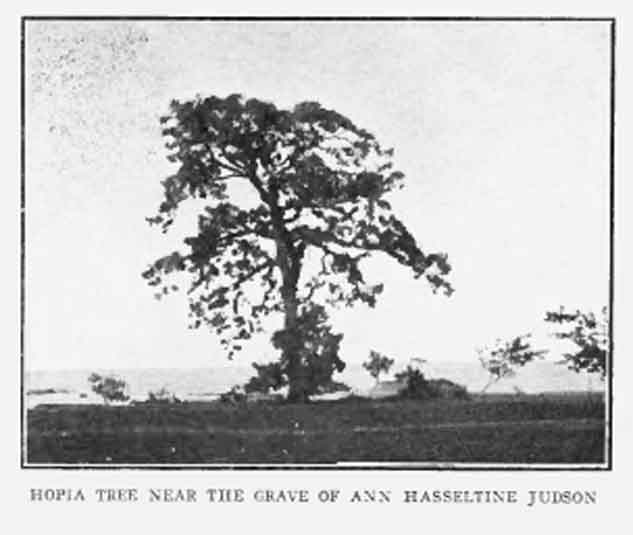
     Adoniram was shattered not only by her death, but by the knowledge he had not been able to support her at that time. Shortly thereafter, Maria also died.  Adoniram was left quite alone, and later wrote with the sad news to Ann’s mother telling her of the burial of his daughter: “The next morning we made her last bed in the small enclosure that surrounds her mother’s lonely grave. Together they rest in hope, under the hope tree, which stands at the head of the graves, and together, I trust, their spirits are rejoicing after a short separation of precisely six months. And I am left alone in the wide world. My own dear family I have buried; one in Rangoon, and two in Amhurst. What remains for me but to hold myself in readiness to follow the dear departed to that blessed world, “Where my best friends, my kindred dwell, Where God my Saviour reigns.” Adoniram was so grief-stricken at his loss that he suffered complete emotional breakdown.
     Ann Hasseltine Judson was converted at 17 during what has come to be called, "The Second Great Awakening."  She was a deeply dedicated Christ-follower, as well as a gifted teacher, linguist, preacher and author. She was instrumental in establishing a Christian church in Burma which, though heavily persecuted, still thrives to this day.  She championed the cause of female education, starting a Burmese girl’s school and tirelessly petitioning Christian sponsorship for her girls during her medical furlough in the United States.  It is generally agreed had it not been for Ann’s sacrificial efforts and representations to the governing authorities, Adoniram would not have survived his time in the death prison. It has been said of her: “She was a woman who loved intensely, loved her husband, loved her children, loved the people of Burma, but above all, she loved her God.”

     When I think of Ann one verse comes to mind: "Many women do noble things, but you surpass them all... let her works bring her praise at the city gates" (Prov. 31:29 & 31).


     If you would like to read a more full account (this was my primary though not sole source for this post) you can click here:  


In His Service, Pastor Jeff

7.20.2016

The Disappearing Bible

Greetings All,

Today's "thought" comes to you from a section of Shane Hipps book "Flickering Pixels," entitled, "The Disappearing Bible." 
     It's a critique of the dangers of the digital age and the growing aversion to right-brain learning (seeking by linear deductive reasoning to solve complex ideas by in-depth study, in order to gain a comprehensive understanding of a topic), in favor of left-brain learning (seeking through art, photos, intuition, emotional stimulation, subliminal impressions, and a short not-so-comprehensive, "throw out a personal opinion and see how people respond" approach to topics). 
     The second, as Hipps points out, is an approach to learning that has made in-depth study of the Bible (to know it well) a thing that is avoided, or even seen as obsolete, in many areas of present-day church culture.  He is not opposed to visual or intuitive learning, but simply advocates what he calls "brain balance" -- seeing the need to retain our ability to reason through complex ideas, while taking advantage of digital technology and all that it has to offer.
     To use a common phrase, the growing popularity of the short, non-comprehensive, opinion-based blog, should not cause us to "throw the baby out with the bathwater."  Believers need both, lest they lose their grip on the truth and fall prey to whatever tweaks their emotions or happens to sit well with their current (but soon passing) preferences.  To help you as you read: right brain = intuitive/artistic/emotive, and left brain = reasoning/logic/science.  Enjoy.
The Disappearing Bible

     "Most books present an extensive, in-depth monologue, a thorough argument carefully crafted in linear, successive paragraphs and pages. This is true of both novels and non-fiction. The left brain is heavily engaged by such activity.  But Internet text presents a nonlinear web of interconnected pages and a vast mosaic of hyperlinks with no fundamental beginning, middle or end.  We are immersed in a boundless, endless, data space. These are conditions specially suited to the right-brain...  The power of intuition, emotion, holistic perception, and pattern recognition are all gifts of the right-brain. The right-brain is the hemisphere that allows us entry into spiritual practices like contemplation, centering prayer and silence. The left-brain is allergic to such practices; it is the dogmatic theologian rather than the intuitive mystic...
     The Internet is stunningly effective at enticing us to open a Pandora's Box of perpetual links, sights, sound, people, places, feelings, and ideas. Our intellects are spread a mile wide and an inch deep. Consider blogs. Their great wonder is their dynamic speed.  We are exposed to many more ideas than previously possible and given a chance to dialogue in near real time. Yet because of their brevity and the constant evolution of content, blogs are forced to stay on the surface. Blogs are ill-suited for deep-level analysis and thoughtful reasoning. The Internet makes a flat stone of the mind and skips it across the surface of the world's information ocean. A book, by contrast, is a sturdy submarine, diving the mind deep into the sea..
     The emerging right-brain culture presents other challenges as well. Protestant Christianity is a by-product of a single medium -- the printed Bible. Without printing, no one could have challenged the authority of the pope. How disconcerting to have a faith yoked so closely to a medium that is now in the dusk of its life, at least as we currently know it. Our culture has a shrinking preference for reading books, especially complex ones, and if the Bible is anything, it is complex. So it should not surprise us to see a growing biblical illiteracy in the electronic age.
     The Bible is an extraordinarily demanding library of books. The stories, letters, and laws are shrouded by the fog of time. The thick dusty languages of ancient Greek and Hebrew convey the message through cumbersome translations. The books were born in civilizations and cultures alien to us, and the assumptions and attitudes of the original authors often escape us entirely.  In many cases, excavating the meaning [of texts] requires the fortitude, patience, and discipline of an archaeological dig.
     In other words, bulging left-brain muscles are an essential tool for understanding the Bible. Unfortunately, our digital diet sedates the left-brain, leaving it in a state of hypnotic stupor.  The left-brain begins acting like our great Uncle Jerry, nodding off in his recliner after Thanksgiving dinner. Large portions of the Bible are growing faint and becoming inaccessible to the lethargic left-brain." 

     Hipps goes on to say these two forms of learning must find a way to co-exist.
     We must never allow the tensions and disagreements (and at times contrary purposes of the one as opposed to the other) prevent us from availing ourselves of the benefits of both. Each has its place, and it is always a danger to, "tear asunder what God has joined together."  If we are to "Love the Lord our God with all our... mind," we must seek to avoid anything that would disparage either the right-brain or left brain approach to truth.
     The Church suffers when the faith is made into something only the scholar and grasp, but it also suffers when people embrace ideas foreign to Scripture, or contrary to Scripture, simply because it came to them in a moment of earnest contemplation or artistic creativity. The two forms of learning balance each other off. After all, God could have created us without dividing the brain into left and right lobes. He could have created the lobes so they functioned identically. But He didn't.  And therefore, to disregard one, simply because we have a preference for the other, is to insult the Creator, and call His all-knowing wisdom into question.
To the end that we may love the Lord our God as we should -- with ALL our mind -- Pastor Jeff


5.04.2016

The History of the King James Version of the Bible

Greetings All!


Today's "thought" comes to you from a helpful little book entitled, "The 5 Minute Church Historian," by Dr. Rick Cornish.  I have loaned to many people the first in the series -- the companion volume, "The 5 Minute Theologian."  He has also written "The 5 Minute Apologist."

   The two books are his attempt to capture the attention of a generation which tends to frown on lengthy and in-depth coverage of topics, and prefers instead short little five minute summaries -- none of which take more than that to read.  For people in a rush it is a helpful way to learn the basics of theology or church history (although I would imagine that as an instructor his hope is that people will go deeper into these topics and find those pertinent details he had to omit to keep it short).
     Depending on who you are, today's selection may be like "fighting words," for he covers the history of the King James Version of the Bible.  Some may not fully agree with everything he says, but he does make some points worthy of earnest consideration.  And after all, if you do disagree, maybe you should take some time to research it a little bit further!  Enjoy! 
Good Enough for Paul?
        "You may have heard someone say, "If the King James Version was good enough for Paul, it's good enough for me."  Unfortunately, that view is more than a joke.  A few people actually believe the great apostle used the King James Version.  Yet we need to ask, who was King James, and why does one Bible bear his name? 
     James, the son of Mary Queen of Scots, was King James VI of Scotland.  But in 1603 he succeeded Queen Elisabeth of England as James the 1st, uniting the two kingdoms for the first time. He ascended the throne when the Puritans were trying to "purify" the church from all remnants of Catholicism.  When Puritan leaders met with him at Hampton Court in 1604 to ask his help in reforming the church, he declined. But he did agree to one request: a new translation of the Bible. They all agreed that the current versions were not accurate to the original Hebrew (Old Testament) and Greek (New Testament).

Hebrew Manuscript of Genesis 1
          The most popular Bible was the Geneva Bible (published in 1560).  But James didn't like it because he thought it sounded too Calvinistic. Another popular Bible was the Bishops Bible (published in 1568), but most of the common people didn't care for it.  England needed a new, more accurate translation that would satisfy as many people as possible.
        King James didn't write, translate, or do any work on the King James Version. He merely appointed fifty scholars and divided them into groups to do the work. The text was doled out in six sections corresponding to the six teams of translators. They were directed to modify previous English versions and make changes only when the Greek and Hebrew demanded it. Therefore, the KJV is a reworking of existing versions more than a new translation.
     The final product was an improvement, but not what we today would expect from a fresh translation working straight from the original languages. Furthermore, the available Greek and Hebrew manuscripts were limited and the translators' expertise was marginal [the best Hebrew scholar of the day was not asked to join the translation team]. 
     The common identification of the KJV as the "Authorized Version" does not mean that it is superior to other translations. That title, in fact, is not accurate, because no evidence has been found that King James formally authorized the final product.
              Nearly a half-century passed before the KJV overcame the Geneva Bible in popularity, but in time it was accepted by the masses. It remained the most-used version among English Protestants until the Revised Version came out in the 1880's.  By the 1960's the increased availability of Greek and Hebrew manuscripts revealed the KJV's errors, opening the door for numerous better translations.  Also, by then its archaic language rendered it nearly obsolete except among people who grew up with it or just preferred the style of the language.
     The language of the KJV is not and never was "more godly" than any other.  It was simply the English of the early seventeenth century.  The mystique some people find in its phrasing is a matter of preference and familiarity. God has used the KJV to change millions of lives over three and a half centuries, and today He uses more accurate and more readable translations to change millions more.  We can thank God for both."
Some other interesting facts are:
1.)  The language of the KJV -- though beautiful and poetic, especially in the Psalms -- was not (as he points out) "religious or spiritual language."   It was simply the common everyday language used in England in 1611.

 2.)  It took 47 men seven years to complete the translation (54 were asked, 47 saw it through to completion).  Some dropped out because of the time commitment required, not to mention the translators were not paid for their linguistic services.

 3.)  The earliest references to the KJV as an "authorized version" date to 1783 and 1792, and the first time it was published with the title "Authorized Version" does not occur until the years 1814 and 1823. The "Great Bible" (heavily influenced by Tyndale)  was the first "Authorized Version" issued by the Church of England under the reign of Henry VIII in 1539.

 4.) To the disappointment of many King James gave the translators instructions designed to guarantee that the new version would conform to the organizational structure (ecclesiology) of the Church of England. That is, the translation would not conflict but conform to the ideas of Episcopalianism/Anglicanism.  This is why some Independent, Congregational, Presbyterian and Baptist groups initially rejected it -- including the likes of the Pilgrims and many other Puritans.

 5.)  In 1631 one printing of 1500 copies of the KJV Bible left out the word "not" in the command "Thou shalt not commit adultery," reading instead, "Thou shalt commit adultery."  Many copies were destroyed as people called it,"The Adulterous Bible," "The Sinners' Bible," or "The Wicked Bible." 


6.) By the late-1800's, and well into the 1900's, the version had become so cherished by many that to even question the accuracy of "The Authorized Version" was seen as an heretical assault on Holy Scriptures themselves, or the writings of the prophets and apostles. This has often been called "AVolatry" or the idolatry of the Authorized Version. 

 7.) Unlike the Geneva Bible (which had helpful footnotes and acted somewhat like a Study Bible) the KJV was purposely devoid of any notes. It was simply the text of the Bible. 

 8.) Some of the most fully preserved of the ancient Greek and Hebrew manuscripts were not available to the translators of the KJV, discovered only after it had been completed (some not until the 1850's). This is why Cornish (and others) point out that some newer translations are more accurate and less dependent on previous versions.
-----------------------------------------------------------
     I hope this post has helped you understand a little better the background of a deeply loved version of the Bible which had a tremendous effect upon the church's culture in years past. For the Psalms, I love the KJV, though Cornish is right -- newer versions (such as the ESV) are more accurate translations.
Just a little tidbit of church history to get you interested in digging deeper!  In Christ, Pastor Jeff