Visitors

free counters
Showing posts with label God's faithfulness. Show all posts

9.19.2017

Gift of Forgiveness

Greetings Everyone!

     Today's "thought" has to do with the gift the Bible calls forgiveness. It comes from Dr. Grant Ethridge, and is found in the book, "The Gift of Jesus."   I found it to be a good reminder and trust you will as well. Enjoy.


Faithful to Forgive
"If we confess our sins, He is faithful and just and will forgive us our sins and cleanse us from all unrighteousness."
I John 1:9

     "Do you remember "if-then" statements from school?  Let's review.  The first part of the statement is conditional -- it may or may not happen. But if that condition does happen, then whatever is described in the second half of the statement will also happen.  These "if-then" statements, like mathematical formulas, are black and white. There is no gray.  Two plus two does not equal fourish.  It equals four.  Three minus one does not equal somewhere close to two or something other than two.  It equals two.
     Look again at today's passage -- it's a most profound if-then statement: "If we confess our sins He is faithful and just and will forgive our sins and cleanse us from all unrighteousness."   Notice that the verse does not say "God might be faithful," or "there's a possibility that He may be faithful."  It says God IS faithful and He WILL forgive. There is no gray area. Also, he doesn't qualify whether the sins are big or little -- which, after all, is a human construction.  The promise simply says "sins,"  meaning all sins.  If we confess, God is faithful and just to forgive all sins. Whether or not we feel forgiven, or whether or not we've forgiven ourselves, is not the issue. If we truly confess our sins as sins before the Lord, He forgives them.  We are not to cover our sins but confess them.
     What guilt or regret are you dwelling on or reliving today?  Remember: If you have confessed it, then God has forgiven it. "There is therefore now no condemnation for those who are in Christ Jesus." (Romans 8:1)."

     When I was a child my grandfather (a farmer in his 80's) used to gauge the next day's weather in two ways. 1.) He would look at the sky and take note of the cloud formations, and 2.) he would seek to discern which direction the slightest of winds were blowing in from by licking his finger and sticking it in the air.  The saliva intensified his ability to feel the wind's direction and thus predict the next day's weather. And I must say he usually got right!  He was usually more accurate than the weatherman we watched on the news channel.
     Yet, what may work in terms of predicting the weather is a poor method for discerning forgiveness.  Too many people I know (and I must confess this was true myself in the past) try to discern whether or not we've been forgiven by looking into our soul and testing how we feel.  If we feel forgiven we assume we must be, and if we don't feel we're forgiven, we assume we must not be.  Or as usually happens, one day they will feel they are, and another day they will feel they aren't -- due to using a faulty system of measure.  In fact, if we measure forgiveness by how we feel on any given day, we condemn ourselves to a roller-coaster-ride of seemingly guilt-free days (when our minds are preoccupied with the day's activities) and guilt-ridden nights (when the busyness subsides and we are left with nothing to distract our thoughts or painful memories).
     The Gospel (thankfully) gives us a better remedy for our sin and guilt than how we might happen to feel on any given day. For it bases our forgiveness, and the assurance of it, in the punishment Jesus received in our place on the cross, and the promise of God's forgiveness because of it.  A punishment He paid not just the small sins, as Dr. Ethridge points out, or the sins that no one found out about and really did not harm to others. But every sin -- even the ones that did hurt someone else immensely and have left lasting scars on people and relationships. When Christ went to the cross He died an unimaginably painful death. And I would say He did that (at least in part) not simply because that's the punishment sin deserves, but to convince us beyond any shadow of a doubt that He had paid the sin-debt of even the most unimaginably heinous sins.
     Therefore we don't have to wonder.  Nor do we have to hope, wish, or guess.  Nor does it have to do with how we may happen to feel at any given time (since feelings are fickle).  It has to do with what Christ did on the cross and the promise of God -- something which really is black and white.  "IF I confess our sins, THEN God -- who IS faithful and just -- WILL forgive our sins and cleanse us of all unrighteousness."
     I know the postmodern mind has an aversion to anything being 'black and white" rather than some shade of gray.  But this is one case (along with others) where healing is thwarted until we see the issue of forgiveness really is black and white.  God purposely made it that way so that the fullness of His redemptive gift in Christ might be internalized in hearts and minds that can be so easily misled by fickle feelings. Feelings are NOT the ultimate gauge of what is true.

     Living in the joy of Christ's finished work and God's precious promise, Pastor Jeff 

4.15.2014

If You Build It They Will Come

Greetings All,

     As we come up upon Easter I thought this selection was particularly helpful since it highlights something that the early church did and we need to return to doing -- intentional Gospel proclamation outside the walls of the church. The joyous news of Jesus death for our sins and His resurrection from the dead which is promised to all who truly believe.
     This selection comes form Dennis Kreiss in an article entitled "If You Build It They Will Come."  It is thought-provoking, realistic and encouraging. The full length article is found in Voice Magazine, Nov. / Dec. 2013. Enjoy.

     "Your church is not growing. People come but they do not stay. While the church is growing at a record rate in Africa and Asia, churches are stagnating in the United States... Why isn't the church growing? I've heard dozens of answers. "We don't like the music. It's too far to drive. There aren't enough young people. I don't feel at home. You are not friendly enough. You are TOO friendly! You don't have the programs we are looking for. We don't like the way you do business. I'm not being fed. The sermons are too long. The sermons lack practical application. Someone offended me and I left. There must be sin in the church camp. The church is dead..." Everybody has their own ideas about why the church isn't growing.
     Church visitors may check you out, but they are picky. When families are "church shopping," before they settle, they want to know what they are going to get. If we don't have the best, the latest, the greatest programs, music, sermons and personalities on the shelf, they often vote with their feet. This consumer mindset is a sad reality.
     Now I must admit with a twinge of pain that there's a little bit of truth in the complaints I listed above... I don't preach like Chuck Swindoll or John MacArthur... we can't offer the dizzying variety of programs a mega-church can. The average size church in America is about seventy-five or less in attendance on any given Sunday. Most churches can't compete with big churches.
     That may be because many church visitors are consumers who are looking for a church that will serve them and the needs of their family. And that is why transfer growth is so common. To some degree, it's all about consumerism. They come as long as you are meeting their needs and leave as soon as they think their needs are not being met.  Consumerism. It reminds me of what Jesus said. Once when the disciples were arguing about how the kingdom would benefit them, Jesus stopped them with this stunning statement: You are looking at it all wrong. "I came not to be served, but to serve and give my life as a ransom for many" (Mark 10:45).  The disciples, like so many church attenders today, were looking out for themselves, but Jesus blindsided them with a radical new concept. He said that we are put on this earth to serve God, not to serve ourselves. We are meant to live a life of mission not consumerism.
     At a consumer church, the church is seen as a dispenser of goods and services. People come to church to be "fed," to have their needs met through quality programs, and to have the professionals teach them about God. These people "go to church"... but they [fail to] realize that 'we are the church.'
     If you want to be pampered I'd suggest a vacation to the Caribbean. If you want a good time with friends, try a club. But if you want to reach the world, that is something altogether different. Jesus calls you to deny yourself, take up your cross and follow Him (Matthew 16:24). These words speak of hardship, long hours, exhausting labor and thankless service. Don't run from suffering. Don't go for the easy life, the comfortable pew, or a church where you can disappear into the crowd.  Welcome to the real church, where you pour your life out in ministry and mission. It's not going to be easy, but it is going to be worth it....
     If we want to change the church in America, we must change from consumers to missionaries. If we want to save America's churches from decline and death, we must make the Great Commission the great priority instead of the Great Omission. For church growth nothing can take the place of simple evangelism...  the church that is reaching out to the unchurched will be the church that is growing. "If you evangelize, they will come." [Yet] evangelism is different from marketing. Many churches have ways of promoting their ministry and giving out information about themselves to others, but they simply have not found an effective means to reach their community with the Gospel message..."
     It's a great article, but I will stop there.  Because what needs to be pointed out is that the concept of "marketing the church" has actually fed into the disheartening problem of a consumer church. How?  It presents the church and the programs and activities it has to offer as the "product" it specializes in -- rather than Jesus, His life-transforming Gospel, and the salvation He calls us to offer to the lost. It's no wonder people keep looking for another church that offers better programs and benefits -- that's what we've made it into by buying into the secular marketing strategy.
     How did churches grow in the past, we might ask, before the internet and advertising? The simple response is -- evangelism. They shared the Gospel. In fact, trying to lure believers away from other legitimate bodies of Christ (which is so common now) was frowned upon as "sheep stealing."  That stigma has now virtually disappeared as churches purposely seek to attract the sheep moving from pasture to pasture subjectively looking for "greener" grass. And all this takes place while intentional evangelistic outreach to unbelievers is often completely overlooked.
     My friends, we have such a awesome message to share. We have such a mighty, wonderful Savior, and such a faithful, gracious God. We have such a powerful Holy Spirit and such a "great salvation" to invite people to share in.  Let us not get sidetracked by marketing the church (ie: us and what we do) and keep the focus on Christ (on Him and what He did for us). Then the "marketing" will take care of itself... passed on by word of mouth.
Have a Blessed Holy Week,  Pastor Jeff 

2.26.2014

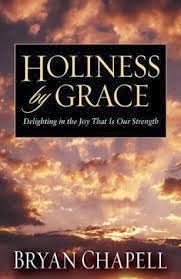
Holiness by Grace

Greetings All,

     This week's 'thought' comes to you from Bryan Chapell.  It is found in his superb book entitled: Holiness by Grace. This book (in my opinion) is a must read for all who are looking for good, solid, practical, Gospel-centered advice on how to grow in godliness. I have left out some sections to make this entry shorter -- merely hoping to whet your appetite for more!  Enjoy.

     "Early in my ministry I didn't recognize how damaging it is to threaten people with God's judgment (or my disapproval) as the primary means for motivating Christian obedience. I used lots of this kind of guilt as a pastor. And I saw people's behavior change... for a while. Still, I often discovered later that he people who did change simply because I had made them feel guilty did not mature. Those whom I pressured with guilt did not grow in faith nor seem more spiritually whole even though their outward actions may have changed.
     For instance, I might deal with a married couple whose relationship was coming apart because they were not being faithful to each other.  I would tell them that if they changed their behaviors God would bless them, but as long as they pursued sinful relationships they could not expect him to love them. With this threatening advice, such a couple might very well cease their immoral activities, but I would later see that their abandonment of the immorality did not necessarily better their lives spiritually. A year of two down the road these same people were often locked into depression, pursuing other addictive behaviors, or were simply disinterested in godly priorities. 
     It took me a few years (we preachers can be notoriously dense), but finally I figured out what was happening. I was telling people that the way to get rid of guilt before God, and assure his blessing, was to change their behaviors. But what did this imply?  If people expect behavior change to get rid of their guilt, then whom are they trusting to take away their guilt?  Themselves!...  I was encouraging people to look to themselves rather than to the cross as the place for guilt's erasure.
     Only Christ can remove the guilt of our sin. By letting people think that what they did made them right with God, I was driving a wedge of human works between them and God. The people who listened to me, though they may have changed some aspect of their lives to get my approval, or secure God's affection, were actually further away from God spiritually than when I began to 'minister' to them. When mercy got out of view, grace went away and a works-righteousness jumped into its place before I even knew it.  My words were making people try to become acceptable to God by being good enough... I was teaching that if people just did things right, they could make things right with God. How foolish was my instruction.
     The Bible says that when we have done all we can do, we are still unworthy servants (Luke 17:10), and our best works are only filthy rags to God (Is. 64:6). I was teaching people that if they just offered God more filthy rags he would favor them more, or smile more, or love them more. What an eccentric and cruel God I painted for them!
     I denied people grace by teaching them that God's love was dependent on their goodness. It was I who had made them intolerant of less mature believers. By listening to me, they had to gauge their holiness by their works. And what better way is there to confirm your own righteousness than by finding fault in others!...
     We should know from our own family experiences how unproductive is obedience motivated by guilt. What happens to a child who obeys only out of fear of parental rejection -- a child who stays good to stay loved? He may obey when he is young, but he is scarred for life. Because such parental love is never more certain than the child's actions, acceptance is always in doubt. As a result, the child grows up calloused or weakened -- hating his parents and doubting himself.
     Many of us know these truths very well because we were manipulated by guilt as children and we may still bear the scars.  We hate what makes us feel guilt to gain favor... We cannot offer loving service to a God who loves us only when we are good.
     If God's love is conditional, if he is only waiting to get us if we step out of line, if avoidance of his rejection, or relief of our guilt is our reason for serving him, then we may obey him for a time, but we will not like him very much....
     Paul exhorts us to keep mercy in view because grace alone will keep us serving the Lord. If we try to compensate for the guilt that only Christ can remove, then we will lose the capacity to love him and to serve him rightly. God doesn't want us to punish ourselves to erase our guilt. He punished his Son to cancel our guilt. God will not build his kingdom on our pain, because he is building it on his mercy."

     One of the most spiritually hurtful ideas (and it's common in the Church) is the idea that by our efforts, or by greater efforts, we can "purchase" more of God's love.  That by repenting, reforming, or performing better we can earn more of His love (at least until we mess up the next time).
     Yet, though it is the cause of much striving and effort in church circles, it would do us good to pause and then counter such un-Gospel-like notions by remembering and believing the Gospel truth that in the economy of grace there is no place for merit (Luke 17:10). That we can never obtain even the smallest fraction more of God's love than what Christ both displayed, and irrevocably secured for us, when He went to the cross to pay the sin-debt for all our innumerable transgressions.
     We do well to remember the love of God is given, not earned. It's a gift of grace, not pay for increased effort or attempts at greater moral renovation. It isn't ours if we "fix" ourselves, it was there long(!) before we ever even come to the conclusion we were in dire need of fixing!
     We work FROM grace, not FOR grace.  We stand in grace, we don't have to strive for it. By faith we discover ourselves to have been the undeserving objects of a free love, not hired hands called to make ourselves worthy of a conditional love.
In the Service of the Gospel, Pastor Jeff

1.15.2014

Motives for Serving God

Greetings All,


     This week's 'thought' comes to you from Marcia Hornok, writer, editor and pastor's wife.  It has to do with our motives for serving God and is applicable to the life of any believer.  In reading it I felt it was wise, relevant, and spot on -- so I share it with you.  It is taken from the most current "Voice" magazine, Jan-Feb. 2014.  Enjoy!


     "Human nature craves recognition and reward.  I like having my articles published, seeing the room full in my Ladies Bible Study, and hearing people thank my husband for his sermons. But is that my motive for serving God? What do I deserve as a result of walking by faith for several decades? What did our biblical relatives, listed in Hebrews 11, receive for their faithfulness?

     The chapter clearly indicates their eternal reward (vv. 13-16, 26, 39-40). They were approved of God (vv. 2, 5, 16, 39).  But did that include earthly rewards as well? The chapter lists some of the things those who lived by faith received on earth. They 'conquered kingdoms, administered justice, obtained promises, shut the mouths of lions, quenched the raging fire, escaped the edge of the sword, gained strength after being weak, became mighty in battle, and put foreign armies to flight. Women received their dead raised to life again.' So far so good.
     

     But the list continues. 'Some men were tortured, not accepting release...and others experienced mockings and scourgings, as well as bonds and imprisonment. They were stoned, they were sawed in two, they died by the sword, they wandered about in sheep skins and goatskins, destitute, afflicted, and mistreated... They wandered in deserts, mountains, caves and holes in the ground (vv. 33-38).

     Such was the reward of walking by faith and pleasing God. Some had their loved ones brought back to life; some watched their loved ones tortured to death. Living by faith can lead to totally opposite outcomes in this life.

     Faith does not guarantee earthly credentials, credits, or accomplishments. These heroes and heroines of faith believed God's promises even though they never came to pass in their lifetimes (v. 39). They concentrated on pleasing God, not on being successful or effective (vv. 5-6). Enduring whatever came their way, they remained faithful to the end because their eyes were set on the invisible, future reward of the heavenly city whose architect and builder is God (v. 10)... 

     Too often, I have expected temporal rewards for living right, serving God, and enduring trials. I have measured my success (and that of others) by visible, countable results. Instead, I need to live for eternity and God's approval there, not for earth and human affirmation here.

     God will look for my usefulness, not my effectiveness. And I can only be useful when I'm dependent upon Him, abiding in His fellowship (John 15:5). Even though God does bless and reward us in this life, I must not expect that, or set my hopes on it. To do so results in either arrogance (over what I have) or anger (over what I don't have). My motive for pleasing God cannot be what I will get out of it. I live by faith, not to gain God's favor, but because I have God's favor. We endure to the end, not to get what we want, but to give God what He deserves.

     Walking by faith means trusting God with the results as we labor together. I plant and/or water; He gives (or does not give) the increase (I Cor. 3:7-9). I should concentrate on my responsibility, not His. Then, someday, when faith becomes sight, I will bow before Him, utterly unworthy of His promised rewards."

     In a culture so focused on numbers, and getting results, and achieving great things, and being successful, it is helpful to remember that God never calls us to be successful, He calls us to be faithful and endure to the end. And He calls us to such faithfulness even though we may be entirely unable to point to huge numbers, significant results, or noteworthy success (as measured by earthly standards).

     As our passage from Hebrews 11 points out, some of the most blessed of God's faithful servants -- people "of whom the world was not worthy" -- had nothing to show for their faithful service to Christ except persecution, suffering, poverty, homelessness, and eventual (and sometimes extremely painful) martyrdom.

     I know.  Not a good selling point from a worldly perspective.  But then again, we don't win people to Christ by our salesmanship. God does so as His Spirit exerts the powerful influences of His calling, regenerating, and converting grace.

     My part is to remain faithful -- to Him, His Word, and my duty of seed-planting or watering. Then I must simply leave the rest to Him.  And when all is said and done, our "reward" is ultimately the fact that we had the blessed privilege and opportunity of serving our gracious Redeemer and being even the smallest part of His redemptive plan for the ages.


Grace to you as you seek to remain steadfast, Pastor Jeff

6.12.2013

Remember Jesus Christ

Greetings All,

     This week's 'thought' comes to you from an old book I purchased recently.  I started glancing through it and found this selection interesting -- from a historical and biblical perspective. In fact, if you are one of those people who idealizes the past as the "good old days" when everything was supposedly,  "the way it should be," when compared to today, you may be disappointed to discover otherwise!
     I'll save the date the book was published for the end so you can try to guess from its contents what era he is talking about. The title is "Remember Jesus Christ" and its author is Robert E. Speer.  [I have taken the liberty of condense and update the language while holding to the author's intent].  Enjoy.

Christ's Command to Believe

     "One of the most significant characteristics of the temper of our day is its dislike of the imperative mood. It does not like commands, or to be addressed in terms of, 'You must!'  It likes to be spoken of in other terms, such as, 'Will you not, if it pleases you?'... For the last few years in this land we have had abundant evidence of the dislike of great classes of men for enforced limitation, for obligation, for law. There is across the country an antagonism to obligation...
     The human will has never liked to limit its sovereignty, but it is quite clear that there is scarcely anything that is now as distasteful, especially in the sphere of religion, as the imperative mood. We are told that as far as religion is concerned, it must keep its hands off the rest of our life; that it is a matter altogether beyond reason, having no right whatsoever to coerce reason; and that it cannot say to people, 'you must.' 
     Yet it must at once occur to us that Christ speaks constantly in the imperative. We have it in these words: not, 'It is desirable, if you wish to have blessings, that you should have faith in God' -- but 'Have it.' 'Have faith in God.'
     And He not only uses the imperative in religion, but He uses it in the most objectionable sphere of religion - faith. 'It is all right,' some will declare, 'to say, 'Thou shalt' and 'thou shalt not,' in the sphere of conduct. But to tell us we must do certain things in the sphere of belief is absurd.'  They continue, 'How can God override all the laws of our lives by compelling us or ordering us to do things which, perhaps, in the very nature of our constitution, it may not be possible for us to do? We cannot intellectually assent to a proposition on orders.' 
     And yet, it is precisely on this matter of faith that the New Testament persists in putting the imperative... When the Philippian jailor asked Paul and Silas what he must do to be saved, they advised him in terms of a command: 'Believe!' This is a stumbling block to many, or at least to everyone who does not like obligation. But it is also a stumbling block to those who say that belief comes from having the facts laid before them, and that if belief does not spring up spontaneously from it, no amount of commanding it will create it.  That may be true if faith were to be defined as 'intellectual assent' and nothing more. But this is not an adequate definition. If it were, faith could not be commanded.
     Yet faith, primarily and essentially, is vital, moral -- a personal relationship -- and intellectual assent is a fruit of this relationship. When a child believes something which its father tells it, we call the child's acceptance an act of faith.  Yet it is not.  It is a fruit of faith.  Faith is the confidence which the child posits in its father, which leads it to believe in what the father says...
     If you will read through the New Testament carefully, you will see the commands to believe are used with reference to the moral and vital relationship every soul is summoned to recognize between himself and God [ie: I John 3:23 -- 'And this is God's command: to believe in the name of His Son, Jesus Christ, and love one another.']...
     And so Christ felt He had a right to order people to have faith, because it was not a matter, primarily, of their minds. He could and does order it because it is primarily a matter of moral character, of heart, of life, of personal relationship.

With that emphasis in mind, let us consider Christ's command as a fourfold call.

     FIRST of all, it is a call to a personal surrender to God. If you read through your New Testament you will find that in pretty nearly every case the root idea of the writer or the speaker is that there should be on the part of men, a moral surrender to God or to the personal truths of God.  'Believe   on the Lord Jesus Christ' means 'believe on Jesus as Lord; as the one who possesses you; as the one to whom you must make a personal surrender... In saying 'Have faith in God,' Jesus summons us to an unconditional, hold nothing back, irreversible, life-engulfing surrender to Him.

     SECOND, the words, 'Have faith in God,' are a call to intensity in service... Faith, Christ meant to tell them, links us so closely with God as to make us co-workers with Him to give us His power in the world, so that we work no longer with a human soul's strength only, but with the strength of God... Faith in God is a rest, surely enough, but it is also a life of power and a call to a life of intensity of service in which every faculty and gift of life must find play, transfigured and made a thousand fold more effective by the Spirit of Christ...

      THIRD, the call to 'have faith in God' is a call to confidence. It was not, 'Have speculations about God,' or, 'Have doubts regarding Him.'  The early church had an unqualified unhesitating message. 'Have faith in God' was its one word -- 'in God, and in His Son, the Lord Jesus Christ'... The agnostic type mind was vexed by the positive certainty of the Christian doctrine and life. But the early church knew. It had faith, and spoke... So stand fast. Believe. Be not tossed to and fro with every wind of doctrine. Have faith in the eternal and trust-deserving God.
      Then LAST, Christ's command is a call to hopefulness... The writer of the epistle to the Hebrews conceives of faith as 'the assurance of things hoped for, the evidence of things not seen'... He goes on to say to those struggling believers who lived by faith even though it resulted in their torture or death, 'God is not ashamed to be called their God, for He has prepared for them a city.'
     The Gentiles conceived of the night as coming after the day.  Day came first, night followed. Their golden age was behind. The good old days had passed. It was darkness ahead.  But for the Jew, the golden age was always to come. They left darkness (Egypt) behind... Day does not begin when morning comes. It ends in light.  The Genesis account says, 'there was evening and then there was morning, the first day' not, 'there was morning and then evening, the first day.'  The Christians brightest days are ahead.  Bonar expresses this truth in one of his hymns,
'Not first the bright, and after that the dark,
But first the dark, and after that the bright.
First the thick cloud, and then the rainbow's arc; 
First the dark grave, then resurrection light.'"

     Oh yes, I forgot to mention this was published in 1899.  One of those "not so good old days" when people from coast to coast (according to the author) had a loathing for imperatives, laws or commands (similar to our day)!
     Yet, in light of his last point, where he tells us the call to faith is a call to hopefulness, do we have that biblical mindset where we believe that day follows night, instead of night following day?
     Could it be that despite the present darkness, a morning is coming and light is just around the corner? Can we believe God to bring it about? Can we, "Have faith in God"? Or should I phrase it in that despised imperative tense -- people, "Have faith in God!" "Believe!"
It does make a difference. Yet as he notes, it all depends on that ever-necessary personal relationship with God.    Blessings on your day, Pastor Jeff

5.15.2013

Jesus' Promise To Be With Us Always & God's Promise to Bless His People

Greetings All,

     This week's 'thought' comes to you from the very gifted preacher, Alistair Begg. It is the combination of two of his devotional postings which I found encouraging. The first speaks of Jesus' promise in Matthew 28:20 to, "be with us always, even to the end of the age."  The second flows out of God's promise in Psalm 67 to bless His people so that, "all the ends of the earth will fear Him."
     Both truths should encourage the earnest believer, and I offer them to you for the purpose. Enjoy, and have a great week doing what he urges you to do.  In His Service, Pastor Jeff

     "It is good that there is One who is always the same and who is always with us. It is good that there is one stable rock amidst the billows of the sea of life. Let us not set our soul's affections upon rusting, moth-eaten, decaying treasures but set our hearts upon Him who remains faithful forever. Let us not build our house upon the moving quicksands of a deceitful world but base our hopes upon this rock that, amid descending rain and roaring floods, shall stand immovably secure.
     My soul, I charge you, lay up your treasure in the only secure cabinet; store your jewels where you can never lose them. Put your all in Christ; set all your affections on His person, all your hope in His merit, all your trust in His efficacious blood, all your joy in His presence, and then you may laugh at loss and defy destruction.  Remember that all the flowers in the world's garden fade by turns, and the day comes when nothing will be left but the black, cold earth and death will soon put out your candle.
     How sweet to have the sunlight when the candle is gone! The dark flood must soon roll between you and all you have; so join your heart to Him who will never leave you; trust Him who will go with you through the surging current of death's stream and who will bring you safely to the celestial shore and have you sit with Him in heavenly places forever. In the sorrows of affliction, tell your secrets to the Friend who sticks closer than a brother. Trust all your concerns to Him who can never be taken from you, who will never leave you, and who will never let you leave Him, even "Jesus Christ [who] is the same yesterday and today and forever." "I am with you always" is enough for my soul to live upon no matter who forsakes me."
--------------------------------------------------------------------
     "It is our own fault if we do not enjoy the riches of our God. Since you have such a friend, and He invites you to draw from Him daily. Never be wanting while you have a God to go to. Never fear or faint while you have God to help you.  Go to your treasure and take whatever you need--there is all that you can ever want. Learn the divine skill of making God all things to you. He can supply you with everything; or better still, He can be everything to you. Let me urge you, then, to make use of your God. Make use of Him in prayer. Go to Him often, because He is your God.
     Will you fail to use such a great privilege? Run to Him; tell Him all your needs. Use Him constantly by faith at all times. If some dark providence has cast a shadow on you, use God as a sun; if some strong enemy has attacked you, find in Jehovah a shield, for He is a sun and shield to His people. If you have lost your way in the mazes of life, use Him as a guide, for He will direct you. Whatever you are, and wherever you are, remember, God is just what you want and just where you want, and that He can do everything you want."

2.13.2013

A Profile of the Obsessed

Greetings All,       

     This week's 'thought' comes to you from Francis Chan, in his book, "Crazy Love -- Overwhelmed By A Relentless God."  In it he considers the radical nature of the love we should have for God, and what our response to Him should be in light of all He has done for us.  This selection comes from chapter eight, which is entitled: "A Profile of the Obsessed."

     In a world where fanaticism is most often seen as bad -- especially when it comes to people of faith -- Chan challenges us to see that the notion of being "balanced" -- if we follow the world's definition of being reserved, or half-hearted, or holding back so as not to be seen as too extreme in our devotion for Christ -- does not come from the Bible.  In fact, that type of balance essentially makes us virtually invisible to the onlooking world where we are called to live in such a way that we stand out; being salt and light and committed without reserve.  His book is a call to wholehearted devotion to Christ (and what truly Spirit-birthed Christian would not want to pursue that)?  Enjoy.

Obsessed: To have the mind excessively preoccupied with a single emotion or topic.  The idea of holding back certainly didn't come from Scripture. The Bible teaches us to be consumed with Christ and to faithfully live out His words. The Holy Spirit stirs in us a joy and peace when we are fixated on Jesus, living by faith, and focused on the life to come.
I think sometimes we assume that if we are nice, then people will know that we are Christians and want to know more about Jesus. But it really doesn't work that way. I know a lot of people who don't know Christ and are really nice people -- nicer and more fun to be with than a lot of Christians I know. There has to be more to our faith than friendliness, politeness and even kindness...    

 Lovers: People who are obsessed with Jesus give freely and openly, without censure. Obsessed people love those who hate them and who can never love them back (Luke 6:32-34 / Luke 14:12-14). 

Risk Takers: People who are obsessed with Jesus aren't consumed with their personal safety and comfort above all else.  Obsessed people care more about God's kingdom coming to this earth than their own lives being shielded from pain or distress (Luke 9:1-6 / Luke 10:1-12).

Friends of All: People who are obsessed with Jesus live lives that connect them with the poor in some way or another. Obsessed people believe that Jesus talked about money and the poor so often because it was really important to him (I John 2:4-6 / Matt. 16:24-26).

Crazy Ones: Obsessed people are more concerned with obeying God than doing what is expected or fulfilling the status quo. A person who is obsessed with Jesus will do things that don't always make sense in terms of success or wealth on this earth. As Martin Luther put it, 'There are two days on my calendar: this day and that day [that is, the day of judgment when we will stand before Christ to give an account of all that have done in the flesh] (Luke 14:25-35 / Matt. 7:13-23 / Matt. 8:18-22 / Rev. 3:1-6). 

The Humble: A person who is obsessed with Jesus knows that the sin of pride is always a battle. Obsessed people know that you can never be 'humble enough,' and so they seek to make themselves less known and Christ more known (Matt. 5:16). People who are obsessed with Jesus do not consider service a burden. Obsessed people take joy in loving God by loving His people (Matt. 13:44 / John 15:8). 

Givers: People who are obsessed with God are known as givers, not takers. Obsessed people genuinely think that others matter as much as they do, and they are particularly aware of those who are poor around the world (James 2:14-16).

Sojourners: A person who is obsessed thinks about heaven frequently. Obsessed people orient their lives around eternity; they are not fixed only on what is here in front of them (I Peter 1:17-23).
The Engrossed: A person who is obsessed is characterized by committed, settled, passionate love for God, above and before every other thing and every other being.

Unguarded Ones: People who are obsessed are raw with God; they do not attempt to mask the ugliness of their sins or their failures. Obsessed people don't put it on for God; He is their safe place, where they can be at peace.

The Rooted: People who are obsessed with God have an intimate relationship with Him. They are nourished by God's  Word throughout the day because they know that 40 minutes on Sunday is not enough to sustain them for a whole week, especially when they will encounter so many distractions and alternative messages.

The Dedicated: A person who is obsessed with Jesus is more concerned with his or her character than comfort. Obsessed people know that true joy doesn't depend on circumstances or environment; it is a gift that must be chosen and cultivated, a gift that ultimately comes from God (James 1:2-4).  

 Sacrificers: A person who is obsessed with Jesus knows that the best thing he can do is be faithful to his Savior in very aspect of his life, continually saying 'Thank You!' to God. An obsessed person knows there can never be intimacy if he is always trying to pay God back or work hard enough to be worthy. He revels in his role as child and friend of God."

Chan gives us a lot to think about; not only in his words, but also through his lifestyle (deciding after a trip to Africa to sell his larger house and move into a smaller one (half the size) -- so that he could have more money to give away).

Is that crazy, or obedience to Jesus? Is that "radical," or the normal response of a person who takes his commitment to Jesus seriously?  Unfortunately, too many of us are more obsessed with fitting into the American lifestyle and what that looks like, than being a sold-out follower of Jesus and what that might look like. It's no easy battle -- especially for those who have children and know how much they desire to fit it.  Yet it's a battle we're called to, and lose, the minute we think we don't even need to be concerned about it.
With you in the immense struggle to live as Jesus calls us to live, Pastor Jeff