Visitors

free counters
Showing posts with label Attitude. Show all posts

7.23.2019

The Pursuit of Holiness

Greetings All,

     This week's "thought" speaks of a topic which I don't hear much about any more -- holiness.  Therefore I thought it would be a good reminder for us all.  It is taken from Jerry Bridges book, "The Pursuit of Holiness."   I once had the privilege of hearing Mr. Bridges speak at a conference alongside John Piper, John MacArthur, and others. They were all good, but the one thing that struck me about Mr. Bridges (as opposed to the others, whose content was unquestionably superb) was his humility.  I can't remember all that he said, yet that was partly because I was so struck (distracted?) by the sense that here was a truly holy and humble man That's what stood out the most to me as I listened to him speak.  And it was confirmed a few years later when I took a class on "Grace and Discipline" with him while pursuing my doctorate. Thus I offer this selection on holiness from a humble man who took to heart the earnest pursuit of it.  Enjoy. 
     "God expects every Christian to live a holy life.  Holiness is not only expected; it is the promised birthright of every Christian.  Paul's statement in Rom. 6:14 is true: "For sin shall not be your master, because you are not under law, but under grace."  The concept of holiness may seem a bit archaic to our current generation. To some minds the very word holiness brings images of bunned hair, long skirts, and black stockings. To others the idea is associated with a repugnant "holier than thou" attitude.  Yet holiness is very much a Scriptural idea. The word "holy" in it's various forms occurs more than 600 times in the Bible.  One entire book, Leviticus, is devoted to the subject, and the idea of holiness is woven elsewhere throughout the fabric of Scripture.  More importantly, God specifically commands us to be holy (see Leviticus 11:44 / I Peter 1:16).
     The idea of exactly how to be holy has suffered from many false concepts.  In some circles, holiness is equated with a series of specific prohibitions -- no smoking, drinking, dancing, etc. The list of prohibitions varies depending on the group.  When we follow this approach to holiness, we are in danger of becoming like the Pharisees with their endless lists of trivial do's and don'ts, and their self-righteous attitude. For others, holiness means a particular style of dress and mannerisms. And for still others, it means unattainable perfection, an idea that fosters either delusion or discouragement about one's sin. All these ideas, while accurate to some degree, miss the true concept. To be holy is to be morally blameless. It is to be separated from sin and, therefore consecrated to God. The word signifies, "separation to God [to be set apart for God], and the conduct befitting those so separated."
     Perhaps the best way of understanding the concept of holiness is to note how writers of the New Testament used the word.  In I Thessalonians 4:3-7, Paul used the term in contrast to a life of immorality and impurity.  Peter used it in contrast to living according to the evil desires we had when we lived outside of Christ (I Peter 1:14-16).  John contrasted one who is holy with those who do wrong and are vile (Revelation 22:11).  To live a holy life, then, is to live a life in conformity to the moral precepts of the Bible and in contrast to the sinful ways of the world. It is to live a life characterized by the "[putting] off of your old self, which is being corrupted by its deceitful desires.... and [putting] on the new self, created to be like God in true righteousness and  holiness" (Ephesians 4:22-24)...
     At the risk of oversimplification, the lack of personal holiness can be grouped into three basic problem areas:

     1st) Our first problem is that our attitude toward sin is more self-centered than God-centered. We are more concerned about our own "victory" over sin than we are about the fact that our sins grieve the heart of God. We cannot tolerate failure in our struggle with sin chiefly because we are success-oriented, not because we know it is offensive to God.  W S. Plumer said, "We never see sin aright until we see it as against God...  All sin is against God in this sense: that it is His law that is broken, and His authority that is despised.... As the returning prodigal said, "I have sinned against heaven and before you," and David said to God (after his adulterous affair with Bathsheba), 'Against You, and You only, have I sinned."  God wants us to walk in obedience, not victory. Obedience is oriented toward God, victory is oriented toward self...
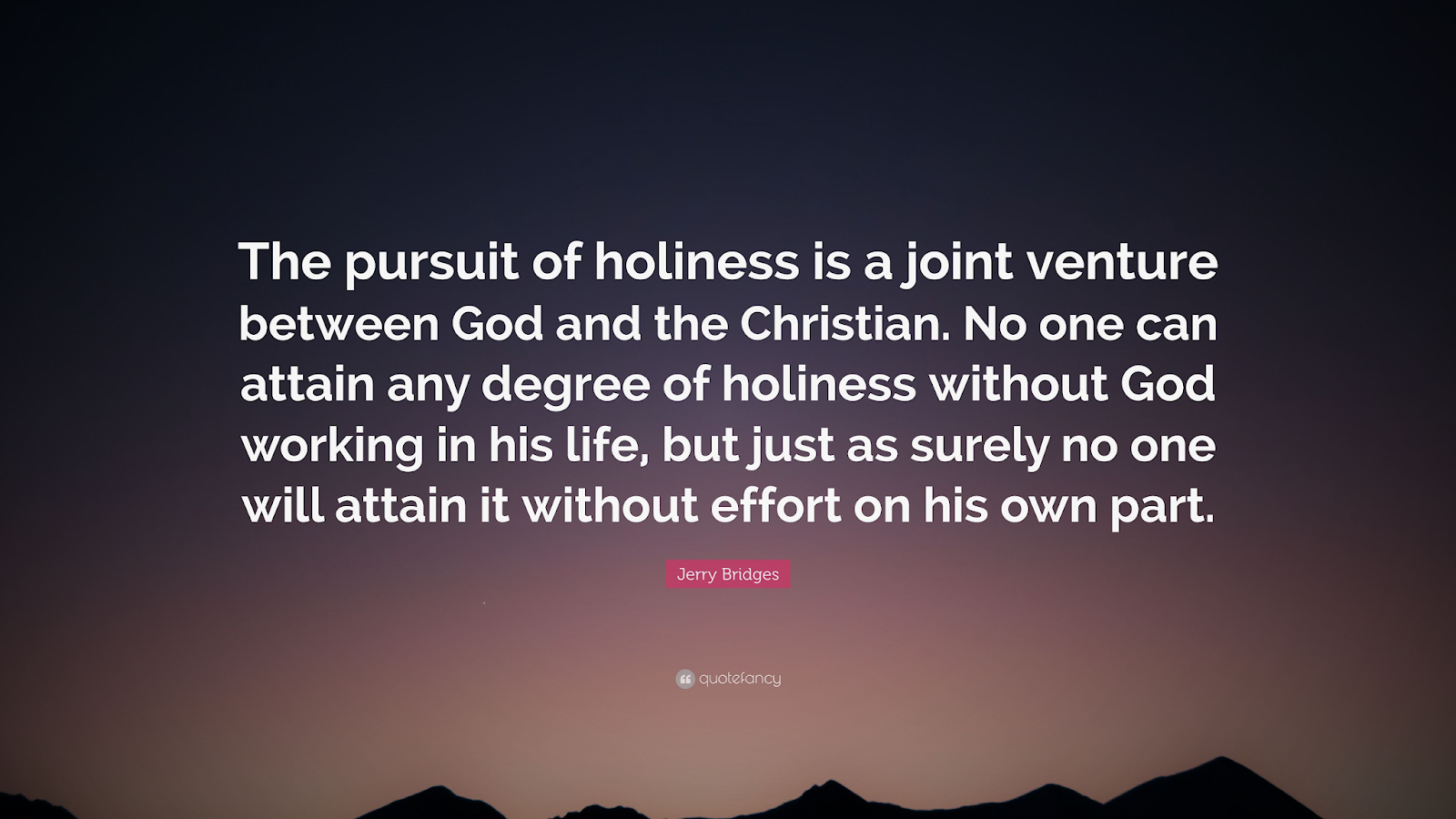
     2nd) Our second problem is that we have misunderstood "living by faith" (Galatians 2:20) to mean that no effort at holiness is required on our part. In fact, sometimes we have even suggested that any effort on our part is, "of the flesh." The words of J. C. Ryle are instructive to us at this point: "Is it wise to proclaim in so bold, naked and unqualified a way as many do, that the holiness of converted people is by faith only, without any personal exertion?  Is it according to the proportion of God's Word?  I doubt it. That faith in Christ is the root of all holiness, no well-instructed Christian will ever think of denying.  But surely the Scriptures teach us that in following holiness the true Christian needs personal exertion and work as well as faith."  We must face the fact that we have a personal responsibility for our walk of holiness...
     3rd) Our third problem is that we do not take some sin seriously.  We have mentally categorized sins into that which is unacceptable and that which may be tolerated a bit... But the Scripture tells us it is, "the little foxes that ruin the vineyards" (Song of Songs 2:15).  It is compromise on the little issues that leads to greater downfalls...   As Andrew Bonar said, "Is the Lord to be obeyed in all things whatsoever He commands? Is He a holy lawgiver? Are all His creatures bound to give implicit assent to His will?"  Are we willing to call sin "sin" not because it is big or little, but because God's law forbids it?  We cannot categorize sin (suggesting some sins are ok and others to be avoided) if we are to live a life of holiness... Will you begin to take personal responsibility for your sin, realizing that as you do, you must depend on God's grace?  And will you decide to obey God in all areas of life, however insignificant the issue may seem to you?"
     When it comes to "holiness" most all people view it in slightly different ways.  Some as stern and joyless, others as restrictive and still others as refreshing.  And some, having been exposed to a counterfeit version of it (which was super-strict, joyless and judgmental) -- want nothing to do with it.  Yet, we are (as Bridges points out) called to pursue it, and to do something in our pursuit of it, for our struggle with sin does require resisting temptation, repenting of sin, clothing ourselves with Christ, putting to death the sinful nature, and so on. 
     We are often so afraid of hearing someone accuse us of being "legalistic" that we shy away from the pursuit of holiness, forgetting that what makes something "legalistic" is not personal effort, but the thought that by that effort we are earning salvific credits, or securing our justification with God. It is thinking our obedience earns us our salvation.
     Yet the pursuit of holiness is not like that. It is simply seeking to avoid that which grieves the heart of the God who has so loved us that He saved us.  It is working from grace, not for grace. It is working from the place of God's acceptance, not for a place in His acceptance.  And it must be said that just because we have God's acceptance through Christ, and the Gospel, doesn't mean we stop seeking to do what pleases Him. It simply means we are secure in His acceptance as we seek to please Him.  "Legalism" seeks to gain an acceptance it feels it doesn't have through it's efforts; a sanctified pursuit of holiness simply pursues godliness as it rests in the acceptance it knows by faith that it already has and can't lose -- that's why it can't be called legalism.

     Living in the Grace of Jesus as we pursue the holiness that is our Christian birthright, Pastor Jeff

7.16.2019

Devotions for Men on the Go


Greetings All,

     Today I found a book I had laid on my desk weeks ago. It was "Devotions for Men on the Go," by Stephen Arterburn.  I opened it and it randomly fell open to this devotion. It struck me as worthy of sharing. I hope it moves and challenges you as well. Enjoy.


"Even if my life is to be poured out like a drink offering 
to complete the sacrifice of your faithful service 
(that is, if I am to die for you), I will rejoice, 
and I want to share my joy with all of you." 
(Philippians 2:17)

A Matter of Honor
     "About an hour into United Flight 93 from Newark to San Francisco on September 11, 2001, terrorists commandeered the cockpit, herded the passengers to the back of the plane, and turned it back toward a target in Washington, D.C.  Among those passengers were four remarkable men who didn't much like being herded around. 
     One was 31 year old publicist Mark Bingham, who had helped the University of California win the 1991 and 1993 national collegiate rugby championships. He was six foot five, rowdy and fearless.  One was 38 year-old medical research company executive Tom Burnett, who told his wife over the phone, "I know we are going to die. Some of us are going to do something about it."  One was 31 year old businessman Jeremy Glick. He called his wife, Lyz, at her parents home in Windham, New York, to say good-bye to her and their twelve-week-old daughter, Emmy.  The other was 32 year-old sales account manager Todd Beamer, who had played third base and shortstop over three seasons for Wheaton College in Wheaton, Illinois.
     These four brave men apparently came up with a plan to storm the cock-pit and attempt to wrest control of the aircraft from the terrorists.  Flight 93 never made it to Washington. Instead, it crashed into a field eighty miles southeast of Pittsburgh. All passengers and crew perished.  Nobody on the ground was killed. 

     What will you do when it is your turn to be poured out for the sake of others?

     Dear God, may I value honor more than survival." 
     Jesus said, "Greater love has no man than this, that he would lay down his life for his friends" (John 15:13).  I wonder if it might not be just as hard (if not harder) to lay down your life for strangers you would never meet -- like these men who's heroic act saved the lives of countless many in whatever the target was to be in Washington, D.C.  All  on board did die, but if the terrorists were allowed to continue on unchallenged, it would have been all on board plus many more in D.C.
     Self-sacrifice is never easy. It goes against our survival instinct, and with few exceptions goes against the sway of our self-focused society.  Whether it be offering one's life up to death for others, or dying to self daily, by, "considering others better than yourself" (Phil. 2:3) it does not come easy.  Yet, it is an expression of imitating Christ in His condescension, sacrificial love, and self-emptying humility (Phil. 2:5-11).
     We admire such things in Jesus, but sometimes forget that, "our attitude should be the same as that of Christ Jesus: Who, being in very nature God, did not consider equality with God something to be grasped, but made himself nothing, taking the very nature of a servant and being made in human likeness. And being found in appearance as a man, he humbled Himself, and became obedient unto death -even death on a cross" (Phil 2:5-8).  Such humble and sacrificial love is part of following His command to, "love one another as He has loved us." 
     So, maybe I could put Mr. Arterburn's last prayer this way: "Dear God, may we value the opportunity to imitate Christ in His humility more than self-interest, self-protection and survival." 

Only as we lean on Him, Pastor Jeff

7.09.2019

You Can't Take It With You

Greetings All,

     Today's "thought" is at the same time interesting, intriguing and convicting. It is a critique on our culture, and upon us at the same time.  It is worth reading simply because it's true, and the truth of it should make us do some inner reflection. It may even cause us to make some healthy changes or do some cleaning out. Above all it should make us consider what's important, reevaluate our priorities, and consider how we could better use our resources in a world with much so much need.
     It comes from John Ortberg's book (written with a somewhat satirical flair) "When The Game Is Over, It All Goes Back in the Box."   It is available in shortened form in, "You Can't Take It With You."  Enjoy.


Stuff, Stuff and More Stuff

     "We all have stuff. We see it, want it, buy it, display it, insure it, and compare it with other people's stuff.  We talk about whether or not they have too much stuff; we envy or pass judgment on other people's collections of stuff.  We collect our own little pile of stuff.  We imagine that if that pile got big enough, we would feel successful or secure. That's how you keep score in Monopoly, and that's how our culture generally keeps score as well. You get a large house, then you have to get stuff to put in it...
     There are now more than 30,000 self-storage facilities in the country offering over a billion square feet  for people to store their stuff. [That was in 2009 when the book was written. Today in 2019 it is estimated there are 52,000 and close to 2 billion square feet and growing!]  In the 1960's this industry did not exist. We now spend $12 billion a year [in 2018 it was $38 billion a year] just to pay someone to store our extra stuff!  It's larger than the music industry.  Psychologist Paul Pearsall comments on people finding it difficult to give their stuff away: "Many people can't bring themselves to get rid of any of their stuff. You may require a 'closet exorcist.'  A trusted friend can help prevent the 're-stuffing phenomena.'  Re-stuffing happens when, in the process of cleaning out closets and drawers, we are somehow stimulated to acquire new stuff..." 
     Some people have a gift for acquiring stuff. Not long ago I took my daughter to a place called Hearst Castle. William Randolph Hearst was a "stuffaholic."  He had 3,500-year-old Egyptian statues, medieval Flemish tapestries, and centuries-old hand-carved ceilings, and some of the greatest work of art of all time. Hearst built a house of 72,000 square feet to put his stuff in.  He acquired property for his house -- 265,000 acres. He originally owned 50 miles of California coastline.  He collected stuff for eighty-five years. Then you know what he did?  He died.  Now people go through Hearst's house by the thousands. They all say the same thing: "Wow, he sure had a lot of stuff."  People go through life, get stuff, and then they die -- leaving all their stuff behind.  What happens to it?  The kids argue over it. The kids -- who haven't died yet, who are really just pre-dead people -- go over to their parents house. They pick through their parents old stuff like vultures, deciding which stuff they want to take to their houses. They say to themselves, "Now this is my stuff."  Then they die and some new vultures come for it.
     People come and go. Nations go to war over stuff, families are split apart because of stuff.  Husbands and wives argue about stuff more than any other single issue. Prisons are full of street thugs and CEO's who committed crimes to acquire stuff.  [Some people will even kill others for their stuff.]  Why?  It's only stuff.  Houses and hotels are the crowning jewels in Monopoly. But the moment the game ends they go back in the box. So it is with all our stuff.  Christ said, "Do not store up for yourselves treasures on earth, where moth and rust destroy, and where thieves break in and steal.  But store up for yourselves treasures in heaven, where moth and rust do not destroy, and where thieves do not break in and steal. For where your treasure is, there your heart will be also" (Matthew 6:20).... 
     So Jesus says it is wise to store up treasure in what's eternal -- God and people.  To an adult, it's ironic when a two-year-old says, "Mine."  Adults know that two-year-olds don't earn any of their stuff.  It is all provided for them.  It is a gift from someone much larger and wiser than they.  They don't even generally take very good care of it.  Nevertheless, two-year-olds get extremely attached to their stuff.  If someone tries to take something, that item suddenly becomes their favorite stuff.  Two-year-olds can be so deluded, can't they?" 

     As Christians we need to pause every so often and consider where our values and priorities come from.  Do they come from Christ, or do we get them from our culture?  And if (or when) they are in conflict with each other, which takes precedence in dictating our actions and habits?  Do we heed the voice of culture over Christ, or the voice of Christ over culture?   Which do you personally follow and obey? 
     It is worth considering what Jesus would have to say about the thousands upon thousands of storage facilities in our country, and the billions upon billions of dollars spent just to store the excess stuff we don't use or have room for in our houses.  What might he say about that $38 billion spent each year simply storing excess stuff (an average of $88.00 per month per unit)?  Actually, Jesus already spoke quite clearly on that subject in Matthew 6:20.  So, we don't need to ask his opinion, we already know what that is.  So what we do need to ask him is what we should do about all our stuff in light of what he says. How should we respond?  Do we really need all the stuff we have?  How could the money spent storing it be better spent on "storing up treasures in heaven"? How could it be better used in the service of God's kingdom or relieving the plight of people who have so little?  In light of the Jesus we know from Scripture, it is at least worth asking.
     And I know that by now someone is probably thinking, "Don't get legalistic on us, Pastor Jeff."   I find that's a common response whenever what we believe or practice appears to be in conflict with what Jesus taught.  We pull out the"legalistic" card to try and shut down such questions or suggestions. Yet, isn't the goal of our lives to follow the teachings of Jesus more closely.  The Jesus who often turns the values of the world upside down.  And in this case, the Jesus who, if He did have stuff, had very little, since Scripture tells us he had no house (or storage unit) to store it in (Matthew 8:20, Luke 9:58).
     It is true that Scripture does not forbid us from owning things, and there is the ever-present need for housing and shelter and some of the things that make life in it functional. But it is at least worth asking, "At what point we violate Jesus' clear instruction not to 'store up for ourselves treasures on earth'"?
     Is it time to take a trip to the Salvation Army Thrift Shop? 
     Is there someone in real need who could use something we simply have stuffed away in our closet, attic, cellar, garage or storage unit?
     How can we turn an unused "earthly treasure" into a "treasure in heaven"?  Can we break free from it's hold on us and get rid of some stuff without re-stuffing? 
     
     I don't know about you, but I do know I need to unstuff some of my stuff without re-stuffing -- and bless someone else in the process.  And not just once, but as an ongoing habit, lest that stuff comes to have too much of a hold on me, and dictate my attitudes and choices more than the words of the One I have come to call my Lord.

Living in the Grace of Jesus, Pastor Jeff

1.02.2019

Attitude Adjustment

Greetings All!

     What does one do when they find their job unfulfilling?  One answer?  Try looking at their job in a different light.
     I was searching through my documents (looking for something else) when I found this "thought" which I saved over a year ago. It was written by Gene Twilley, who works for CCO (Coalition for Christian Outreach) and oversees CCO staff who work on college campuses doing outreach in the Philadelphia area.  I felt his insights could help those caught is a similar predicament, so I thought I would pass it along as we begin 2019.  It is entitled "Attitude Adjustment."  Most all of us could use that on one occasion of another!  Enjoy.


Attitude Adjustment

     "Eight months after finishing my undergraduate studies, I started working as an auto liability claims adjuster for a very large insurance company. There were ample benefits with the job—from day one, I was vested in a matched 401k; I had a pension, nearly a month of vacation per year, and great health benefits.  I loved the people I worked with An older African-American woman called me her newly adopted son. We worked in collaborative cubicles—four to a large cube—and laughed a lot.
     But I hated the work.  In a claims environment, every call is a complaint The workload is heavy. I was threatened with physical violence over the phone, bullied with potential lawsuits, and accused of all sorts of character flaws.  There were and are far worse places to be employed. But in the moment of any sort of seemingly bad circumstance, we don’t usually think about what could be worse. We long for something better.
     Then my wife and I attended a wedding for one of her co-workers, and I was making small talk with a woman I didn’t know, and who I probably wouldn’t recognize if I saw her today.  In the midst of conveying to her what I did, before I had the opportunity to complain about my job, she exclaimed, “How exciting! You have the opportunity to help put people’s lives back together every day.”

Sobering.
Clarifying.
Convicting.
     I was willing to approach my work as a Christian who had hope in Jesus, but not as a Christian who had hope that my work actually mattered.  I don’t know where this woman was in terms of faith, but she pointed out something that I was completely missing.
     Isaiah 61 is a messianic prophetic utterance. Jesus took up this section, read it in a synagogue in Nazareth, and explained, “Today this Scripture has been fulfilled in your hearing” (Luke 4:21).

     He was anointed to preach good news to the poor.
     He was sent to proclaim liberty to captives.
     He was sent to give sight to the blind
     He came to release the oppressed.

     In all of that, Jesus was announcing the “year of the Lord’s favor.” In the broader context of Isaiah 61, we see other really good things too! There is comfort for those who mourn. Those who sit in shame and in repentance are made beautiful. They are planted deeply into God’s grace, that they might praise rather than mourn. The people of God are called by the Servant of God to be re-creators of things that are broken… All that hope, that expectation, that rebuilding of the things that have been broken—it’s in Isaiah 61. It all finds its beginning, current, and end in Jesus.
     And this is the kind of hope that can lift me out of myself and all my meandering thoughts about greener pastures. I start to ask different questions.  After all, aren’t we called to care about the situations that God has placed us in, the broken places already in our midst? How can we make the most of our God-given opportunities today? How might we redeem the time that he’s given into our possession?
     As a claims adjuster, I was occupied with my work—getting through the day, looking for the next best thing. It was a job, not a calling.  Or was it?  What if every opportunity to serve others is a calling from the Lord?  Tim Keller explains, “our work can be a calling only if it is re-imagined as a mission of service to something beyond merely our own interests. Thinking of work mainly as a means of self-fulfillment and self-realization slowly crushes a person.”
     Calling is found at the sweet spot where my vertical and horizontal relationships meet—where I love the Lord and where I love my neighbor. Too often, maybe we’re disappointed with where we are because we simply don’t see the potential of the work ahead of us. But what if some of us are so concerned with our own emptiness that we don’t see the joy set before us?  Isaiah 61 tells a bigger story, and in this story, work becomes service, pain becomes joy, and despair becomes hope.  Come, Lord Jesus. Give us eyes to see." 
     Where might an "attitude adjustment" (or simply looking at something from a different perspective) help you in your struggle to find fulfillment in something which is not at present?  Only you can know. But it is worth pondering!

Living in the Grace of Jesus, Pastor Jeff