Visitors

free counters
Showing posts with label Love. Show all posts

11.12.2019

Fanny Crosby's Life Story

Greetings All,

     Everyone loves an inspiring story!   I came across the story below while preparing for my Sunday School class on, "100 Must Know Christians From Church History."  It is about Fanny Crosby the well-known hymn writer (well-known, at least, to those who attend churches that did, or still do, sing hymns - since many don't)!  I have taken material from three sources to create the account below, the major source being, "50 People Every Christian Should Know - Learning From Spiritual Giants of the Faith" by Warren Weirsbe.  Should you desire to look at a far more extensive recounting of her life, it can be found in her autobiography, "Fanny Crosby's Life Story," or  Edith Blumhofer's book, "Her Heart Can See."  Enjoy.


     "I believe myself still really in the prime of my life!" wrote Frances Jane Crosby at the age of eighty-three. She lived twelve more years (1820-1915)...  Donald P. Hustad has called Fanny Crosby "the most prolific and significant writer of Gospel songs in American history." She wrote more than 8000 songs, most of which are now forgotten.  But many continue to minister to people: "To God Be the Glory," "Blessed Assurance," "Praise Him, Praise Him," "Jesus keep Me Near the Cross," "All the Way My Savior Leads Me," “Safe in the Arms of Jesus,” “Rescue the Perishing,” “Savior, More Than Life to Me,” “Pass Me Not, O Gentle Savior,” and many others. 
     When Fanny was only six weeks old she developed a minor eye inflammation and the doctor's careless treatment left her blind. "It seemed to be intended by the blessed Providence of God that I should be blind all my life," she wrote in her delightful autobiography Fanny Crosby's Life Story, "and I thank Him for the dispensation."  The doctor who destroyed her sight never forgave himself and moved from the area, but Fanny held no ill-will toward him. "If I could meet him now," she wrote, "I would say "Thank you, thank you -- over and over again -- for making me blind."  In fact, she claimed that if she could have her sight restored, she would not attempt it. She felt that her blindness was God's gift to her so that she could write songs for his glory.  "I could not have written thousands of hymns," she said, "if I had been hindered by the distractions of seeing all the interesting and beautiful objects that would have been presented to my notice." 
     Fanny was greatly influenced by her mother and grandmother (her father died when she was very young). When the family moved to Connecticut a neighbor (Mrs. Hawley) read to her from the Bible and taught her Bible stories.  It seems unbelievable, but by the time Fanny was ten years old, she could recite (from memory) the first four books of the Old Testament and the four Gospels!  She could also repeat "poems without number."  She sometimes compared her mind to a writing desk, with little drawers and compartments filled with information readily available. In 1835 (at the age of 15) her mother took her to the famous "Institution for the Blind" in New York City for formal education  She proved an excellent student in everything except mathematics. In rebellion against the subject she wrote the following poem:  "I loathe, abhor, it makes me sick; To hear the word arithmetic!"  Before long, she became the resident poet for the school, and the superintendent was concerned that the growing praise might go to her head. So he called her into his office and warned her to beware of pride. He also urged her to use her gifts to the glory of God.  "His words were like bombshells," she would later write, "but they did me an immense amount of good."
     In 1845 (at the age of 25) Fanny, who was somewhat frail in health and had experienced loss through the death of loved ones, became increasingly concerned about the state of her own soul.  She had been so busy learning, teaching and nursing that she had forgotten something very important: She realized that she did not have a true love for God in her heart. She began to attend numerous churches of varying denominations in her quest to find what she needed from the Lord.  She attended Congregationalist, Episcopalian, Dutch Reformed, and Methodist Episcopal churches, as well as Wesleyan camp meetings. Her concerns intensified after an interesting dream: She dreamt one night that a friend was on his deathbed, and he asked her quite pointedly (in the dream) if she would meet him in heaven.  She responded "yes" in the dream, but when she awoke the next morning she felt uneasy about the state of her soul.  Five years later, in November of 1850, she attended revival meetings at the Broadway Tabernacle Methodist Church in New York City.  She went to altar twice, yet it was not until the singing of, "Alas! And Did My Savior Bleed? that she went forward a third time while the words of the last verse, "Here, Lord - I give myself away! 'Tis all that I can do" were being sung.  This line took hold in her heart and she began to shout!  She had been born again, and finally had the personal assurance she had been searching for.  This, needless to say, led to one of her most famous songs: "Blessed Assurance."  "My very soul was flooded with celestial light," she said. "For the first time I realized that I had been trying to hold the world in one hand and the Lord in the other." After this experience, she boldly testified about Christ and never shied away from praying in public. 
     In 1851 she published her second volume of poems, where she makes reference to her declining health in the preface -- though she would go on to live another 64 years!  In 1858 she wrote her third volume of poems -- the same year she married Alexander Van Alstyne, who had also been a student at the school for the blind and, like Fanny, had taught there upon graduating. He was a gifted musician and a perfect partner to the poetess.  The turning point in her life came in 1864 when she met William Bradbury, the famous hymn writer and publisher. "For many years I have been wanting you to write for me," he told here.  "I wish you would begin right away!"  She did begin, and the result was her first gospel song, "Our Bright Home Above." Little did anyone realize that God would use her to pen over eight thousand songs in the next fifty-one years.  How did Fanny write her lyrics?  "I never undertake a hymn," she explained, "without first asking the good Lord to be my inspiration in the work I am about to do." She would pray and meditate until she was in the right mood. Sometimes she would quote other hymns to prime the pump. Then the ideas would come and she would develop the song in her mind and commit it to memory.  At times, she would have as many as forty different songs stored away in her mind. She would let each song lie still for a few days before dictating it to a friend, who would then send it off to the publisher.
     In her day she was one of the best known women in America  In fact, on the occasion of her 85th birthday, Grover Cleveland, President of the United States, wrote to her:  "My dear friend:  It is more than fif­ty years ago that our ac­quaint­ance and friend­ship be­gan; and ev­er since that time I have watched your con­tin­u­ous and in­ter­es­ted la­bor in up­lift­ing hu­man­i­ty, and point­ing out the way to an ap­pre­ci­a­tion of God’s good­ness and mer­cy..."
     Fanny was just a few weeks away from her 95th birthday when she was called home -- a hope she had written about often in her songs. For the first time she could see, and, best of all, she could see her Savior.  Have you ever noticed how often she wrote about "seeing" in her lyrics?  Watch for the references the next time you sing a Fanny Crosby song. "Saved by Grace" is just one example, where she writes: "And I shall see Him face to face, And tell the story -- Saved by Grace; Yes we shall see him face to face, And tell the story -- Saved by Grace."  It was said of another blind hymn writer, George Matheson, that God made him blind so he could see clearly in other ways and become a guide to others.  The same tribute could be applied to Fanny Crosby, who triumphed over her handicap and used it to the glory of God."
     It's hard to summarize such a profound life of 95 years in a few simple paragraphs without leaving out many pertinent details.  Maybe the lengthy autobiography and other biographies would fill in the holes, answering such questions as: Were there brief times when she wished she could see, or struggled with the limitations brought about by her blindness?  What truths of Scripture helped her remain so grateful, joyful and positive?  What would her attitude have been if she hadn't been given parents and others who poured themselves into her in regards to her faith?  And what about the amazing gift of her near photographic memory and immense poetic skills, since we know not all are blessed with such awesome abilities?  How did such extraordinary graces help her when it came to accepting the doctor's blunder in causing her blindness?  Did he ever come to forgive himself?  So many questions and many surely without answers this side of eternity!
     For hymn lovers like myself, Fanny Crosby's songs have been an inspiration and great spiritual help.  My favorites are Blessed Assurance and To God Be the Glory.  They have always uplifted me, both the music and the words. For who could say it better?
To God be the glory great things He has done,
So loved He the world that He gave us His son,
Who yielded His life an atonement for sin,
And opened the life gate that all may go in.

Praise the Lord, praise the Lord let the earth hear His voice!
Praise the Lord, praise the Lord let the people rejoice!
O come to the Father through Jesus the Son,
And give Him the glory great things He has done

O perfect redemption the purchase of blood,
To every believer the promise of God.
The vilest offender who truly believes,
That moment from Jesus a pardon receives

Great things He has taught us great things He has done,
And great our rejoicing through Jesus the Son.
But purer and higher and greater will be,
Our wonder our worship when Jesus we see.

In His Grace, Pastor Jeff


11.05.2019

What do I look for in a Pastor?

Greetings All,

     Another week, another message!  I so look forward to sending out these gems I glean from my reading of Christian authors.
     This week's "thought"  has to do with the trend in the church to court or win the approval of the movers and shakers in the world by conforming Christian ministry to standards people in the world would find more acceptable.  It addresses the attempt to make ministry more proper, legitimate, credible and well-received in the eyes of the world -- more professional.  And to a degree the thought may seem good. But it must be approached with caution, lest the faith be made into something it was never intended to be - just one among a plethora of other legitimate admirable professions to pursue.


     This thought comes to you from John Piper in one of his less-well-known books, "Brothers, We Are NOT Professionals."   It's a good reminder in a world that often seeks to pressure the Church to conform to its standards. Though written primarily to pastors, it has a message for every Christian. Try to understand what he's saying and I believe you will see the validity of his points.  And at the end, ask yourself: What do I look for in a pastor?  Enjoy.
     "We pastors are being killed by the professionalizing of the pastoral ministry.  The mentality of the professional is not the mentality of the prophet. It is not the mentality of the slave of Christ. Professionalism has nothing to do with the essence and heart of the Christian ministry.  The more professional we long to be, the more spiritual death we will leave in our wake. For there is no professional childlikeness (Matt. 18:3); there is no professional tenderheartedness (Eph. 4:32); there is no professional panting after God (Ps. 42:1).  But our first business IS to pant after God in prayer. Our business IS to weep over our sins (James 4:9). Is there professional weeping?  Our business IS to strain forward to the holiness of Christ and the prize of the upward calling of God (Phil. 3:14); to pummel our bodies and subdue them lest we be castaways (I Cor. 9:27); to deny ourselves and take up the blood-spattered cross daily (Luke 9:23). How do you carry a cross professionally?  We have been crucified with Christ; yet now we live by faith in the one who loved us and gave Himself up for us (Gal. 2:20).  What is professional faith?
     We are to be filled not with wine but with the Spirit (Eph. 5:18). How can you be drunk with Christ professionally? Then, wonder of wonders, we were given the gospel treasure to carry around in clay pots to show that the transcendent power belongs to God (II Cor. 4:7).  Is there a way to be a professional clay pot?  We are afflicted in every way but not crushed, perplexed but not driven to despair, persecuted but not destroyed, always carrying in the body the death of Jesus (professionally?) so that the life of Jesus may also be manifested (professionally?) in our bodies (II Cor. 4:9-11). I think God has exhibited us preachers as last of all in the world. We are fools for Christ's sake, but professionals are wise.  We are weak, but professionals are strong.  Professionals are held in honor, we are held in disrepute. We do not try to secure a professional lifestyle, but are ready to hunger and thirst and be ill-clad and homeless. When reviled, we bless; when persecuted, we endure; when slaughtered, we try to conciliate; we have become the refuse of the world, the scum of the earth (I Cor. 4:9-13).  Or have we?
     Brothers, we are NOT professionals!  We are outcasts. We are aliens and exiles in the world (I Pet. 2:11).  Our citizenship is in heaven and we wait in eager expectation for the Lord (Phil. 3:20).  You cannot professionalize the love for His appearing without killing it.  And it IS being killed.  The aims of our ministry are eternal and spiritual. They are not shared by any of the professions. It is precisely by the failure to see this that we are dying. "The life-giving preacher," says Richard Cecil, "is a man of God, whose heart is ever athirst for God, whose soul is ever following hard after God, whose eye is single to God, and in whom, by the power of God's Spirit, the flesh and the world have been crucified and his ministry is like the generous flood of a life-giving river." 
     ...The professionalization of the ministry is a constant threat to the offense of the Gospel. It is a threat to the profoundly spiritual nature of our work. I have seen it often: the love of professionalism (the desire for equality in status and pay with the world's professionals) kills a man's belief that he is sent by God to save people from hell and make them Christ-exalting, spiritual aliens in this world. If the world sets the agenda for the professional man; God sets the agenda for the spiritual man. The strong wine of Jesus Christ explodes the wineskins of professionalism. There is an infinite difference between the pastor whose heart is set on being a professional and the pastor whose heart is set on being the aroma of Christ -- the fragrance of death to some and eternal life to others (II Cor. 2:15-16).  God deliver us from the professionalizers!
     God, give us tears for our sins.  Forgive us for being so shallow in prayer, so thin in our grasp of holy truths, so content amid perishing neighbors, so empty of passion and earnestness in all our conversations.  Restore to us the childlike joy of our salvation.  Frighten us with the awesome holiness and power of Him who can cast both soul and body into hell (Matt. 10:28). Cause us to hold to the cross with fear and trembling as our hope-filled and offensive tree of life.  Grant us nothing, absolutely nothing, the way the world views it.  May Christ be all in all (Col. 3:11). Banish professionalism from our midst, Oh God, and in its place put passionate prayer, poverty of spirit, hunger for God, rigorous study of holy things, white-hot devotion to Jesus Christ, utter indifference to all material gain, and unremitting labor to rescue the perishing, perfect the saints, and glorify our sovereign Lord. Humble us, O God, under your mighty hand, and let us rise -- not as professionals, but as witnesses and partakers of the sufferings of Christ. In His awesome name. Amen." 
     Some of us (myself included) have lost elements of the passion we once had when we started out in the ministry.  In some cases wisdom has thankfully tempered a lopsided zeal, a blatant omission of duty, or a pride-motivated (rather than Christ-motivated) passion for service.  But in other cases the passion that drove us into the ministry can get driven out of us by the ministry -- sometimes by the expectations placed upon us that we need to be more like the successful worldly professionals around us.
     Yet other times it may even be due to the pastors themselves adopting the subtle worldly idea that ministry is a "profession" rather than a "calling."  One that is to be carried out even if there are no "competitive benefit packages."  Yes, carried out even if it were to mean persecution, the loss of all our possessions, or even our life (Hebrews 11:32-40 / Rev. 2:8-10).  Piper's point is well taken --  professionalization of the ministry can (and has) brought spiritual apathy to the church.  Maybe it's time to consider afresh what it means to be a follower of Jesus, and remember that the call to follow Jesus is a call to serve Him for His sake, at whatever the cost, no matter what comes our way as a result -- something most of the professionals I know would not be inclined to do in their particular professions.


In His Service, Pastor Jeff

8.27.2019

The Mystery of Prayer

Greetings All,

     After two weeks away I am back from a relaxing vacation! Time spent in nature, in the woods and mountains of New England, has its benefits in refreshing the soul!
     This morning a friend asked a question about prayer.  It was a question many ask, since prayer is something that takes time to understand, even though we will never fully comprehend the mystery of it. After all, there are so  many different views and opinions and approaches people have toward praying.  Therefore, I decided I would send out this "thought" on prayer by Gary Thomas, entitled: "The Mystery of Prayer."  It is found in his book, "Sacred Pathways."  It does not address the question asked this morning, but given the fact that most all people struggle at one time or another in their prayer life, I thought some might find it helpful and encouraging -- especially those who have encountered the often confusing dilemma called "unanswered prayer."  Enjoy.

The Mystery of Prayer

     "Is there anything more mysterious than prayer? Prayer moves us to call on a Being we cannot see and ask him to altar that which we can see.  Formulas do not work; rituals cannot guarantee success. Neither the length nor the form of prayer makes the prayer potent. This is why we need to create pockets of prayer in our lives, learning to trust God to come through in unexpected ways. There is an element of mystery, however, against which we sometimes rebel -- the mystery of unanswered prayer, or, perhaps more appropriately stated, prayers that receive the answer "no." 
     Because God sometimes answers our prayers with a yes, it can become intoxicating, and this intoxication can become so addicting that we begin to demand that God answer every prayer with a yes When a prayer doesn't get answered in the way we want it to be, we may mistakenly assume there must be hidden sin, lack of faith, or some other buried obstruction, which then sends us into hours of fruitless introspection.  But to demand that God answer all our prayers with a yes is to ask for his omnipotence (power) without having the benefit of his omniscience (knowledge).
     Looking back, I'm thankful that God said no to some of my prayers. The mystery of faith calls us to love and serve a God whom we can't always understand. We love this when the result satisfies us and God answers in ways that make our knees weak. It is much less exciting, however, when the mystery leads us to believe that God is silent, indifferent, or even cruel. Mystery is mystery. It has its exhilarating elements as well as frustrating ones, and we can't expect one without the other.
     The pursuit if maturity will lead virtually every one of us through this canyon of unanswered prayer, where expectancy runs dry and the only mystery seems to be where God is hiding. Understand that this is a necessary avenue on the destination to holiness and that it usually has an end -- in God's timing however."

     Some thoroughly enjoy prayer.  Some struggle with snags and disappointments in prayer.  And some have dispensed with prayer -- at least in the more formal sense -- though I do not believe it's possible for the true believer to dispense completely with conversational interaction with God. Few will go an entire lifetime without the "why's" of both answered and unanswered prayer, yet there is blessing in persevering. Just as a child passes through phases of equilibrium and disequilibrium in their trek to maturity, so also the person maturing in prayer goes through such phases. The key, in the famous words of Winston Churchill, is to, "Never, never, never give up." 
     With you in what is often the struggle to find God, and the pathway to the throne of His grace, in prayer, Pastor Jeff

8.06.2019

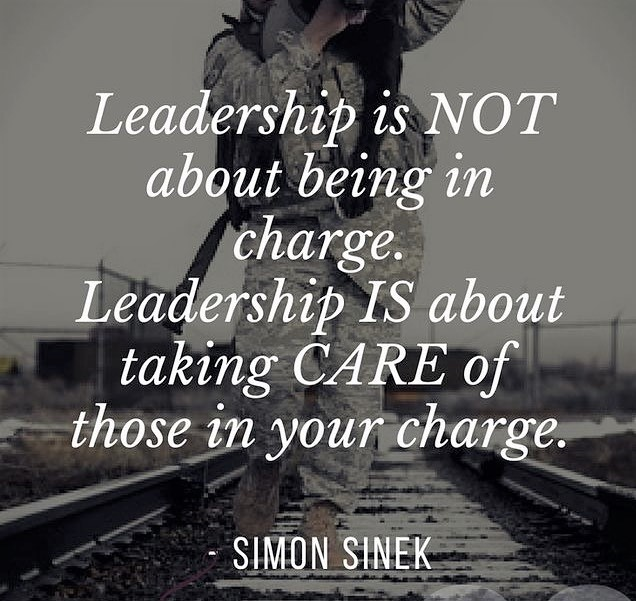
Thoughts on Leadership


Greetings All!

     This week's post is a collection of 25 quotes relating to leadership.  I post them for three reasons.  First, because it is my conviction that no matter who we are, someone is looking up to us as an example, or for guidance of one sort of another, which makes us a leader of sorts even when we don't have the title and didn't ask for the responsibility.  One does not have to be delegated the authority to carry out the role, and we can inadvertently carry out the role without even knowing we are!  The person simply trying to be an example to others is being a leader in their own right.
     The second reason I post them is because we can all gain insight and wisdom from leaders of the past who have shared what guided their leadership -- even if we don't consider ourselves to be one.  And last, I share it because as I looked hem over I was amazed how much current thought of leadership is little more than a confirmation (plagiarization of sorts) of the teaching of Jesus on the topic, or practical insights gained from His words and example, even when those giving the advice are not themselves Christians. I had many more than listed. I paired them down to 25. I offer them as the best of what I found.  If you have a favorite (or favorites) and have a chance, let me know which ones.  Enjoy.

Thoughts on Leadership

1. "The true test of a leader is this: A respect for that person that is so deep that people will continue following their lead even when the official title and delegated authority have been taken away."

2. “I start with the premise that the function of leadership is to produce more leaders, not more followers.”  Ralph Nader

3. “Leaders must possess courage.  Yet do not be mistaken: Courage is not the absence of fear; courage is the determination not to let our very real fears paralyze us, hold us back, or scare us into silence and inactivity when words and actions are what is needed.”
4. “You aren’t fit to lead until you know how to follow.  If you want to become a remarkable leader, follow a leader of character, conviction, and vision. Don’t ask people to follow you until you’ve humbly followed someone else. Following is perhaps the most neglected development principle of remarkable leadership… Follow advice from those more knowledgeable.  Follow a vision bigger than yourself.  Follow someone you respect.  Follow the most noble person available.  Follow someone who is going somewhere.  Remarkable leaders are remarkable followers. Admiration of big-egoed-leaders degrades us all.  Worry less about becoming a remarkable leader and more about becoming a remarkable follower.”   Dan Rockwell

5. “The chief characteristic of Christian leaders, Jesus insisted, is humility not authority, and gentleness not power… The authority by which the Christian leader leads is not power but love, not force but example, not coercion but reasoned persuasion. Leaders have power, but power is safe only in the hands of those who humble themselves to serve.”  John Stott

6. “A leader is one who knows the way, goes the way, and shows the way.”   John C. Maxwell

7. “Perfection is not attainable, but if we chase perfection, we can catch excellence.”    Vince Lombardi

8. “When everything seems to be going against you, remember that the airplane takes off against the wind, not with it...  I never failed, I just learned 10,000 ways that won't work.”   Henry Ford
9. “According to Scripture, virtually everything that truly qualifies a person for leadership is directly related to character.  It’s not about style, status, personal charisma, clout, or worldly measurements of success. Integrity is the main issue that makes the difference between a good leader and a bad one.”   John MacArthur

10. “Be strong enough to stand alone, smart enough to know when you need help, and brave enough to ask for it.”   Unknown

11. “True greatness, true leadership, is found in giving yourself in service to others, not in coaxing or inducing others to serve you.”   J. Oswald Sanders

12. "My research debunks the myth that many people seem to have… that you become a leader by fighting your way to the top. Rather, you become a leader by helping others to the top.  Helping your employees is as important as, and many times more so than, trying to get the most work out of them."   William Cohen

13. "The first and most important choice a leader makes is the choice to serve, without which one's capacity to lead is severely limited."    Robert Greenleaf

14. “The ability to learn is the most important quality a leader can have.”   Sheryl Sandberg

15. "We must be silent before we can listen.  We must listen before we can learn.  We must learn before we can prepare.  We must prepare before we can serve.  We must serve before we can lead."   William Arthur Ward
16. “To change your life, you have to admit what’s not working. You have to humble yourself. You have to ask for help. You have to learn... Your ego will defend your current circumstances, but you cannot allow a fleeting feeling of shame to eclipse reason. You cannot live the rest of your life as you are just because you are too prideful to admit something isn’t right.”   Brianna Wiest

17. “If your objective is to be as good as you can be, then you’re going to want criticism.”  Ray Dalio

18. "If leadership serves only the leader, it will fail.  Ego satisfaction, financial gain, and status can all be valuable tools for a leader, but if they become the only motivations, they will eventually destroy a leader. Only when service for a common good is the primary purpose are you truly leading."   Sheila Murray Bethel

19. “A leader takes people where they want to go. A great leader takes people where they don’t necessarily want to go but ought to be.”   Rosalynn Carter

20. "People do not care how much you know until they know how much you care."   John C. Maxwell
21. "When you get to be the president, there are the honors, the 21-gun salutes, all those things.  You have to remember it’s not for you.  It’s for the presidency…  It's amazing what you can accomplish if you do not care who gets the credit.”    President Harry S. Truman

22. "Be more concerned with your character than your reputation, because your character is what you really are, while your reputation is merely what others think you are."    John Wooden

23. “A man who wants to lead the orchestra must turn his back on the crowd.”   Max Lucado

24. "Do the thing you fear, and the death of fear is certain."   Ralph Waldo Emerson

25. "Servant leadership is all about making the goals clear and then rolling your sleeves up and doing whatever it takes to help people win.  In that situation, they don't work for you; you work for them."   Ken Blanchard
     So, what are the key characteristics of good leadership?  Humility, learning to be a follower, the heart of a servant, integrity, character, love, determination, a desire to see others excel, pushing beyond our fears, and many more. They are all virtues that anyone can apply to their lives.  And when we do, we may in some cases find people following our lead -- even when that wasn't our objective.

Living in His Grace, Pastor Jeff

7.16.2019

Devotions for Men on the Go


Greetings All,

     Today I found a book I had laid on my desk weeks ago. It was "Devotions for Men on the Go," by Stephen Arterburn.  I opened it and it randomly fell open to this devotion. It struck me as worthy of sharing. I hope it moves and challenges you as well. Enjoy.


"Even if my life is to be poured out like a drink offering 
to complete the sacrifice of your faithful service 
(that is, if I am to die for you), I will rejoice, 
and I want to share my joy with all of you." 
(Philippians 2:17)

A Matter of Honor
     "About an hour into United Flight 93 from Newark to San Francisco on September 11, 2001, terrorists commandeered the cockpit, herded the passengers to the back of the plane, and turned it back toward a target in Washington, D.C.  Among those passengers were four remarkable men who didn't much like being herded around. 
     One was 31 year old publicist Mark Bingham, who had helped the University of California win the 1991 and 1993 national collegiate rugby championships. He was six foot five, rowdy and fearless.  One was 38 year-old medical research company executive Tom Burnett, who told his wife over the phone, "I know we are going to die. Some of us are going to do something about it."  One was 31 year old businessman Jeremy Glick. He called his wife, Lyz, at her parents home in Windham, New York, to say good-bye to her and their twelve-week-old daughter, Emmy.  The other was 32 year-old sales account manager Todd Beamer, who had played third base and shortstop over three seasons for Wheaton College in Wheaton, Illinois.
     These four brave men apparently came up with a plan to storm the cock-pit and attempt to wrest control of the aircraft from the terrorists.  Flight 93 never made it to Washington. Instead, it crashed into a field eighty miles southeast of Pittsburgh. All passengers and crew perished.  Nobody on the ground was killed. 

     What will you do when it is your turn to be poured out for the sake of others?

     Dear God, may I value honor more than survival." 
     Jesus said, "Greater love has no man than this, that he would lay down his life for his friends" (John 15:13).  I wonder if it might not be just as hard (if not harder) to lay down your life for strangers you would never meet -- like these men who's heroic act saved the lives of countless many in whatever the target was to be in Washington, D.C.  All  on board did die, but if the terrorists were allowed to continue on unchallenged, it would have been all on board plus many more in D.C.
     Self-sacrifice is never easy. It goes against our survival instinct, and with few exceptions goes against the sway of our self-focused society.  Whether it be offering one's life up to death for others, or dying to self daily, by, "considering others better than yourself" (Phil. 2:3) it does not come easy.  Yet, it is an expression of imitating Christ in His condescension, sacrificial love, and self-emptying humility (Phil. 2:5-11).
     We admire such things in Jesus, but sometimes forget that, "our attitude should be the same as that of Christ Jesus: Who, being in very nature God, did not consider equality with God something to be grasped, but made himself nothing, taking the very nature of a servant and being made in human likeness. And being found in appearance as a man, he humbled Himself, and became obedient unto death -even death on a cross" (Phil 2:5-8).  Such humble and sacrificial love is part of following His command to, "love one another as He has loved us." 
     So, maybe I could put Mr. Arterburn's last prayer this way: "Dear God, may we value the opportunity to imitate Christ in His humility more than self-interest, self-protection and survival." 

Only as we lean on Him, Pastor Jeff

5.28.2019

When I Don't Desire God


Greetings!

For over a year I've been engaging numerous young people in conversations about God, church, and simply life in general.  In the process one major theme has repeatedly come up: Many young people are struggling to experience joy in God.  As a result some gave given up on God.  Many say their friends are depressed and struggle to find meaning and motivation in life.  I know there are various reasons for this, but I send out this week's "thought" because it offers at least one possible remedy for the problem.  It's found in John Piper's book, "When I Don't Desire God," the sequel to his best-selling book "Desiring God - The Confessions of a Christian Hedonist."  Both books are well-worth reading if you have not yet done so.  Enjoy.
     "One of the greatest witnesses I know of to the power of regular disciplined reading of the Bible for the sake of love-producing joy is George Mueller (1805-1898), who is famous for founding orphanages in Bristol, England, and for depending on God for meeting all his needs.  He asked the very question this book is asking: "In what way shall we attain to this settled happiness of soul? How shall we learn to enjoy God? How shall we obtain such an all-sufficient soul-satisfying portion in him as shall enable us to let go of the things of this world as vain and worthless in comparison? I answer: This happiness is to be obtained through the study of the Holy Scriptures. God has therein revealed Himself unto us in the face of Jesus Christ."  
     That's what we have seen so far in this book: Happiness in God comes from seeing God revealed to us in the face of Jesus Christ through the Scriptures.  Mueller says, "In them...we become acquainted with the character of God. Our eyes are divinely opened to see what a lovely Being God is!  And this good, gracious, loving, heavenly Father is ours -- our portion for time and for eternity."  Knowing God is the key to being happy in God.  "The more we know God," says Mueller, "the happier we are... When we became a little acquainted with God... our true happiness... commenced; and the more we become acquainted with him, the more happy we become.  What will make us exceedingly happy in heaven?  It will be the fuller knowledge of God."  Therefore the most crucial means of fighting for joy in God is to immerse oneself in the Scriptures where we see God in Christ most clearly.
     When Mueller was seventy-one years old, he spoke to younger believers: "Now...I would give a few hints to my younger fellow-believers as to the way in which to keep up spiritual enjoyment. It is absolutely needful... we should read regularly through the Scriptures, consecutively, and not just pick out here and there a chapter.  If we do, we remain spiritual dwarfs. I tell you so affectionately. For the first four years after my conversion I made no progress, because I neglected the Bible. But when I regularly read on through the whole Bible with reference to my own heart and soul, I directly made progress. The my peace and joy continued more and more. Now I have been doing this for 47 years. I have read through the Bible about 100 times and I always find it fresh when I begin again. Thus my peace and joy have increased more and more.
     He would live and read his Bible for another twenty-one years. But he never changed his strategy for satisfaction in God. When he was seventy-six, he wrote the same thing he had learned for over fifty years: "I saw more clearly than ever, that the first and primary business to attend to every day was, to have my soul happy in the Lord."  And the means stayed the same: "I saw that the most important hing I had to do was to give myself to the reading of the word of God, and to meditation upon it... What is the food of the inner man?  Not prayer, but the word of God; and... not the simple reading of the Word of God, so that it only passes through our minds like water runs through a pipe, but considering what we read, pondering over it, and applying it to our hearts.""
     In a society that tries to get us to question the uniqueness, validity, authority and divine origin of the Scriptures as being "God-breathed" revelation (II Timothy 3:16-17), it is not unusual to see people laying aside the priority of Bible reading, Scriptural meditation and Bible memorization.  Yet they do it to their own peril and the impoverishment of their own soul. They rob themselves of the possibility of the peace and joy that come from knowing God.  For as both Mueller and Piper note: "This happiness is to be obtained through the study of the Holy Scriptures...." "Happiness in God comes from seeing God revealed to us in the face of Jesus Christ through the Scriptures...."  "Knowing God is the key to being happy in God."  "The more we know God the happier we are."
     Did not Jesus essentially tell us the same thing regarding the soul-feeding and soul-satisfying function of God's Word in the Scriptures?  Is He not looking out for our greatest good -- our spiritual happiness, contentment and satisfaction in God -- when He says:  "Man does not live by bread alone, but by every word that proceeds from the mouth of God."  And as we know, by the word "live" he is not simply speaking of physical life as opposed to death, He's speaking of being alive inwardly, or thriving spiritually, of finding our soul-sustaining nourishment in the Scriptures.
     With prayers that you may seek to feast more earnestly and consistently upon the Word that was given to sustain your happiness in God, Pastor Jeff