Visitors

free counters
Showing posts with label Hardships. Show all posts

4.30.2019

Pioneer Missionary Ann Hasseltine Judson

Greetings All,

     In my last "thought" I shared about Adoniram Judson.  A couple days later I was asked to send one out highlighting the brave and heroic commitment of his wife -- Ann Hasseltine Judson.  This is her story (or at least part of it). Her profound influence in regard to the place of women in missions has few rivals.  As the first woman missionary sent out from the U.S., she set the standard for future generations.  This is by far the longest thought I've ever sent out (and it has been heavily redacted to shorten it to what it is)!  Yet, with Mothers Day fast approaching, I thought honoring her contribution as a wife, mother and missionary was warranted. Enjoy.

     "Two hundred and nine years ago in 1810, a young man named Adoniram Judson composed an extraordinary letter to the father of the young woman he wanted to marry. He wrote as follows: “I have now to ask, whether you can consent to part with your daughter early next spring, to see her no more in this world; whether you can consent to her departure for a heathen land, and her subjection to the hardships and sufferings of a missionary life; whether you can consent to her exposure to the dangers of the ocean; to the fatal influence of the southern climate of India; to every kind of want and distress; to degradation, insult, persecution, and perhaps a violent death. Can you consent to all this, for the sake of him who left his heavenly home and died for her and for you; for the sake of perishing immortal souls; for the sake of Zion, and the glory of God?” 
     At 21 years of age, her parents left the choice to Ann.  She decided to marry Adoniram and to leave everything behind for the unknown. She knew she would probably never see her family again. The voyage was far too long, perilous and expensive for the possibility of any visit from relatives or friends. Letters took months, and might well never arrive. There was no established mission network to give support or counsel. There was no American Embassy in Asia to give protection. There was no certainty that these pioneer missionaries would even find a place in which they could safely minister. Nothing was guaranteed – neither safety, health, toleration, and least of all success. But Adoniram, Ann, and the other young people with them understood that Christ did not issue the Great Commission on the condition that health, comfort and safety could be guaranteed. Christ had said simply, “GO.”  Therefore they married on February 5, 1812 and the very next day the newlyweds sailed from Salem, Massachusetts...
     The religion of Burma was Buddhism: a system of belief that arose in the sixth century BC with the enlightenment of Gautama, the Buddha The Buddha taught that all appearance is characterized by transience, that there is not really a soul, and no eternal God… Ann wrote bluntly in her journal of the emptiness of Buddhism: “The religion of Burmah, then, is, in effect, atheism; and the highest reward of piety, the object of earnest desire and unwearied pursuit, is annihilation. How wretched a system is this; how devoid of adequate motives to virtue; and how vacant of consolation!”  Consequently, the Burmese had no concept of an eternal God, and no means in their language to express such an idea. Ann and Adoniram worked hard studying up to 12 hours a day for two years learning the difficult language. Eventually Adoniram produced a gospel tract in Burmese and commenced working on a Burmese translation of the New Testament. Ann authored a Burmese language catechism, translated the books of Daniel and Jonah into Burmese, and began to teach women’s Bible classes. She was also the first person to translate Bible passages into Siamese. Ann also formed a society of native women who met together on Sundays to pray and read the Scriptures.
     By 1820, six years after their arrival in Burma, Ann was so seriously ill that she had to seek medical help in Calcutta. Two years later she was told that unless she returned either to Europe or America for treatment, she would die. She had previously consented to her husband accompanying her to Calcutta, but the longer voyage to England (and a possible further trip to America) would take at the least two years, and she refused to consider Adoniram abandoning the infant church and the crucial Bible translation for that long. As a result, in 1822, she made the long and difficult journey alone. She sailed first for England, and Christians there raised funds for her passage to America.  Back at home, she received skilled medical care and was reunited with her family and that of Adoniram. The whole trip took two years, and of this separation Adoniram said that it felt like cutting off his right arm and gouging out his right eye.
     Ann returned in 1824, but her reunion with her husband, though joyful, was pitifully brief.  War between Burma and England began, and all male foreigners fell under suspicion of being English spies. So Adoniram and his associate Mr. Price, were thrown into the notorious death prison from which few ever emerged alive. While in prison they awaited execution in the most filthy and sordid of conditions, weighed down with fetters so that they could not walk. Daily they observed the torture and execution of their fellow prisoners, not knowing when their time would come. Nightly they were placed in the stocks, and their legs and bodies raised so that only their head and shoulders remained on the ground. They remained incarcerated for one and a half years, during which time they were never able to wash, were often ill with no access to medical help, and had little contact with the outside world...
     During her husband’s imprisonment, Ann petitioned tirelessly on the prisoners’ behalf with no regard for personal risk. Daily she walked the two miles from their small home to the prison in hopes of supplying them with food and drink. Sometimes she was allowed to see them, but often they were forbidden to speak. She also visited every person of influence to whom she could gain access, trying to explain that as missionaries they had nothing to do with the English war effort. She was quite alone through this ordeal, and she was pregnant. Eight months after Adoniram had been arrested, in February 1825, she gave birth to little Maria, and was able to visit the prison with the infant, whom the father could only observe from afar. Their first baby had been stillborn, their second had died at eight months, and this child’s chances of survival seemed even more slender.  Of this terrible time she wrote:  “Sometimes for days and days together, I could not go into the prison till after dark, when I had two miles to walk, in returning to the house. O how many, many times, have I returned from that dreary prison at nine o’clock at night, solitary and worn out with fatigue and anxiety… My prevailing opinion was, that my husband would suffer violent death; and that I should, of course become a slave, and languish out a miserable though short existence in the tyrannical hands of some unfeeling monster. But the consolations of religion, in these trying circumstances, were neither `few nor small.’  It taught me to look beyond this world, to that rest, that peaceful happy rest, where Jesus reigns, and oppression never enter.”
     Eventually she had to set up a little shelter near the prison, as the daily four-mile-round-trip proved too much to walk in the blazing heat. As the weather brought unbearable heat, the conditions in the prison only worsened. Of this time her memoirs record: “The situation of the prisoners was now distressing beyond description. It was at the commencement of the hot season. There were above a hundred prisoners shut up in one room, without a breath of air excepting from the cracks in the boards. I sometimes obtained permission to go to the door for five minutes, when my heart sickened at the wretchedness exhibited. The white prisoners, from incessant perspiration and loss of appetite, looked more like the dead than the living…”
     It would seem that things could not get worse. But with the British troops advancing to the capital, the foreign prisoners were removed on a death march to a remote spot in the country some miles north of the capital, where rumor had it they were to be buried alive as an offering to the gods in the path of the advancing troops. Their sufferings on the march were indescribable, their survival remarkable. Even more remarkable was the determination of Ann to follow them. With her three-month-old infant, plus two little girls she was looking after, and a faithful Burmese helper, she immediately set out by boat, and then by rough cart, in pursuit of the prisoners. For the duration of their imprisonment outside of the capital she persuaded their jailer to let her and the children share his two-room hut. From there she continued to try to minister such help as she could to her husband and Price. During this appalling period she became so ill that she had no milk for the baby, and the only way Maria survived was by bribing the jailer to allow Adoniram out of prison to carry the baby round the local village, begging nursing mothers to let Maria have a little of their milk.
     When the Burmese realized how hopeless the struggle against England was, they decided they needed all the help they could get in negotiating the least humiliating peace settlement. Adoniram and Price were released to help with the peace negotiations, as they could speak both Burmese and English. Again Ann and Adoniram had a wonderfully happy but tragically brief reunion. They enjoyed two blissful weeks of freedom and comfort at the British base before Adoniram was summoned elsewhere for further negotiations. This was to be their final separation. Ann’s health had been broken by the sufferings of the previous two years, and her body, past the point of exhaustion, finally broke and succumbed to cerebral meningitis. Her final sufferings were to be endured without her husband. She was thirty-seven.
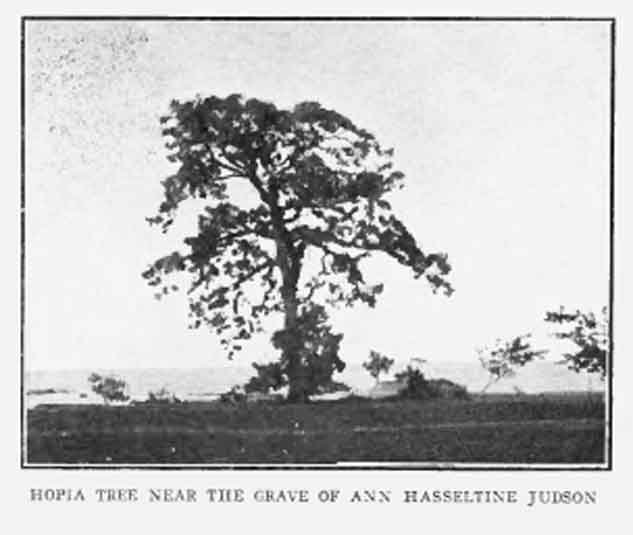
     Adoniram was shattered not only by her death, but by the knowledge he had not been able to support her at that time. Shortly thereafter, Maria also died.  Adoniram was left quite alone, and later wrote with the sad news to Ann’s mother telling her of the burial of his daughter: “The next morning we made her last bed in the small enclosure that surrounds her mother’s lonely grave. Together they rest in hope, under the hope tree, which stands at the head of the graves, and together, I trust, their spirits are rejoicing after a short separation of precisely six months. And I am left alone in the wide world. My own dear family I have buried; one in Rangoon, and two in Amhurst. What remains for me but to hold myself in readiness to follow the dear departed to that blessed world, “Where my best friends, my kindred dwell, Where God my Saviour reigns.” Adoniram was so grief-stricken at his loss that he suffered complete emotional breakdown.
     Ann Hasseltine Judson was converted at 17 during what has come to be called, "The Second Great Awakening."  She was a deeply dedicated Christ-follower, as well as a gifted teacher, linguist, preacher and author. She was instrumental in establishing a Christian church in Burma which, though heavily persecuted, still thrives to this day.  She championed the cause of female education, starting a Burmese girl’s school and tirelessly petitioning Christian sponsorship for her girls during her medical furlough in the United States.  It is generally agreed had it not been for Ann’s sacrificial efforts and representations to the governing authorities, Adoniram would not have survived his time in the death prison. It has been said of her: “She was a woman who loved intensely, loved her husband, loved her children, loved the people of Burma, but above all, she loved her God.”

     When I think of Ann one verse comes to mind: "Many women do noble things, but you surpass them all... let her works bring her praise at the city gates" (Prov. 31:29 & 31).


     If you would like to read a more full account (this was my primary though not sole source for this post) you can click here:  


In His Service, Pastor Jeff

6.26.2018

Scripture-grounded Take on Suffering in Times of Trial and Difficulty

Greetings Friends!

     Today's "thought" is taken from the daily devotional, "Streams in the Desert" by L. B. Cowman.
     In it we find an interesting, refreshing, and Scripture-grounded take on suffering that I offer to you to encourage you and nurture hope in you in times of trial and difficulty.  This excerpt appears to be a group of thoughts on the redemptive nature of suffering taken from the writings of several different people -- only two of whose names she cites.  As I was reading it on June 19th it struck me as one I would want to share with you. So please, enjoy!


“Grain must be ground to make bread.”
Isaiah 28:28
     Many of us cannot be used to become food for the world’s hunger until we are broken in Christ’s hands. “Grain must be ground to make bread,” and being a blessing for Christ often requires sorrow on our part.  Yet even sorrow is not too great a price to pay for the privilege of touching other lives with Christ’s blessings.  The things that are most precious to us today are things that have come to us through tears and pain" (J. R. Miller).
     "God has made me bread for His chosen ones, and if it is necessary for me to be ground in the teeth of lions in order to feed His children, then blessed be the name of the Lord" (St. Ignatius).

     "To burn brightly we must first experience the flame. In other words, we cease to bless when we cease to bleed.”
     Poverty, hardship and misfortune have propelled many a life to moral heroism and spiritual greatness. Difficulties challenge our energy, and our perseverance, yet they bring the strongest qualities of the soul to life. It is the weights on the old grandfather clock that keep it going. And many a sailor has faced a strong headwind while using it to help him reach port. God has appointed opposition as an incentive to faith and holy service.

     The most illustrious characters of the Bible were bruised, broken, and ground into bread for the hungry.

     Abraham, because he endured affliction while remaining obedient, stood at the top of the class and found his diploma inscribed with the words, ’the father of the faithful.’

     Jacob, like wheat, suffered severe threshing and grinding.

     Joseph was bruised and beaten and had to go through Potiphar’s kitchen, and into Egypt’s prison, on his way to getting to the throne.

     Job was ground to powder like medicine, yet through his sufferings has helped untold millions find hope in their own.
     David was hunted like an animal through the mountains.  Bruised, weary, and footsore, he was ground into bread for the kingdom.

     Paul could never have been bread for Caesar’s household if he had not endured the bruising of being whipped and stoned. He was ground into fine flour for the royal family.

     Combat comes before victory.  If God has chosen special trials for you to endure, be assured that in His heart He has kept for you a special place. A soul that is sorely bruised is one God has chosen to use.”
     It is a somewhat interesting phenomena that the messages I share from the pulpit where I use illustrations from my own life (or from the lives of others) where I or they struggled with pain, hardship, or difficulty, are the ones people say they appreciate the most. Not ones where I speak of my victories, successes, or achievements, but those where I share my struggles with pain, difficulty or trials.  There is, it seems, something universally helpful, desired, and appreciated when people are transparent about struggles, which is not there when one speaks about their victories and successes.  This pattern is so pronounced in Scripture, and my own experience, that it has made me hesitant to ask God (as some do) to be "used in a mighty way."  For it seems that those who have endured the greatest suffering and struggle are the most likely to be used in such a fashion.
     If the immense popularity of the Book of Job, and the transforming power of the sufferings of Jesus tell us anything, they tell us people find one immense help from one who is a friend in suffering. It should assure us that if we as believers experience hardship, it's not because God is angry at us or punishing us, but because God is growing our faith and equipping us for useful service to others in His kingdom.

Living in the Grace of Jesus, Pastor Jeff


2.13.2018

Streams in the Desert

Greetings All!

     After three fruitful weeks of doing ministry with my wife Nancy in India, I am finally back!  Therefore I'd like to get back on schedule and pass on what I found to be an encouraging thought for your spiritual edification. It is taken from the devotional classic, "Streams in the Desert," by L. B. Cowman.  It struck me as a story (or analogy) containing much truth in regard to those difficult times in life when we cry out to God from the depth of our being and he seemingly remains silent, distant, or fails to respond to our cries.  May her words offer encouragement to your soul.  Enjoy.


"A Canaanite woman from that vicinity came to Jesus crying out, 'Lord, Son of David, have mercy on me!  My daughter is suffering terribly from demon-possession.' Jesus did not answer a word." Matthew 15:23


     "Are you reading these verses as a child of God who is experiencing a crushing sorrow; a bitter disappointment, or a heartbreaking blow from a totally unexpected place? Are you longing to hear your Master's voice calling you, saying, "Take courage!  It is I. Don't be afraid" (Matthew 14:27)?  Yet only silence, the unknown, and misery confront you -- "Jesus did not answer a word."
     God's tender heart must often ache listening to our sad, complaining cries. Our weak and often impatient hearts cry out because we fail to see through our tear-blinded eyes that it is for our sake that He does not answer at all, or that He answers in a way we believe is less than the best.   In fact, the silences of Jesus are as eloquent as His words and may be a sign, not of His disapproval, but of His approval and His way of providing a deeper blessing for you...
     Let me relate a beautiful old story of how one Christian dreamed she saw three other women in prayer. When they knelt the Master drew near to them. As He approached the first of the three, He bent over her with tenderness and grace. He smiled with radiant love and spoke to her in tones of pure, sweet music.  Upon leaving her, He came to the next, but only placed His hand upon her bowed head and gave her one look of loving approval. He passed the third woman almost abruptly, without stopping for a word or a glance. The woman having the dream said to herself, "How greatly He must love the first woman. The second gained His approval but did not experience the special demonstrations of love He gave the first. But the third woman must have grieved Him deeply, for He gave her no word at all, not even a passing look."
     She wondered what the third woman must have done to have been treated so differently. As she tried to account for the actions of her Lord, He Himself came and stood beside her. He said to her, "O Woman!  How wrongly you have interpreted my actions!  The first kneeling woman needs the full measure of my tenderness and care to keep her feet on My narrow way.  She is weak and needs My love, thoughts, and help every moment of the day, for without them she would stumble into failure. The second woman has stronger faith and deeper love than the first, and I can count on her to trust Me no matter how things may go or whatever people may do. Yet the third woman, whom I seemed not to notice, and even to neglect, has faith and love of the purest quality.  I am training her through quick and drastic ways for the highest and holiest service. She knows me so intimately, and trusts me so completely, that she no longer depends on my voice, loving glances, or other outward signs to know of my approval. She is not dismayed or discouraged by any circumstances I arrange for her to encounter. She trusts me when common sense, reason, and even every subtle instinct of the natural heart would rebel, knowing that I am preparing her for eternity, and realizing that the understanding of what I do will come later."
     "My love is silent because I love beyond the power of words to express it and beyond the understanding of the human heart. Also, it is silent for your sake -- that you may learn to love and trust me with pure, Spirit-taught, spontaneous responses.  I desire for your response to my love to be without prompting of anything external."  Learn, then, the mystery of His silence and praise Him every time He withdraws His gifts from you. Through this you will better know and love and trust the Giver."

     I must confess I have seen something of this truth actively played out in my life.  I am not by any means a giant in the faith, and have a long way to go (as those closest to me will affirm).  But I have often wondered why it is that when I first came to Christ I had far more intense, tangible, faith-building spiritual experiences where I tangibly sensed God's presence, witnessed startling answers to prayer, and received what could only be called profoundly clear guidance attested to by others and confirmed by God's grace in providentially bringing certain things to pass.
     Yet, as I grew in the Lord I noticed the number of them diminish significantly.  Initially (for the most part) God seemed to answer my cries more quickly, and in ways that seemed more tangible and dramatic, even stunning this newly born-again child on many occasions. But as I continued to walk with the Lord I found He was slower to "rescue" me from trials.  Rather, He started to let me weather them. Instead of the former hand of help offered quickly to usher me out of hardships, He left me to endure hardships, go through heartbreak, and walk through dark nights of the soul where my path led through valleys so deep it seemed to my impatient soul the darkness would never be dispelled by the light!
     And though at first it was very unsettling and sometimes frightful (feeling God had abandoned me), I soon realized that the spiritual life is in many ways like a parent teaching it's new child to walk.  At first you are there with arms outstretched ready to grab the wobbly-legged 9 or 10 month old at the slightest sign of them going down, often keeping a grip on their arm or shirt, or grabbing them before their diaper-lined rear end ever hits the ground!
     But at some point (out of love and a desire for them to learn and grow) you must let go of the shirt, pull back, and refrain from helping them.  As they grow you must let them learn to stand (and even fall) so as to realize the consequences of their actions and the need for wise choices and good decision-making. God does the same with us. As infant Christians he responds more quickly, and in more tangible ways, realizing how frail we are in the faith and how much help we need initially in order to make it past those first hurdles in our new life.  But imagine how absurd it would be to see a parent cautiously hovering over their six or eight year old in the same way, holding on to their shirt and ready to grab them before they ever fall.
     No, as a child grows into an adolescent and then into adulthood, the parent steps back further and further and gives more space, freedom, and responsibility.  Why would God, as the perfect parent, do any differently with us as we grow spiritually? 

In the Bonds of Christian Charity, Pastor Jeff

2.16.2016

Gateway to Joy

Greetings All,

     Today's "thought" is a tribute to an extraordinary woman of God who passed into glory June 15, 2015 - Elisabeth Elliot.


     She taught in many of the foreign missions classes I took at Gordon-Conwell Theological Seminary (1982-1986) where I majored in missions. And as a missionary herself, who endured many hardships, her thoughts were always extremely helpful.
  For some she is best known as "the wife of Jim Elliot" one of the five missionaries martyred on January 8th, 1956, in the jungles of Ecuador (two months after I was born)! They were attempting to contact and reach out to the remote Auca Indians with the Gospel.  Jim's well-known quote which guided his life was: "He is no fool who gives what he cannot keep to gain what he cannot lose."

     Yet those who know Elisabeth better know that her reputation does not hang on her husbands coattails. She had a significant ministry of her own, doing Bible translation into the Quechua language, and then going into the jungle to live for two years with the very Indians who killed her husband, taking her three year old daughter Valerie with her. It's a ministry chronicled in her book, "The Savage My Kinsman."
     After leaving Ecuador and returning to the States she became a sought after spokesperson for foreign missions.  One of the first books she authored was, "Through Gates of Splendor," the story of the five martyred missionaries. The documentary by the same name had a profound impact on me and fed my desire to be involved in missions.  In my opinion they should both be on the required reading and viewing list for every missionary candidate. The contemporary sequel, "The End of the Spear" is extremely informative and challenging as well.

Elisabeth has written many other books, including the classic biographical work, "A Chance to Die" -- about the great missionary to India, Amy Carmichael -- one of her childhood hero's. Carmichael rescued, and then started a home for young Hindu girls who had been forced into temple prostitution.
     Elliot also wrote Shadow of the AlmightyKeep a Quiet Heart, Passion for Purity, Quest for Love, A Path Through Suffering, Be Still My Soul, These Strange Ashes, Gateway To Joy, and about 20 others!  She is now in the presence of the One she spent her life serving, but her legacy here will continue through the many who heard her speak, and will continue to read her many books. This particular excerpt comes from, "Gateway to Joy."  Enjoy!

One of the "Gateways to Joy" -- COMMIT TO SERVICE 

     "There has been a tendency to think of service to God as necessarily entailing physical hardship and sacrifice. Although this is not really a scriptural idea, it has gained wide acceptance.  It is easy to recall the saints who climbed the steep ascent of heaven through peril. But the Bible also makes mention of Dorcas, whose service to God was the making of coats...
     When I lived in the Auca settlement (deep in the Ecuadorean jungle)... some correspondents envied me, some pitied me. Some admired, some criticized. I could not help asking myself if perhaps I had been mistaken. Was I really obeying God, or had I merely obeyed some misguided impulse, some lust for distinction, some masochistic urge to bury myself in the forsaken place?  There was no way of being sure what was in the murky reaches of my subconscious, but I was sure I had committed myself to God for His service, and I knew no other motivation.
     The opinions of others -- whether they commended or condemned -- could not alter my duty.  But their very diversity caused me to ponder carefully what that duty was...  My duty was one thing, theirs another.  My responsibility lay there, but the responsibility of some of my correspondents (who gazed starry-eyed at my role) lay perhaps in an office, or a kitchen, or the cockpit of an airplane.  The commitment to wholehearted service in obedience to God looks different for everyone. 
COMMIT AT ANY COST...

     When I was sixteen years old I copied in the back of my Bible a prayer of missionary Betty Scott Stam, whose visit in our home when I was very small (living in Brussels, Belgium, with my missionary parents) had made such a deep impression on me.  Her prayer:
"Lord, I give up all my own plans and purposes, all my own desires and hopes, and accept Your will for my life. I give myself, my life, my all, utterly to You, to be Yours forever.  Fill me and seal me with Your Holy Spirit.  Use me as You will, send me where You will, work out Your whole will in my life at any cost, now and forever." 
     The cost, for her, was quite literally her life only a few years after she had prayed that prayer.  Betty was martyred in China in 1934." 

       Some of you may have prayed similar prayers -- yet your commitment to service and obedience has looked much different. 
    God is not into making clones. He is putting together a body that is made up of many different parts with many varied gifts. And therefore, what may be obedience for one would be disobedience for another.  The path one is called to trod is not the same path we are all called to follow.  His plan for the ages sends people down a plethora of varied paths - some rough and some much smoother. The key, or the gateway to joy, though, remains the same for all -- commitment at any cost to do His unique will for your life.
       Hopefully we can all pray, with earnest and transparent hearts:
"Lord, I give up all my own plans and purposes, all my own desires and hopes, and accept Your will for my life. I give myself, my life, my all, utterly to You, to be Yours forever. Fill me and seal me with Your Holy Spirit. Use me as You will, send me where You will, work out Your whole will in my life at any cost, now and forever." 
     Two women prayed the same prayer. One was led to China where she was martyred for the faith.  The other ended up losing her husband, living in the jungles of Ecuador for a time, and then spent her later years speaking, writing, teaching, and doing a weekly broadcast north of Boston, Massachusetts. For others it may be a career, parenthood, fidelity in marriage, service in the local church, a neighborhood outreach, helping at a homeless shelter, Hospice, some support group, or another form of obedient service.  The, "as You will... where You will," is up to God and looks different for all.  Yet the call to commit, or, "give ourselves, our lives, and our all, utterly to God, to be His forever" -- that is the same for every believer. Offer Him that and you will find your place in His plan.
With Prayers for a Surrendered Heart, Pastor Jeff 

3.09.2015

Finish Strong

Greetings All,

     This week's 'thought' comes to you from a book entitled, "Finish Strong" by Dan Green.
     It is a book of true stories about people who have overcome immense obstacles, through faith, and have "finished strong."  I found this entry particularly inspiring. I offer it to you with the hope that it might inspire you in the same way.  Enjoy.


A Spirit Forged in Steel

     "On June 23, 1940, Wilma Glodean Rudolph was born prematurely, weighing only four and a half pounds. Wilma was the twentieth of Ed and Blanche Rudolph's twenty-two children. The Rudolph's were African Americans living in a time of segregation. Since the local hospital was for whites only, and since the Rudolph's had little money, Mrs. Rudolph was forced to care for Wilma herself. The early years were rough. Wilma's mother nursed her through one illness after another -- measles, mumps, scarlet fever, chicken pox, and double pneumonia.
     A few years after Wilma's birth, her parents discovered that her left leg and foot were not developing normally and, consequently, were becoming deformed. Doctors told Blanche that Wilma had polio, and that she would have to wear steel braces on her legs. Refusing to accept this diagnosis, Mrs. Rudolph set out to find a cure. She discovered that Wilma could receive treatment at Meharry Hospital in Nashville.
     The Rudolphs also relied on their faith in God, the Great Physician. When young Wilma would ask if she would ever walk, her parents pointed her to her good God: "Honey, you only have to believe. You have to trust in God because with God all things are possible" (Luke 1:37).
     For the next two years, Mrs. Rudolph drove Wilma fifty miles each way to physical therapy appointments. Eventually, the hospital staff taught Mrs. Rudolph how to do the exercises at home. Everyone in the family worked with Wilma, providing her with encouragement to be strong and get better. Thanks to the patience, support, effort, and the love she received from her family, at the age of twelve Wilma could walk normally without the assistance of crutches, braces, or corrective shoes.
     Having spent a great deal of her life limited by illnesses, Wilma felt a freedom she had never felt before. It was then that Wilma decided to become an athlete. She chose to pursue basketball first, just as her older sister had. For three years she rode the bench, not playing in a single game.  But Wilma's spirit had been forged of steel, and she continued to practice hard, refusing to give up. In her sophomore year she became the starting guard for the team and subsequently led the team to a state championship.
     But Wilma's first love was running. At the age of sixteen (barely four years free of braces) Wilma participated in track at the 1956 Olympics and won a bronze medal in the 4 x 100 meter relay. However, it was at the state basketball tournament that she was first spotted by Ed Temple, the coach for the women's track team at Tennessee State University. Ed recruited Wilma on a track scholarship and changed the course of her athletic pursuits.
     Wilma's most famous athletic accomplishments happened during the 1960 Olympic Games in Rome. The little girl who could hardly walk without the assistance of crutches or braces had completely overcome her physical limitations. At the age of 20, she became the first American woman to win three gold medals in a single Olympics. (The 100 meter dash in 11.0 seconds, the 200 meter dash in 24.0 seconds, and the 4 x 100 Relay in 44.5 seconds.)"
     Sometimes it helps us in our own struggles to hear the stories of people who had to endure great hardships and overcome great obstacles, by faith, and with the inner strength and determination God provides. Many times we become too quickly discouraged. We give up too easily. We don't persevere and fight on until victory comes.
     A high school student in Honduras once said the following quotes inspired him. I do not know his name, but I'm sure he has pressed on! The first, by Don Juan, states: "The basic difference between an ordinary man and a warrior is that a warrior takes everything as a challenge, while the ordinary man takes everything as either a blessing or a curse."
     The second, by Ralph Parlette, says: "Strength and struggle go together. The supreme reward of struggle is strength. Life is a battle and the greatest joy is to overcome. The pursuit of easy things make men weak. It is following the lines of least resistance that makes rivers and men crooked."
     In the Christian life it's not about pulling ourselves up by our bootstraps. It's about looking in faith to 'God our Helper' (Psalm 118:7) for that which is necessary to overcome the many obstacles in life.  Sometimes He graciously does miraculous things for us.  But more often what He gives us is increased strength and resolve and determination to press on. After all, were He to do everything for us all the time, He would do us a great disservice by robbing us of the life lessons learned through perseverance, struggle and hardships overcome.
Blessings upon your day, Pastor Jeff

8.21.2013

The Gospel Driven Life

Greetings All,

     Today's 'thought' comes to you from Michael Horton and is found in his book, "The Gospel Driven Life."
     It speaks of the dangers of following Jesus in a society where one can not only live out their faith unafraid of being persecuted for it, but even prosper off it, or make a successful business out of it. His insights into this problem are worthy of our consideration, and may serve as a needed wake-up call, or call for repentance. Enjoy.


The Cross Isn't an Accessory 
     "After calling his disciples, Jesus prepared them for the journey ahead of them, beyond his own cross-bearing and resurrection (Matthew 10). They too will bear their cross, suffering not for sin, but for their testimony to the sin-bearer. Persecution will come; even parents and siblings will hand over their family members to the authorities (vv. 16-24)... 
     Immediately after his ascension the dominoes started to fall. Some caved in, renouncing Christ, while others persevered. Peter, who denied Christ three times, ended up being crucified upside down, because he did not consider himself worthy to be executed in the same manner as his Savior.
     So what does this mean: 'Whoever finds his life will lose it, and whoever loses his life for my sake will find it?'  The context, of course, is the imminent persecution of the disciples and indeed the wider church. Those who cling to their life as it is will never receive eternal life. The securities of this fleeting lifespan pale in comparison with the riches of the inheritance that the saints have in Christ.
     Such passages speak directly to suffering brothers and sisters in China, India, Nigeria, and Saudi Arabia (and more recently Egypt), but what about the rest of us? We like to imagine sometimes that we too share in Christ's sufferings, but we do not suffer in the same way or to the same degree as the martyrs and the persecuted. The suffering that Jesus had in mind is not the general troubles that believers face in common with unbelievers, such as physical or financial hardships. It was suffering for their witness to Christ that Jesus has in mind. Yet precisely because we do not find ourselves threatened with death for the sake of the gospel, those of us in liberal democracies may be the ones who find it most difficult to accept Jesus exhortation.
     Like a cross that is worn around one's neck, Christ can become an accessory. Rather than being commanded at gunpoint to deny Christ, we are led by the devil out into the wilderness of consumerism, shopping for identities. Far from being harried and harassed, we are shown the kingdoms of this world that can be ours if we will just turn away from Golgotha.
     We don't have to become atheists. We do not even have to renounce Jesus Christ. In fact, we can sell everything from rock concerts to coffee mugs with Jesus as the trademark.
     
     All that is necessary is for us to cling to ourselves -- the securities, aspirations, felt needs, and relationships that define us and that we have chosen for ourselves -- rather than to God's saving love in Christ and the identity for which he has chosen us. Jesus' comment about losing our life to find it presses us to ask ourselves this question: "Do I define the Jesus story, or does it define me?' Is Jesus's significance objective and universal, which I am simply to acknowledge and embrace, or do I determine his significance in my own life?
     Paul tells believers, 'For you have died, and your life is hidden with Christ in God.'  This is more radical than anything that we could conceive. According to the gospel, 'I' don't exist anymore. Our self-identity is not a stable thing, but is defined by the story we tell -- or hear -- about ourselves. Of course the gospel does not obliterate my identity; it comes to save my nature, not destroy it. However, my nature in Adam is corrupt, in bondage to sin and death. Even in my moral striving I am decadent. Even in my craving for spiritual experience, I am an idolater. Another makeover or transformation will not change my identity. I must be crucified and buried with Christ, and raised with him in newness of life...
     The salvation that God promises in Christ requires my death. Here I am, cheerfully going about my daily affairs, picking and choosing the roles I would like to play from the advertisements, movies, and 'put-together' people I admire around me.  I may even find a role for Jesus, although who am I to say that others are wrong for finding someone or something else more helpful for achieving their goals in life?
     Then, along comes the gospel, telling me who I really am, telling me how this character I have written for myself is doomed.  God hands me a new script -- the Good News that I am no longer a child of Adam or stranger and alien to God's promises, but a child of God in Jesus and stranger and alien to the world's spin.
     I no longer can see God as existing to make me happy, to satisfy my felt needs, even to give me a sense of well-being and add a few suggestions to improve my life. He comes to kill me and make me alive. Repentance means I give up the script; I stop pretending that I can write the story of my life. Through faith in Christ, I become a character in God's story, part of the new creation."
     In our self-obsessed culture where we're led to believe that we are the center of our world and everything revolves around us, it's often hard to grasp how a message that predicts persecution for those who embrace it, tells us we must lose our life to find it, "requires our death," and tells us we can no longer see God as existing to make us happy or satisfy our felt-needs, could be called, "Good News"!
     It is indeed a paradox, though a liberating one, and one we will never experience until we, "give up the old script, and stop pretending that we can write the story of our lives."
     For most, the thought of moving from a self-centered life to a God-centered/Christ-centered life, is terribly frightening.  It seems so irrational -- at least when considered in light of earthly reasoning and worldly wisdom. It is one of those divine mysteries that one can only know; a truth that can only be discovered, when a person steps out in faith and experiences the gracious benefits of what it means to be, "crucified with Christ."
In His Service, Pastor Jeff