Visitors

free counters
Showing posts with label Obeying. Show all posts

7.09.2019

You Can't Take It With You

Greetings All,

     Today's "thought" is at the same time interesting, intriguing and convicting. It is a critique on our culture, and upon us at the same time.  It is worth reading simply because it's true, and the truth of it should make us do some inner reflection. It may even cause us to make some healthy changes or do some cleaning out. Above all it should make us consider what's important, reevaluate our priorities, and consider how we could better use our resources in a world with much so much need.
     It comes from John Ortberg's book (written with a somewhat satirical flair) "When The Game Is Over, It All Goes Back in the Box."   It is available in shortened form in, "You Can't Take It With You."  Enjoy.


Stuff, Stuff and More Stuff

     "We all have stuff. We see it, want it, buy it, display it, insure it, and compare it with other people's stuff.  We talk about whether or not they have too much stuff; we envy or pass judgment on other people's collections of stuff.  We collect our own little pile of stuff.  We imagine that if that pile got big enough, we would feel successful or secure. That's how you keep score in Monopoly, and that's how our culture generally keeps score as well. You get a large house, then you have to get stuff to put in it...
     There are now more than 30,000 self-storage facilities in the country offering over a billion square feet  for people to store their stuff. [That was in 2009 when the book was written. Today in 2019 it is estimated there are 52,000 and close to 2 billion square feet and growing!]  In the 1960's this industry did not exist. We now spend $12 billion a year [in 2018 it was $38 billion a year] just to pay someone to store our extra stuff!  It's larger than the music industry.  Psychologist Paul Pearsall comments on people finding it difficult to give their stuff away: "Many people can't bring themselves to get rid of any of their stuff. You may require a 'closet exorcist.'  A trusted friend can help prevent the 're-stuffing phenomena.'  Re-stuffing happens when, in the process of cleaning out closets and drawers, we are somehow stimulated to acquire new stuff..." 
     Some people have a gift for acquiring stuff. Not long ago I took my daughter to a place called Hearst Castle. William Randolph Hearst was a "stuffaholic."  He had 3,500-year-old Egyptian statues, medieval Flemish tapestries, and centuries-old hand-carved ceilings, and some of the greatest work of art of all time. Hearst built a house of 72,000 square feet to put his stuff in.  He acquired property for his house -- 265,000 acres. He originally owned 50 miles of California coastline.  He collected stuff for eighty-five years. Then you know what he did?  He died.  Now people go through Hearst's house by the thousands. They all say the same thing: "Wow, he sure had a lot of stuff."  People go through life, get stuff, and then they die -- leaving all their stuff behind.  What happens to it?  The kids argue over it. The kids -- who haven't died yet, who are really just pre-dead people -- go over to their parents house. They pick through their parents old stuff like vultures, deciding which stuff they want to take to their houses. They say to themselves, "Now this is my stuff."  Then they die and some new vultures come for it.
     People come and go. Nations go to war over stuff, families are split apart because of stuff.  Husbands and wives argue about stuff more than any other single issue. Prisons are full of street thugs and CEO's who committed crimes to acquire stuff.  [Some people will even kill others for their stuff.]  Why?  It's only stuff.  Houses and hotels are the crowning jewels in Monopoly. But the moment the game ends they go back in the box. So it is with all our stuff.  Christ said, "Do not store up for yourselves treasures on earth, where moth and rust destroy, and where thieves break in and steal.  But store up for yourselves treasures in heaven, where moth and rust do not destroy, and where thieves do not break in and steal. For where your treasure is, there your heart will be also" (Matthew 6:20).... 
     So Jesus says it is wise to store up treasure in what's eternal -- God and people.  To an adult, it's ironic when a two-year-old says, "Mine."  Adults know that two-year-olds don't earn any of their stuff.  It is all provided for them.  It is a gift from someone much larger and wiser than they.  They don't even generally take very good care of it.  Nevertheless, two-year-olds get extremely attached to their stuff.  If someone tries to take something, that item suddenly becomes their favorite stuff.  Two-year-olds can be so deluded, can't they?" 

     As Christians we need to pause every so often and consider where our values and priorities come from.  Do they come from Christ, or do we get them from our culture?  And if (or when) they are in conflict with each other, which takes precedence in dictating our actions and habits?  Do we heed the voice of culture over Christ, or the voice of Christ over culture?   Which do you personally follow and obey? 
     It is worth considering what Jesus would have to say about the thousands upon thousands of storage facilities in our country, and the billions upon billions of dollars spent just to store the excess stuff we don't use or have room for in our houses.  What might he say about that $38 billion spent each year simply storing excess stuff (an average of $88.00 per month per unit)?  Actually, Jesus already spoke quite clearly on that subject in Matthew 6:20.  So, we don't need to ask his opinion, we already know what that is.  So what we do need to ask him is what we should do about all our stuff in light of what he says. How should we respond?  Do we really need all the stuff we have?  How could the money spent storing it be better spent on "storing up treasures in heaven"? How could it be better used in the service of God's kingdom or relieving the plight of people who have so little?  In light of the Jesus we know from Scripture, it is at least worth asking.
     And I know that by now someone is probably thinking, "Don't get legalistic on us, Pastor Jeff."   I find that's a common response whenever what we believe or practice appears to be in conflict with what Jesus taught.  We pull out the"legalistic" card to try and shut down such questions or suggestions. Yet, isn't the goal of our lives to follow the teachings of Jesus more closely.  The Jesus who often turns the values of the world upside down.  And in this case, the Jesus who, if He did have stuff, had very little, since Scripture tells us he had no house (or storage unit) to store it in (Matthew 8:20, Luke 9:58).
     It is true that Scripture does not forbid us from owning things, and there is the ever-present need for housing and shelter and some of the things that make life in it functional. But it is at least worth asking, "At what point we violate Jesus' clear instruction not to 'store up for ourselves treasures on earth'"?
     Is it time to take a trip to the Salvation Army Thrift Shop? 
     Is there someone in real need who could use something we simply have stuffed away in our closet, attic, cellar, garage or storage unit?
     How can we turn an unused "earthly treasure" into a "treasure in heaven"?  Can we break free from it's hold on us and get rid of some stuff without re-stuffing? 
     
     I don't know about you, but I do know I need to unstuff some of my stuff without re-stuffing -- and bless someone else in the process.  And not just once, but as an ongoing habit, lest that stuff comes to have too much of a hold on me, and dictate my attitudes and choices more than the words of the One I have come to call my Lord.

Living in the Grace of Jesus, Pastor Jeff

10.04.2016

The Discipline of Grace

Greetings All!

Today's thought comes to you from Jerry Bridges and is found in his superb book, "The Discipline of Grace."
     What's the theme of the book?  How grace and the effort required to live a life of holiness are not incompatible. He shows how grace does not negate the need for effort, but actually empowers it and makes godly effort possible. Grace is not the need to do "nothing," but the God-implanted and God-sustained motivation and power to do what God would have us do! As Paul wrote in I Corinthians 15:10 where he compares himself to the other apostles: "By the grace of God I am what I am, and His grace to me was not without effect.  No, I worked harder than the all, yet not I but the grace of God that was with me."  Grace, Paul assures us, empowers and sustains effort.  It is undeserved power and divinely given assistance that enables us to do what God wills. It's an unearned and undeserved inner urge, compulsion, strength, and assistance which comes from God and apart from which "we can do nothing" (John 15:5). 
     If you don't have a copy of this book, or have not read it, you have missed out on a real gem.  For he clears up what is for many the seemingly unsolvable paradox between grace and effort, usually caused by a wrong understanding of grace, or the place of grace in the process of our growth in godliness.  The following excerpt is only one step in that process which he elaborates on in the rest of the book. Enjoy.


Good Day Bad Day

     "Grace and the personal discipline required to pursue holiness... are not opposed to one another. In fact, they go hand in hand. An understanding of how grace and personal, vigorous effort work together is essential for a life-long pursuit of holiness. Yet many believers do not understand what it means to live by grace in their daily lives, and they certainly don't understand the relationship of grace to personal discipline.
     Consider two radically different days in your own life. The first one is a good day for you spiritually. You get up promptly when your alarm goes off and you have a refreshing and profitable quiet time as read your Bible and pray... The second day is just the opposite. You don't get up when your alarm goes off. Instead, you shut it off and go back to sleep. When you finally awaken, it's too late to have quiet time. You hurriedly gulp down some breakfast and rush off to the days activities. You feel guilty about oversleeping and missing your quiet time, and things generally go wrong all day.  On the evening of both days you quite unexpectedly have an opportunity to share the gospel with someone who is really interested in receiving Christ as Savior. Would you enter those two witnessing opportunities with a different degree of confidence? Would you be less confident of the bad day than the good day? Would you find it difficult to believe that God would bless you and use you in the midst of a rather bad spiritual day?
     If you answered yes to any of those questions, you have lots of company among believers. I've described these two scenarios and asked audiences, "Would you respond differently?" Invariably about 80% indicate they would. They would be less confident of God's blessing while sharing Christ at the end of a bad day than they would after a good one. Is such thinking justified? Does God work that way? The answer to both questions is no, because God's blessing does not depend on our performance.  Why then do we think this way? It is because we believe that God's blessing on our lives is somehow conditioned on our spiritual performance. If we've performed well we assume we are in a position for God to bless us.  We know God's blessings come to us through Christ, but we also have this vague but very real notion that they are also conditioned on our behavior.  A friend used to think, "If I do certain things then I can get God to come through for me."  People who have a bad day tend to have no doubt in their minds that they have forfeited God's favor for a certain period of time, most likely until the next day... They think God would not use them to share the Gospel with someone on a "bad" day because, "they wouldn't be worthy." Such a reply reveals an all-too-common misconception of the Christian life: The thinking that although we are saved by grace, we earn of forfeit God's blessings in our daily lives by our performance.
     So what should we do when we've had a "bad" day spiritually, when it seems we've done everything wrong and are feeling guilty?  We must go back to the cross and see Jesus there bearing our sins in His own body (I Peter 2:24). We must by faith appropriate for ourselves the blood of Christ that will cleanse our guilty consciences (Hebrews 9:14).  We must remember that even when we have flagrantly and willfully sinned, Jesus bore the sins we've committed this day in His body on the cross. He suffered the punishment we deserve, so that we might experience the blessings He deserved.... I am not proposing a cavalier attitude toward sin. Rather, I am saying Christ is greater than our sin, even on our worst days. To experience that grace, however, I must lay hold of it by faith in Christ and His death on our behalf...
     Now let's go back to the "good" day scenario... Have you thereby earned God's blessing that day?  Will God be pleased to bless you because you've been good?  You are probably thinking, "Well, when you put it like that, the answer is no. But doesn't God work through clean vessels? To which I reply, "Let's assume that is true. How good do you have to be to be a clean vessel? How good is good enough?" ...
     Jesus said: "Love the Lord your God with all your heart and with all your soul and with all your mind... and your neighbor as yourself" (Matthew 22:37-39)... Have you perfectly kept those two commands (even on your best day)? And if not, does God grade on a curve? Is 90% a passing grade with God? We know the answers to those questions, don't we? Jesus said, "Be perfect as your heavenly Father is perfect."  And James wrote, "Whoever keeps the whole law but stumbles at just one point, is guilty of breaking it all" (James 2:10).
     The point of this good-day-bad-day scenario is this: Regardless of our performance, we are always dependent on God's grace, His undeserved favor to those who deserve His wrath. Some days we may be more acutely conscious of our sinfulness and hence more aware of our need of His grace, but there is never a day when we can stand before Him on the two feet of our own performance and be worthy enough to deserve His blessing. At the same time, the good news of the Gospel is that God's grace is available even on our worst days. That is because Christ Jesus fully satisfied the claims of God's justice and fully paid the penalty of a broken law when he died on the cross in our place. Because of that the apostle could write, "He forgave all our sins" (Colossians 2:13).
     Does the fact that God has forgiven us all our sins mean that He no longer cares whether we obey or disobey? Not at all. (Ephesians 4:30, Colossians 1:10)   He cares about our behavior and will discipline us when we refuse to repent of conscious sin. But God is no longer our Judge. Through Christ He is now our heavenly Father who disciplines us only out of love and only for our good.  If God's blessings were dependent on our performance they would be meager indeed. For even our best works are shot through with sin -- with varying degrees of impure motives and lots of imperfect performance.
     So here is an important spiritual principle that sums up what I've said so far: Your worst days are never so BAD that you are beyond the reach of God's grace. And your best days are never so GOOD that you are beyond the need of God's grace.  Every day of our Christian experience should be a day of relating to God on the basis of His grace alone. We are not only saved by grace, but we also live by grace every day. This grace comes through Christ, "through whom we have gained access by faith into this grace in which we now stand"  (Romans 5:2)." 

     It's another way of stating the truth I frequently tell believers to make sure they don't get it backwards: "In Christ we work FROM grace, not FOR grace."  And believe me, that should be the cause of much thanks and praise!
     Blessings on your day, whether you happen to be having a bad one where you need God's grace, or a good one where you also need God's grace, Pastor Jeff


5.20.2014

Fear

Greetings All,

     Today's 'thought' goes out to those who may be wrestling with fear.  Fear of inadequacy, fear of failure, fear of being vulnerable, and even the common fear of those in ministry -- the fear of letting God down or not doing things in a fashion worthy of His glory (as inappropriate as such thinking can in many cases be).
     This excerpt comes from Sheila Walsh and is found in the little gem of a book entitled, "The Desert Experience."


In it she is extremely open, honest, and transparent. And as is typical of her writings, they are saturated with grace-filled insights. I offer it to any who might be dealing with a fear of their own profound sense of inadequacy. Enjoy.

     "All I know is that I was slowly dying inside. I was lonely.  I was afraid. I was unbearably sad. What added to my hopelessness was the fact that I had no idea what was wrong with me. I loved God. I enjoyed serving Him. I believed He loved me.
     Some nights I would drive out of the gates of CBN and turn my car toward the ocean. I would park at the far end of the beach and get out and walk and walk for miles. I remember sitting on a sand dune, gripping my knees to my chest and groaning from a place too deep inside for me to understand. I decided that I was losing my mind.
     My father had died in his thirties in a bleak psychiatric hospital in Scotland. The legacy seemed to be imprinted on my soul, "Like father, like daughter."
     I remember sitting in Pat Robertson's office asking for a leave of absence, telling him that I had been accepted as a patient in a psychiatric unit in a hospital in Washington, D.C.  I was filled with the shame that is particular to those who struggle with mental illness...
     My greatest fear growing up was that I would end up in a place like my father. What I did not know then was that God had planned to deliver me from myself in the ruins of my life. I did not understand then that some of God's most precious gifts come in boxes that make your hands bleed when you open them. Inside is what you have been longing for all your life. Only His love could do that. Only God would do that. Only His love is as fierce and relentless as our deepest pain, our unspoken fears. We become accustomed to simply surviving. God wants more...
     There are doors in our lives we have locked so tight, we are convinced that if we were to open them we would be consumed by what is inside. We would be left alone. But that's the whole, glorious point: We are not alone. I discovered that on that rainy night in October of 1992 when I checked into the hospital. I thought I checked in alone. I wanted to check in alone. But Christ checked in with me. He sat with me, all night, on the floor....
     As the days turned into a week, then two weeks, what I discovered was a group of people very much like myself. They were people who loved God but didn't have all the answers. They were people who were struggling to come to terms with their humanity lived out in imperfect obedience. A pastor who had nothing left to say to his people. A teacher who had lost hope in the future, whose futility had rendered her impotent to give anything at all to her students.  A young girl whose only perceived area of control was to starve herself; the success of her rebellion was killing her. And me... as deep as the marrow of my bones I felt unloved and unlovable... Was I so afraid of my 'not good enoughness' that I kept God's perfect love standing as the front door? It would have been easier if I'd had some terrible sin to confess, what we consider with our skewed human sight to be one of the 'big ones.' But all I had was me and a sense that I was not enough.
     And I was right.
     That was the bad news and the good news rolled into one spectacular gift. I wasn't enough. Even in all my supposed best moments I wasn't enough and never would be. But that's the point. Christ is enough. He loved me completely, shadows and all.
     That hit me one morning as I sat with several of the patients and nurses in a small church. It wasn't a remarkable service or a particularly new sermon topic, but I was raw and open; my defenses were down. And deep in my soul I heard and I believed: 'You are loved. You are loved. You are loved.' I wept the exhausted tears of one who had been wandering alone in the desert for years and finally catches sight of the way home. There was no quick fix or dramatic rescue, just the relief of finding Christ, the Way...
     I had based most of my Christian life on all the things I could do for God. Now I had nothing. I was empty-handed. I was like a newborn child learning how to live. I was living a divine paradox. I had never felt less worthy and yet more loved. I had never been so disenfranchised yet more welcomed by the Father. I began to realize I had spent most of my life trying to make God glad He chose me. I had run myself into the ground because I wanted to be invaluable. Now there was nothing good left to say about myself, and even if there had been I was too tired to say it.
     There seems to be something that the desert experience alone can gift us with. Perhaps it's because there are no distractions. Perhaps it's the very aloneness, the silence, that makes us finally listen to all the rumblings in our souls. Now I think 'How kind of God to let all my greatest fears happen rather than simply to remove them.' I longed for a rescue; He gave me a relationship. I wanted deliverance; He gave me companionship in the ruins. If He had simply removed my fears I would have lived the rest of my life dreading their return. To let them happen and sit with me, bloodied and bruised, was the most precious gift of love...
     A girl was sitting on a bus reading [a book which included a chapter on grace]. The man beside her asked: 'What's grace.'  'I don't know. I haven't gotten that far.'  That was me. I knew it was in the book, I just hadn't gotten to it yet. Grace is impossible to grasp outside of the framework of the love of God. It makes no sense. It's as Lewis Smedes described in his book 'Shame and Grace' -- 'The gift of being declared worthy before we become worthy.'  What a gift, but how contrary to how we live our lives in this world, in the church, where proving yourself is everything. 
     At the moment I began to grasp hold of grace, I was as the prodigal son with his well-rehearsed speech drowned out by the love of his father. There is no quid pro quo with God. We have nothing to give, nothing to barter with. He has and is everything. I now believe that God delights to use those of us who have had our hearts and wills broken in the desert... The desert leaves you with the absolute conviction that there is nothing you can do to make God love you and nothing you can do to negate that love. You are left with the liberating awareness that all we are in our best moments are earthen vessels to contain the grace and glory of God."
     She shares much more, and its all very good and helpful, but if you desire to read that you will need to pick up a copy of the book, which also includes stories by other well-known Christians who have gone through difficult times in the 'desert' (J. I. Packer, John Trent, Charles Stanley, John Maxwell, Jill Briscoe, etc.).
     I will end with one last quote from Shelia that I also have found true in ministry. It is worth much consideration in itself: "The amazing thing was that my brokenness was far greater bridge to others than my apparent wholeness had ever been." How true. How true. 
In the Grip of His Grace, Pastor Jeff

5.07.2014

Total Forgiveness

Greetings All,

     This week's 'thought' has to do with forgiveness - total forgiveness. In fact, that's the title of the book it is taken from: "Total Forgiveness" by R. T. Kendall. He is the pastor who took over at London's Westminster Chapel after Dr. Martyn Lloyd-Jones passed.
     There are few things more important to our ongoing spiritual health and growth than obedience to Jesus command to forgive (Matt. 6:14-15 / 18:21-35). That's why He places such a heavy stress on it. There is little that will poison the soul more than the root of bitterness that finds its source in our refusal to forgive -- and all the more when we fertilize it by convincing ourselves it's ok if we don't.
     The root of bitterness we often permit to grow (because it gives us a sense of power over the perpetrator) will choke out our ability to love, experience joy, have inner peace and rest of soul, pray with a clear conscience before God, or come to God with confidence, and so forth.
     In this sense Kendall's book is a good read for most and a must read for some. This section is on forgiveness as an "Inner Condition of the Heart."  Enjoy.

     "Total forgiveness must take place in the heart or it is worthless, for 'out of the overflow of the heart the mouth speaks' (Matt. 12:34). If we have not truly forgiven those who hurt us in our hearts, it will come out -- sooner or later.  But if it has indeed taken place in the heart, our words will show it. When there is bitterness, it will eventually manifest itself; when there is love, 'there is nothing in (that person) to make him stumble' (I John 2:10).
     This is why reconciliation is not essential for total forgiveness. If forgiveness truly takes place in the heart, one does not need to know whether one's enemy will reconcile. If I have forgiven him in my heart of hearts, but he still doesn't speak to me, I can still have inner victory. It may be far easier to forgive when we know that those who maligned or betrayed us are sorry for what they did, but if I must have this knowledge before I can forgive, I may never have the victory over bitterness. Those who believe that they are not required to forgive unless their offender has first repented are not following Jesus example on the cross.

Jesus said, 'Father forgive them, for they
            do not know what they are doing.' And
            they divided up his clothes by casting lots.'
                                                      Luke 23:34

     If Jesus had waited until His enemies felt some guilt or shame for their words and actions, He would never have forgiven them.
     It is my experience that most people we must forgive do not believe they have done anything wrong at all, or if they know that they did something wrong, they believe it was justified. I would even go as far as to say that at least 90 percent of all the people I've ever had to forgive would be indignant at the thought that they had done something wrong. If you gave them a lie-detector test, they would honestly say that they had done nothing wrong -- and they would pass with flying colors.
     Total forgiveness, therefore, must take place in the heart. If I have a genuine heart experience, I will not be devastated if there is no reconciliation. If those who hurt me don't want to continue a relationship with me, it isn't my problem, because I have forgiven them. This is also why a person can achieve inner peace even when forgiving someone who has died. The apostle John wrote, 'Dear friends, if our hearts do not condemn us, we have confidence before God' (I John 3:21).
     Confidence toward God is ultimately what total forgiveness is all about; He is the One I want to please at the end of the day. He cares and knows whether I have truly and totally forgiven, and when I know I have His love and approval, I am one very happy and contented servant of Christ... Relinquishing bitterness (an excessive desire for vengeance that comes from deep resentment, and heads up the list of things that grieve the Spirit of God - Eph. 4:30ff) is an open invitation for the Holy Spirit to give you His peace, His joy, and the knowledge of His will... How can we be sure there is no bitterness in our hearts? Bitterness is gone when there is no desire to get even with or punish the offender, when I do or say nothing that would hurt his reputation or future, and when I truly wish him well in all he seeks to do."

     Hard?  Yes. It goes without saying -- especially when it has to do with such things as rape, incest, abuse, betrayal, or having been used and then tossed aside like a worthless toy -- and even more so for a parent when it happens to one of our children. In such cases there is probably no more difficult thing in this world to do than to forgive -- truly and totally forgive. 
     Yet it must be done. Not so much for the perpetrator (who may never repent or admit wrongdoing) but for us, our conscience, and the sake of our relational intimacy with God. For at its root, all bitterness involves some degree of bitterness toward the all-knowing, all-powerful, sovereign God who could have prevented our pain but chose not (another section he deals with is the need to forgive God, odd as that may sound).
     As one person once put it, "Refusing to forgive is like drinking poison and expecting the other person to die." It only hurts us.  Therefore, as hard as some cases of forgiveness are (and some will drive the victim to the brink) -- since it is commanded by God, He will give us the grace to do it. As with all things in the Christian life, God doesn't ask us to do it alone in our own strength and power. He offers His grace to empower and enable us -- the only thing that makes true and total heart-forgiveness possible in many cases.
In His Service, Pastor Jeff
2.26.2014

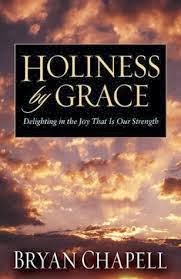
Holiness by Grace

Greetings All,

     This week's 'thought' comes to you from Bryan Chapell.  It is found in his superb book entitled: Holiness by Grace. This book (in my opinion) is a must read for all who are looking for good, solid, practical, Gospel-centered advice on how to grow in godliness. I have left out some sections to make this entry shorter -- merely hoping to whet your appetite for more!  Enjoy.

     "Early in my ministry I didn't recognize how damaging it is to threaten people with God's judgment (or my disapproval) as the primary means for motivating Christian obedience. I used lots of this kind of guilt as a pastor. And I saw people's behavior change... for a while. Still, I often discovered later that he people who did change simply because I had made them feel guilty did not mature. Those whom I pressured with guilt did not grow in faith nor seem more spiritually whole even though their outward actions may have changed.
     For instance, I might deal with a married couple whose relationship was coming apart because they were not being faithful to each other.  I would tell them that if they changed their behaviors God would bless them, but as long as they pursued sinful relationships they could not expect him to love them. With this threatening advice, such a couple might very well cease their immoral activities, but I would later see that their abandonment of the immorality did not necessarily better their lives spiritually. A year of two down the road these same people were often locked into depression, pursuing other addictive behaviors, or were simply disinterested in godly priorities. 
     It took me a few years (we preachers can be notoriously dense), but finally I figured out what was happening. I was telling people that the way to get rid of guilt before God, and assure his blessing, was to change their behaviors. But what did this imply?  If people expect behavior change to get rid of their guilt, then whom are they trusting to take away their guilt?  Themselves!...  I was encouraging people to look to themselves rather than to the cross as the place for guilt's erasure.
     Only Christ can remove the guilt of our sin. By letting people think that what they did made them right with God, I was driving a wedge of human works between them and God. The people who listened to me, though they may have changed some aspect of their lives to get my approval, or secure God's affection, were actually further away from God spiritually than when I began to 'minister' to them. When mercy got out of view, grace went away and a works-righteousness jumped into its place before I even knew it.  My words were making people try to become acceptable to God by being good enough... I was teaching that if people just did things right, they could make things right with God. How foolish was my instruction.
     The Bible says that when we have done all we can do, we are still unworthy servants (Luke 17:10), and our best works are only filthy rags to God (Is. 64:6). I was teaching people that if they just offered God more filthy rags he would favor them more, or smile more, or love them more. What an eccentric and cruel God I painted for them!
     I denied people grace by teaching them that God's love was dependent on their goodness. It was I who had made them intolerant of less mature believers. By listening to me, they had to gauge their holiness by their works. And what better way is there to confirm your own righteousness than by finding fault in others!...
     We should know from our own family experiences how unproductive is obedience motivated by guilt. What happens to a child who obeys only out of fear of parental rejection -- a child who stays good to stay loved? He may obey when he is young, but he is scarred for life. Because such parental love is never more certain than the child's actions, acceptance is always in doubt. As a result, the child grows up calloused or weakened -- hating his parents and doubting himself.
     Many of us know these truths very well because we were manipulated by guilt as children and we may still bear the scars.  We hate what makes us feel guilt to gain favor... We cannot offer loving service to a God who loves us only when we are good.
     If God's love is conditional, if he is only waiting to get us if we step out of line, if avoidance of his rejection, or relief of our guilt is our reason for serving him, then we may obey him for a time, but we will not like him very much....
     Paul exhorts us to keep mercy in view because grace alone will keep us serving the Lord. If we try to compensate for the guilt that only Christ can remove, then we will lose the capacity to love him and to serve him rightly. God doesn't want us to punish ourselves to erase our guilt. He punished his Son to cancel our guilt. God will not build his kingdom on our pain, because he is building it on his mercy."

     One of the most spiritually hurtful ideas (and it's common in the Church) is the idea that by our efforts, or by greater efforts, we can "purchase" more of God's love.  That by repenting, reforming, or performing better we can earn more of His love (at least until we mess up the next time).
     Yet, though it is the cause of much striving and effort in church circles, it would do us good to pause and then counter such un-Gospel-like notions by remembering and believing the Gospel truth that in the economy of grace there is no place for merit (Luke 17:10). That we can never obtain even the smallest fraction more of God's love than what Christ both displayed, and irrevocably secured for us, when He went to the cross to pay the sin-debt for all our innumerable transgressions.
     We do well to remember the love of God is given, not earned. It's a gift of grace, not pay for increased effort or attempts at greater moral renovation. It isn't ours if we "fix" ourselves, it was there long(!) before we ever even come to the conclusion we were in dire need of fixing!
     We work FROM grace, not FOR grace.  We stand in grace, we don't have to strive for it. By faith we discover ourselves to have been the undeserving objects of a free love, not hired hands called to make ourselves worthy of a conditional love.
In the Service of the Gospel, Pastor Jeff

2.18.2014

Faith In Future Grace vs. Lust

Greetings All,

     This week's 'thought' has to do with a struggle most all men wrestle with (every one I've ever known anyway) -- lust.  And in particular, sexual lust. It comes to you from John Piper in his book, "Future Grace."  If you (or someone you know) is looking for help in the fight for purity, this excerpt offers some solid, relevant, helpful truth on how to gain victory over lust.
     So, if that's what you want (and if you struggle with it you should!), I encourage you to read on.  Enjoy. 

Faith In Future Grace vs. Lust
     "Suppose I am tempted to lust. Some sexual image comes into my mind and beckons me to pursue it. The way this temptation gets its power is by persuading me to believe that I will be happier if I follow it. The power of all temptation is the prospect that it will make me happier. No one sins out of a sense of duty. We embrace sin because it promises, at least in the short run, things will be more pleasant. 
     So what should I do?  Some people would say, 'Remember God's command to be holy (I Peter 1:16), and exercise your will to obey because he is God!' But something crucial is missing from this advice, namely, faith in future grace. A lot of people who strive for moral improvement cannot say, 'The life I live I live by faith' (Gal. 2:20). They strive for the purity of love, but don't realize that such love is the fruit of faith in future grace...
     When faith has the upper hand in my heart, I am satisfied with Christ and his promises. This is what Jesus meant when he said, 'Whoever believes in me shall never thirst' (John 6:35). When my thirst for joy and meaning and passion are satisfied by the presence and promises of Christ, the power of sin is broken. We do not yield to the offer of sandwich meat when we can smell the steak sizzling on the grill.
     The fight of faith is to stay satisfied with God. 'By faith Moses... [forsook] the fleeting pleasures of sin...for he was looking to the reward' (Heb. 11:24-26). Faith is not content with 'fleeting pleasures.'  It is ravenous for joy. And the Word of God says, 'In your presence there is fullness of joy; at your right hand are pleasures forever more.' (Ps. 16:11). So faith will not be sidetracked into sin. It will not give up so easily in its quest for maximum joy.
     The role of God's Word is to feed faith's appetite. And, in doing this, it weans my heart away from the deceptive taste of lust. At first, lust begins to trick me into feeling that I would really miss out on some great satisfaction if I followed the path of purity.  But then I take up the sword of the Spirit and begin to fight. I read that it is better to gouge out my eye than to lust. I read that if I think about things that are pure and lovely and excellent, the peace of God will be with me (Phil. 4:8). I read that setting the mind on the flesh brings death, but setting the mind on the Spirit brings life and peace (Rom. 8:6). I read that lust wages war against my soul (I Pet. 2:11), and that the pleasures of this life choke out the life of the Spirit (Luke 8:14). But best of all, I read that God withholds no good thing from those who walk uprightly (Ps. 84:11), and that the pure in heart will see God (Matt. 5:8).
     As I pray for my faith to be satisfied with God's life and peace, the sword of the Spirit carves the sugar coating off the poison of lust. I see it for what it is. And by the grace of God, its alluring power is broken. I wield the sword of the Spirit against the sin of lust by believing the promise of God more than I believe the promise of lust. My faith is not only a backward-looking belief in the death of Jesus, but a forward-looking belief in the promises of Jesus. It's not only being sure of what he did do, but also being satisfied with what he will do -- indeed, it is being satisfied with what he will do precisely because of what he did do (Rom. 8:32). 
     It is this Spirit-given superior satisfaction in future grace that breaks the power of lust. With all eternity hanging in the balance, we fight the fight of faith. Our chief enemy is the lie that says sin will make our future happier. Our chief weapon is the truth that says God will make our future happier. And faith is the victory that overcomes the lie, because faith is satisfied with God."
     As one can see from this selection the Bible's way of fighting sin is with faith, not with more willpower or legalistic restrictions. It is victory found in a return to believing. Believing God's promise rather than Satan's lie.
     In a fascinating little book I just read yesterday, it asks (regarding Hitler's attempted extermination of the Jews in the death camps across Europe): "How Do You Kill 11 Million People?"  (That's also the book's title.)  And what's the answer: "You lie to them."  As he shows in a fairly convincing way, you can get anybody to do almost anything if you can get them to believe a lie.  Tell them that what they do believe (have believed) is wrong, what they need to believe is what you are selling, and then make the lie you are selling as convincing as possible.  Say it with as much earnestness and charisma as you can (the non-biblical kind). That's Satan's ploy.
     Yet faith holds on to the truth -- refusing to believe the lie while also clinging to the firm promises of God. Faith exposes the lie to the soul before we are led in temptation to comply with it.
     The lie: Giving in to lust will fulfill your immediate bodily/fleshly craving for pleasure and therefore make you happy.  The truth: The pleasures of sin last only for a short time and result in death, but Christ offers joy, hope, inner peace, rest of soul, an undefiled conscience, fulfillment, delight, satisfaction, and in the future -- eternal pleasures at God's right hand. And the means of overcoming: Faith -- but especially faith in God's promise of future grace.
Blessings in the battle to believe, Pastor Jeff