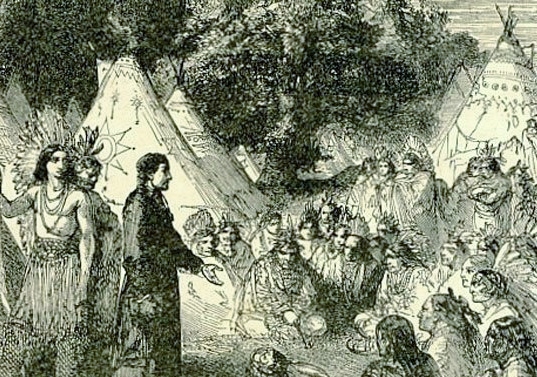
I had a breakfast with a few friends today and the name David Brainerd came up. It led me to think of offering you some thoughts regarding his missionary activity among the Indians in eastern Pennsylvania and New Jersey between June 1744 through June of 1745. He ministered near the Susquehanna, the Forks of the Delaware River, and in Crossweeksung, before succumbing to tuberculosis, riding his horse from there to Massachusetts, and then passing away in the home of Jonathan Edwards at the young age of 29.
 Brainerd was born in
Haddam, Connecticut, on April 20, 1718. His father died when he was nine, and
his mother when he was 14 -- leaving him (his four brothers and four sisters)
orphaned. In July of 1739 (at the age of 21), he was so overcome by the
sense of God's wrath against his sins, and the imperfection in all his
religious duties, that it drove him to seek -- by faith in Christ alone
-- "that way of salvation
that is entirely by the righteousness of Christ."
Brainerd was born in
Haddam, Connecticut, on April 20, 1718. His father died when he was nine, and
his mother when he was 14 -- leaving him (his four brothers and four sisters)
orphaned. In July of 1739 (at the age of 21), he was so overcome by the
sense of God's wrath against his sins, and the imperfection in all his
religious duties, that it drove him to seek -- by faith in Christ alone
-- "that way of salvation
that is entirely by the righteousness of Christ." He started at Yale College in New Haven in September of that year, studying to enter the pastorate. Though he was at the top of his class, and likely to be the valedictorian that next year at graduation, he was casually asked by two friends what he thought of one particular professor (Mr. Whittelsey). He answered that he had no more grace (in him) than the chair he was sitting in. Another student, who happened to overhear his remark, told the faculty and Brainerd was dismissed from the college or ever returning. It would be hard to describe the shame and brokenness of spirit this caused Brainerd -- since without a degree from Harvard or Yale, or a European college, one could not gain a pulpit in New England.
Yet, by the providence of God, this led Brainerd to his short but impactful life's work among the Indians. Due to the severe conditions of working outside, and traveling with the Indians, he succumbed to tuberculosis and died in 1747. Jeshua Edwards (Jonathan Edwards 17 year old daughter) fell in love with him as she nursed him during the last six months of his life in their house. In the last week of his life he told her: "If I had thought that I should not see you, and be happy with you in another world, I could not bear to part with you..." She herself contracted tuberculosis from him and died the next winter at the age of 18.

 The excerpts that follow
are taken from his journal and diary which were never intended to be public, or
published.They were discovered by Edwards after he died, who after editing out
some of the more personal content published them under the title: "The
Life and Diary of David Brainerd." It was one of the volumes
which William Carey read that inspired him to pursue foreign missions. My son
David is named after him. Enjoy.
The excerpts that follow
are taken from his journal and diary which were never intended to be public, or
published.They were discovered by Edwards after he died, who after editing out
some of the more personal content published them under the title: "The
Life and Diary of David Brainerd." It was one of the volumes
which William Carey read that inspired him to pursue foreign missions. My son
David is named after him. Enjoy.
Saturday,
October 5, 1745: "Preached to my
people (the Indians at Crossweeksung, N.J.) from John 14:1-6. The divine
presence seemed to be in the assembly. Numbers were affected with divine truths
and it was a season of comfort to some in particular. Oh what a difference
there is between these Indians and the Indians I had lately ministered to at
the Susquehanna! To be with them seemed like being banished from God, and
all His people; but to be with these, is like being admitted into His family,
and to the enjoyment of His divine presence! How great is the change lately
made upon numbers of these Indians, who not many months ago were as thoughtless
and adverse to Christianity as those upon Susquehanna! And how astonishing is
that grace which has made this change!"

After public service was over I withdrew (being much tired with the labors of the day) and the Indians continued praying among themselves for nearly two hours together. These continued exercises appeared to be attended with a blessed quickening influence from on high. I could not but earnestly wish that numbers of God's people had been present at this season to see and hear these things, which I am sure must refresh the heart of every true lover of Zion's interest..."
October 24, 1745: "Discoursed from John 4:13-14. There was a great attention, a desirable affection, and an unaffected melting in the assembly. It is surprising to see how eager they are of hearing the word of God. I have oftentimes thought they would cheerfully and diligently attend divine worship twenty-four hours straight, had they an opportunity so to do."

October
25, 1745: "Discoursed to my
people respecting the resurrection, from Luke 20:27-36. And when I came to
mention the blessedness the godly shall enjoy at that season; their final
freedom from death, sin, and sorrow; their equality to the angels in regard to
their nearness to, and enjoyment of Christ (an imperfect degree of which they
are favored with in the present life, and from whence springs their sweetest
comfort)... numbers of them were much affected and melted with a view of this
blessed state."
October
26, 1745: "I was asked to
help assist in the serving of the Lord's Supper at a nearby congregation (of
Englishmen). Invited my (Indian) people to go with me. In general they
accepted the opportunity cheerfully, and attended the several discourses (in
English) with diligence and affection, most of them now understanding something
of the English language."
Lord's
Day, October 27, 1745: "While I was
preaching to a vast assembly of people, there was one Indian woman, a stranger,
who never heard me preach before, nor ever regarded anything about religion.
She was persuaded by some of her friends to come to meeting, though much against
her will. She was seized with pressing concern for her soul, and soon after
expressed a great desire of going home, more than 40 miles distant, to call her
husband, that he might also be awakened to a concern for his soul. Some other
of the Indians also appeared to be affected with divine truths this day. The
pious people of the English (numbers of whom I had opportunity to converse
with) seemed refreshed with seeing the Indians worship God in that devout and
solemn manner with the assembly of His people. And with those mentioned in Acts
11:18, they could not but, "glorify God, saying, "Then hath God also
to the Gentiles granted repentance unto life."
October
28, 1745: "Preached again to a
great assembly, at which time some of my people appeared affected. And when
public worship was over, were inquiring whether there would not be another
sermon in the evening, or before the celebration of the Lord's Supper ended,
being still desirous to hear God's word."

About a year before his
death (September of 1746) he wrote in his diary: "My heaven is to please God, and glorify
Him, and to give all to Him, and be totally devoted to His glory. That is the
heaven I long for. That is my religion, and that is my happiness, and always
was ever since I suppose I had any true religion in me."
May the Lord be pleased to
pour out upon the lives of many in our day the same spirit of hungering after
God. In God's providence Brainerd was kept from pastoring a comfortable New
England church.

Yet he was driven by his
love for souls to preach -- to the Indians -- people he came to love so much
that he often pleaded for their rights against the settlers, "complaining of the horrid practice of making the Indians drunk,
and then cheating them out of their lands, and other properties, with too much
warmth of spirit"
(righteous anger).
In His Service, Pastor Jeff