Visitors

free counters
Showing posts with label Legalism. Show all posts

7.23.2019

The Pursuit of Holiness

Greetings All,

     This week's "thought" speaks of a topic which I don't hear much about any more -- holiness.  Therefore I thought it would be a good reminder for us all.  It is taken from Jerry Bridges book, "The Pursuit of Holiness."   I once had the privilege of hearing Mr. Bridges speak at a conference alongside John Piper, John MacArthur, and others. They were all good, but the one thing that struck me about Mr. Bridges (as opposed to the others, whose content was unquestionably superb) was his humility.  I can't remember all that he said, yet that was partly because I was so struck (distracted?) by the sense that here was a truly holy and humble man That's what stood out the most to me as I listened to him speak.  And it was confirmed a few years later when I took a class on "Grace and Discipline" with him while pursuing my doctorate. Thus I offer this selection on holiness from a humble man who took to heart the earnest pursuit of it.  Enjoy. 
     "God expects every Christian to live a holy life.  Holiness is not only expected; it is the promised birthright of every Christian.  Paul's statement in Rom. 6:14 is true: "For sin shall not be your master, because you are not under law, but under grace."  The concept of holiness may seem a bit archaic to our current generation. To some minds the very word holiness brings images of bunned hair, long skirts, and black stockings. To others the idea is associated with a repugnant "holier than thou" attitude.  Yet holiness is very much a Scriptural idea. The word "holy" in it's various forms occurs more than 600 times in the Bible.  One entire book, Leviticus, is devoted to the subject, and the idea of holiness is woven elsewhere throughout the fabric of Scripture.  More importantly, God specifically commands us to be holy (see Leviticus 11:44 / I Peter 1:16).
     The idea of exactly how to be holy has suffered from many false concepts.  In some circles, holiness is equated with a series of specific prohibitions -- no smoking, drinking, dancing, etc. The list of prohibitions varies depending on the group.  When we follow this approach to holiness, we are in danger of becoming like the Pharisees with their endless lists of trivial do's and don'ts, and their self-righteous attitude. For others, holiness means a particular style of dress and mannerisms. And for still others, it means unattainable perfection, an idea that fosters either delusion or discouragement about one's sin. All these ideas, while accurate to some degree, miss the true concept. To be holy is to be morally blameless. It is to be separated from sin and, therefore consecrated to God. The word signifies, "separation to God [to be set apart for God], and the conduct befitting those so separated."
     Perhaps the best way of understanding the concept of holiness is to note how writers of the New Testament used the word.  In I Thessalonians 4:3-7, Paul used the term in contrast to a life of immorality and impurity.  Peter used it in contrast to living according to the evil desires we had when we lived outside of Christ (I Peter 1:14-16).  John contrasted one who is holy with those who do wrong and are vile (Revelation 22:11).  To live a holy life, then, is to live a life in conformity to the moral precepts of the Bible and in contrast to the sinful ways of the world. It is to live a life characterized by the "[putting] off of your old self, which is being corrupted by its deceitful desires.... and [putting] on the new self, created to be like God in true righteousness and  holiness" (Ephesians 4:22-24)...
     At the risk of oversimplification, the lack of personal holiness can be grouped into three basic problem areas:

     1st) Our first problem is that our attitude toward sin is more self-centered than God-centered. We are more concerned about our own "victory" over sin than we are about the fact that our sins grieve the heart of God. We cannot tolerate failure in our struggle with sin chiefly because we are success-oriented, not because we know it is offensive to God.  W S. Plumer said, "We never see sin aright until we see it as against God...  All sin is against God in this sense: that it is His law that is broken, and His authority that is despised.... As the returning prodigal said, "I have sinned against heaven and before you," and David said to God (after his adulterous affair with Bathsheba), 'Against You, and You only, have I sinned."  God wants us to walk in obedience, not victory. Obedience is oriented toward God, victory is oriented toward self...
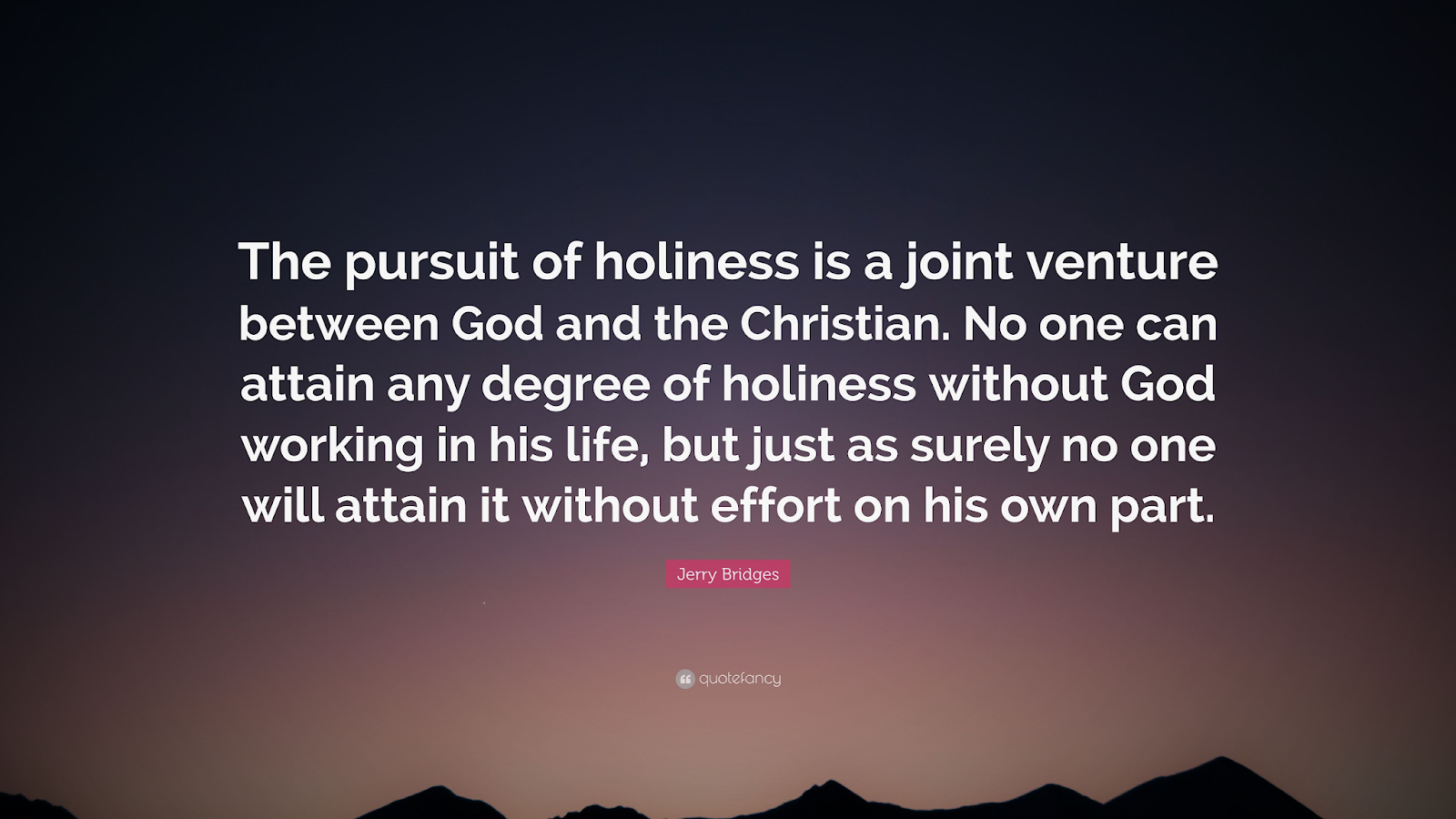
     2nd) Our second problem is that we have misunderstood "living by faith" (Galatians 2:20) to mean that no effort at holiness is required on our part. In fact, sometimes we have even suggested that any effort on our part is, "of the flesh." The words of J. C. Ryle are instructive to us at this point: "Is it wise to proclaim in so bold, naked and unqualified a way as many do, that the holiness of converted people is by faith only, without any personal exertion?  Is it according to the proportion of God's Word?  I doubt it. That faith in Christ is the root of all holiness, no well-instructed Christian will ever think of denying.  But surely the Scriptures teach us that in following holiness the true Christian needs personal exertion and work as well as faith."  We must face the fact that we have a personal responsibility for our walk of holiness...
     3rd) Our third problem is that we do not take some sin seriously.  We have mentally categorized sins into that which is unacceptable and that which may be tolerated a bit... But the Scripture tells us it is, "the little foxes that ruin the vineyards" (Song of Songs 2:15).  It is compromise on the little issues that leads to greater downfalls...   As Andrew Bonar said, "Is the Lord to be obeyed in all things whatsoever He commands? Is He a holy lawgiver? Are all His creatures bound to give implicit assent to His will?"  Are we willing to call sin "sin" not because it is big or little, but because God's law forbids it?  We cannot categorize sin (suggesting some sins are ok and others to be avoided) if we are to live a life of holiness... Will you begin to take personal responsibility for your sin, realizing that as you do, you must depend on God's grace?  And will you decide to obey God in all areas of life, however insignificant the issue may seem to you?"
     When it comes to "holiness" most all people view it in slightly different ways.  Some as stern and joyless, others as restrictive and still others as refreshing.  And some, having been exposed to a counterfeit version of it (which was super-strict, joyless and judgmental) -- want nothing to do with it.  Yet, we are (as Bridges points out) called to pursue it, and to do something in our pursuit of it, for our struggle with sin does require resisting temptation, repenting of sin, clothing ourselves with Christ, putting to death the sinful nature, and so on. 
     We are often so afraid of hearing someone accuse us of being "legalistic" that we shy away from the pursuit of holiness, forgetting that what makes something "legalistic" is not personal effort, but the thought that by that effort we are earning salvific credits, or securing our justification with God. It is thinking our obedience earns us our salvation.
     Yet the pursuit of holiness is not like that. It is simply seeking to avoid that which grieves the heart of the God who has so loved us that He saved us.  It is working from grace, not for grace. It is working from the place of God's acceptance, not for a place in His acceptance.  And it must be said that just because we have God's acceptance through Christ, and the Gospel, doesn't mean we stop seeking to do what pleases Him. It simply means we are secure in His acceptance as we seek to please Him.  "Legalism" seeks to gain an acceptance it feels it doesn't have through it's efforts; a sanctified pursuit of holiness simply pursues godliness as it rests in the acceptance it knows by faith that it already has and can't lose -- that's why it can't be called legalism.

     Living in the Grace of Jesus as we pursue the holiness that is our Christian birthright, Pastor Jeff

7.09.2019

You Can't Take It With You

Greetings All,

     Today's "thought" is at the same time interesting, intriguing and convicting. It is a critique on our culture, and upon us at the same time.  It is worth reading simply because it's true, and the truth of it should make us do some inner reflection. It may even cause us to make some healthy changes or do some cleaning out. Above all it should make us consider what's important, reevaluate our priorities, and consider how we could better use our resources in a world with much so much need.
     It comes from John Ortberg's book (written with a somewhat satirical flair) "When The Game Is Over, It All Goes Back in the Box."   It is available in shortened form in, "You Can't Take It With You."  Enjoy.


Stuff, Stuff and More Stuff

     "We all have stuff. We see it, want it, buy it, display it, insure it, and compare it with other people's stuff.  We talk about whether or not they have too much stuff; we envy or pass judgment on other people's collections of stuff.  We collect our own little pile of stuff.  We imagine that if that pile got big enough, we would feel successful or secure. That's how you keep score in Monopoly, and that's how our culture generally keeps score as well. You get a large house, then you have to get stuff to put in it...
     There are now more than 30,000 self-storage facilities in the country offering over a billion square feet  for people to store their stuff. [That was in 2009 when the book was written. Today in 2019 it is estimated there are 52,000 and close to 2 billion square feet and growing!]  In the 1960's this industry did not exist. We now spend $12 billion a year [in 2018 it was $38 billion a year] just to pay someone to store our extra stuff!  It's larger than the music industry.  Psychologist Paul Pearsall comments on people finding it difficult to give their stuff away: "Many people can't bring themselves to get rid of any of their stuff. You may require a 'closet exorcist.'  A trusted friend can help prevent the 're-stuffing phenomena.'  Re-stuffing happens when, in the process of cleaning out closets and drawers, we are somehow stimulated to acquire new stuff..." 
     Some people have a gift for acquiring stuff. Not long ago I took my daughter to a place called Hearst Castle. William Randolph Hearst was a "stuffaholic."  He had 3,500-year-old Egyptian statues, medieval Flemish tapestries, and centuries-old hand-carved ceilings, and some of the greatest work of art of all time. Hearst built a house of 72,000 square feet to put his stuff in.  He acquired property for his house -- 265,000 acres. He originally owned 50 miles of California coastline.  He collected stuff for eighty-five years. Then you know what he did?  He died.  Now people go through Hearst's house by the thousands. They all say the same thing: "Wow, he sure had a lot of stuff."  People go through life, get stuff, and then they die -- leaving all their stuff behind.  What happens to it?  The kids argue over it. The kids -- who haven't died yet, who are really just pre-dead people -- go over to their parents house. They pick through their parents old stuff like vultures, deciding which stuff they want to take to their houses. They say to themselves, "Now this is my stuff."  Then they die and some new vultures come for it.
     People come and go. Nations go to war over stuff, families are split apart because of stuff.  Husbands and wives argue about stuff more than any other single issue. Prisons are full of street thugs and CEO's who committed crimes to acquire stuff.  [Some people will even kill others for their stuff.]  Why?  It's only stuff.  Houses and hotels are the crowning jewels in Monopoly. But the moment the game ends they go back in the box. So it is with all our stuff.  Christ said, "Do not store up for yourselves treasures on earth, where moth and rust destroy, and where thieves break in and steal.  But store up for yourselves treasures in heaven, where moth and rust do not destroy, and where thieves do not break in and steal. For where your treasure is, there your heart will be also" (Matthew 6:20).... 
     So Jesus says it is wise to store up treasure in what's eternal -- God and people.  To an adult, it's ironic when a two-year-old says, "Mine."  Adults know that two-year-olds don't earn any of their stuff.  It is all provided for them.  It is a gift from someone much larger and wiser than they.  They don't even generally take very good care of it.  Nevertheless, two-year-olds get extremely attached to their stuff.  If someone tries to take something, that item suddenly becomes their favorite stuff.  Two-year-olds can be so deluded, can't they?" 

     As Christians we need to pause every so often and consider where our values and priorities come from.  Do they come from Christ, or do we get them from our culture?  And if (or when) they are in conflict with each other, which takes precedence in dictating our actions and habits?  Do we heed the voice of culture over Christ, or the voice of Christ over culture?   Which do you personally follow and obey? 
     It is worth considering what Jesus would have to say about the thousands upon thousands of storage facilities in our country, and the billions upon billions of dollars spent just to store the excess stuff we don't use or have room for in our houses.  What might he say about that $38 billion spent each year simply storing excess stuff (an average of $88.00 per month per unit)?  Actually, Jesus already spoke quite clearly on that subject in Matthew 6:20.  So, we don't need to ask his opinion, we already know what that is.  So what we do need to ask him is what we should do about all our stuff in light of what he says. How should we respond?  Do we really need all the stuff we have?  How could the money spent storing it be better spent on "storing up treasures in heaven"? How could it be better used in the service of God's kingdom or relieving the plight of people who have so little?  In light of the Jesus we know from Scripture, it is at least worth asking.
     And I know that by now someone is probably thinking, "Don't get legalistic on us, Pastor Jeff."   I find that's a common response whenever what we believe or practice appears to be in conflict with what Jesus taught.  We pull out the"legalistic" card to try and shut down such questions or suggestions. Yet, isn't the goal of our lives to follow the teachings of Jesus more closely.  The Jesus who often turns the values of the world upside down.  And in this case, the Jesus who, if He did have stuff, had very little, since Scripture tells us he had no house (or storage unit) to store it in (Matthew 8:20, Luke 9:58).
     It is true that Scripture does not forbid us from owning things, and there is the ever-present need for housing and shelter and some of the things that make life in it functional. But it is at least worth asking, "At what point we violate Jesus' clear instruction not to 'store up for ourselves treasures on earth'"?
     Is it time to take a trip to the Salvation Army Thrift Shop? 
     Is there someone in real need who could use something we simply have stuffed away in our closet, attic, cellar, garage or storage unit?
     How can we turn an unused "earthly treasure" into a "treasure in heaven"?  Can we break free from it's hold on us and get rid of some stuff without re-stuffing? 
     
     I don't know about you, but I do know I need to unstuff some of my stuff without re-stuffing -- and bless someone else in the process.  And not just once, but as an ongoing habit, lest that stuff comes to have too much of a hold on me, and dictate my attitudes and choices more than the words of the One I have come to call my Lord.

Living in the Grace of Jesus, Pastor Jeff

1.22.2019

Service to God and Others

Greetings All,

Today's "thought" speaks of spiritual disciplines. Yes, spiritual disciplines!  Those activities we train ourselves to do to grow spiritually.  Yet this message is not always popular.  In an age of comfort and ease, even people in the church often see spiritual disciplines as "legalistic," often thinking (or suggesting) that somehow growth just happens without any effort or self-discipline on our part. Something they  will state even though Paul tells us in Galatians 5:23 that self-discipline is a Fruit of the Spirit.  It's one of the traits of character that God's Spirit (if that Spirit dwells within us) works to produce and grow in us over time as an expression of godliness.


     So, today, I will let Donald Whitney speak on this topic from his excellent book entitled: "Spiritual Disciplines for the Christian Life."  For those whose hearts have been reoriented by God to desire godliness, this book is very helpful. For he shows us that spiritual disciplines are not contrary to grace, but flow out of the grace God gives. They don't earn us merits with God, they evidence that God has changed our affections so that we desire the things He wants for us.  They show us that God is within us moving us to engage in those activities that will bring growth in godliness. This selection has to do with the Spiritual Discipline called Service to God and Others.  Enjoy.
     "Discipline without direction is drudgery... It is said of God's elect in Romans 8:29: "For those God foreknew he also predestined to be conformed to the likeness of his Son." God's eternal plan ensures that every Christian will ultimately conform to Christ-likeness.  We will be changed "when he appears" so that "we shall be like him" (I John 3:2). This is no vision. This is you, Christian, in a few years. So why all this talk about discipline? If God has predestined our conformity to Christ-likeness, where does the discipline come in?  Although God will grant us Christ-likeness when Jesus returns, until then He intends for us to grow toward that Christ-likeness.  We aren't merely to wait for holiness, we're to pursue it.  "Make every effort to live in peace with all men and to be holy," we're commanded in Hebrews 12:14, "for without holiness no one will see the Lord."  Which leads us to ask what every Christian should ask, "How then shall we pursue holiness? How can we be like Jesus Christ, the Son of God?"  We find the clear answer in I Timothy 4:7: "Discipline yourself for the purpose of godliness."
     ...There is little value in practicing Spiritual Disciplines apart from the single purpose that unites them (Colossians 2:20-23, I Timothy 4:8). That purpose is godliness... The Spiritual Disciplines are the God-given means we are to use in the Spirit-filled pursuit of Godliness. Godly people are disciplined people.  It has always been so. Call to mind some heroes of church history -- St. Augustine, Martin Luther, John Calvin, John Bunyan, Susanna Wesley, John Wesley, George Whitefield, Lady Huntingdon, Jonathan and Sarah Edwards, Charles Spurgeon, George Mueller -- they we all disciplined people.  Godliness comes through discipline.  We avail ourselves of the Spiritual Disciplines because they help grow us in Christ-likeness.


THE DISCIPLINE OF SERVING

     The Pony Express was a private express company that carried mail by an organized relay of horseback riders. The eastern end was in St. Joseph, Missouri, and western terminal was in Sacramento, California.  The cost of sending a letter by Pony Express was $2.50 an ounce.  If the weather and horses held out, and the Indians held off, that letter would complete the entire two-thousand-mile journey in a speedy ten days, as did the report of Lincoln's Inaugural Address.... Being a rider for the Pony Express was a tough job. You were expected to ride seventy-five to one hundred miles a day, changing horses every fifteen to twenty-five miles. Other than the mail, the only baggage you carried contained a few meager provisions... In case of danger, you also had a medical pack... In order to travel light and to increase speed of speed of mobility during Indian attacks, the men always rode with nothing but shirts, even during the fierce winter weather.  How would you recruit volunteers for this hazardous job?  An 1860 San Francisco newspaper printed this ad for the Pony Express: "WANTED: Young, skinny, wiry fellows not over 18. Must be expert riders willing to risk daily. Orphans preferred."  Those were the honest facts of the service required, but the Pony Express NEVER had a shortage of riders [even though 20 employees lost their lives in the year and a half it was in existence until the telegraph wires replaced the need for riders].
     We also need to be honest with the facts about serving God.  Like the Pony Express, serving God is not a job for the casually interested. It's costly service. He asks for your life. He asks for service to Him to become a priority, not a pastime. He doesn't want servants who will give Him the leftovers of their life commitments. Serving God isn't a short-term responsibility either. Unlike the Pony Express, His kingdom will never go under, no matter how technological our world gets.  The mental picture we have of the Pony Express is probably much like the one imagined by the young men of 1860 who read that newspaper ad.  Scenes of excitement, camaraderie, and the thrill of adventure filled their heads as they swaggered over to the Express office to apply. Yet few of them envisioned how that excitement would only occasionally punctuate the routine of the long, hard hours and the loneliness of the work.
     The discipline of serving is like that. Although Christ's summons to service is the most spiritually grand and noble way to live a life, it is typically as pedestrian as washing someone's feet. Richard Foster puts it starkly: "In some ways we would prefer to hear Jesus' call to deny father and mother, houses and land for the sake of the Gospel, rather than His word to wash feet. Radical self-denial gives the feel of adventure. If we forsake all, we even have the chance of glorious martyrdom. But in service we are also banished to the mundane, the ordinary, the trivial." The ministry of serving may be as public as preaching or teaching, but more often it will be as sequestered as nursery duty. It may be as visible as singing a solo, but usually it will be as unnoticed as operating the sound equipment to amplify the solo. Serving may be as appreciated as a good testimony in the worship service, but typically it is as thankless as washing dishes after a church social. Most service, even that which seems the most glamorous, is like an iceberg. Only the eye of God sees the larger hidden part of it.
     Beyond the church walls, serving is baby-sitting for neighbors, taking meals to families in flux, running errands for the home-bound, providing transportation for the one whose car breaks down, feeding pets and watering plants for vacationers, and -- hardest of all -- having a servants heart in the home. Serving is as commonplace as the practical needs it meets. That's why serving must become a spiritual discipline. The flesh connives against hiddenness and sameness. Two of the deadliest of our sins -- sloth and pride -- loathe serving. The paint glazes over our eyes and puts chains on our hands and feet so we don't serve as we know we should or even want to.  If we don't discipline ourselves to serve for the sake of Christ and His kingdom (and for the purpose of Godliness), we'll serve only occasionally, or when it's convenient or self-serving...  However, those who want to train themselves for Christlike spirituality will find it one of the surest and most practical means of growth in grace."
     Tom Landry (former coach of the Dallas Cowboys for most of three decades) put it well when he said: "The job of a football coach is to make men do what they don't want to do in order to achieve what they always wanted to be."  That's true for us as Christians as well.  "Christians are called to do things they would naturally not be prone to do -- pursue spiritual disciplines -- in order that they might become what they've always wanted to be, that is, like Jesus Christ" (Whitney).  A mentor once told me (and I now have it taped to the wall in my house): "Character is making yourself do what you don't want to do because you know it will be good for you."  This can't happen without the fruit of the Spirit we call self-discipline. In an age that tends toward undisciplined living, his words go against the grain. Yet they are totally in line with the teaching of the New Testament (I Corinthians 9:23-27).  Self-discipline is a primary part in the pursuit of godliness.

In the Service of Christ, Pastor Jeff

4.03.2018

A Man in Christ

Greetings All!

     Each Christian has certain authors, preachers, or teachers that they click with.  People who speak to them in a way others do not.  I have many of them just as I am sure you do.  Some of the people who have profoundly affected me range (the list is not exhaustive) from Charles Spurgeon, to J. I. Packer, to A. W. Tozer, Deitrich Bonhoeffer, John Owen, John Frame, Tim Keller, Richard Sibbes, Jonathan Edwards, Jerry Bridges, Wayne Grudem, R. C. Sproul, Ravi Zacharias, Gordon Fee, John Piper and the person you will hear from today -- James S. Stewart.  Some of you may be scratching your heads wondering who some of them are, when they lived, and why I'm enamored with their take on things, just as I likewise have wondered the same thing after reading some authors people gushed about and said, "you just have to read_____________"!
     Anyway, if you do have the time today, maybe you could zip off a quick response telling me your top three authors.  I'd be very interested in knowing which one's "speak your language" and have fed your soul (along with the book titles that helped you most).  If enough respond, maybe I'll share the results.
     Yet, today, you will hear from James S. Stewart, from his book "A Man in Christ."  For me it has been a "go to" book whenever I want something of substance to challenge or feed my soul. These excerpts simply give you the essence of what he fleshes out in greater detail throughout the rest of the book.  Enjoy.


A Man in Christ

     “The evangel of an ethical example (salvation by trying to be good) is a devastating thing. It makes religion the most grievous of burdens. Perhaps this is the real reason why, even among professing Christians, there are so many strained faces and weary hearts and captive, unreleased spirits. They have listened to Jesus' teaching, they have meditated on Jesus' character; and then they have risen up and tried to drive their own lives along Jesus' royal way. Disappointment heaped on bitter disappointment has been the result. The great example has been a dead-weight beating them down, bearing them to the ground, bowing their hopeless souls in the dust.
     One of the vital distinctions between true religion and false, is that, whereas the latter is a dead burden for the soul to carry, the former is a living power to carry the soul… "Christ in me" means something quite different from the weight of an impossible ideal, something far more glorious than the oppression of a pattern for ever beyond all imitation. "Christ in me" means Christ bearing me along from within, Christ as the motive-power that carries me on, Christ giving my whole life a wonderful poise and lift and turning every burden into wings. This is what the apostle means when he speaks of "Christ in you, the hope of glory" (Col. 1:27)... This, and this alone, is the true Christian religion.
     To be "in Christ," to have Christ within, to realize your creed not as something you have to bear, but as something by which you are born. This is Christianity. It is more: it is release and liberty, life with an endless song at its heart. It means feeling within you, as long as life lasts here, the carrying power of Love Almighty; and underneath you, when you come to die, the touch of everlasting arms…
     The heart of Paul's religion is union with Christ. This, more than any other conception – ­ more than justification, more than sanctification, more even than reconciliation, is the key which unlocks the secrets of Paul’s soul. Within the Holy of Holies which stood revealed when the veil was rent in two from the top to the bottom that day on the road to Damascus, Paul beheld Christ summoning and welcoming him in infinite love into vital unity with Himself.
     If one seeks for the most characteristic sentences the apostle ever wrote, they will be found, not where he is refuting the legalists, or vindicating his apostleship, or meditating on eschatological hopes, or giving practical ethical guidance to the Church, but where his intense intimacy with Christ comes to expression. Everything that religion meant for Paul is focused for us in such great words as these: "I live, yet not I, but Christ lives in me" (Gal. 2:20). "There is, therefore, now no condemnation to them which are in Christ Jesus" (Rom. 8:1). "He that is joined unto the Lord is one with him in spirit" (I Cor. 6:17)…  Paul declares his conviction that in Christianity the final stress must ever fall on one thing – and on one thing only – union with Christ.  Life in fellowship with Christ.”
     If what is written here resonates with you, or intrigues you, and you would like to go into it further, I would encourage you to pick up the book. I don't think you would be disappointed. God has given the Church gifted teachers and preachers, it is wise to avail yourselves of the things he has laid upon their hearts to share with us.

In His Service, Pastor Jeff

6.01.2010

Right and Wrong Views

Greetings All,

This week's 'thought' comes to you from A. W. Tozer. It is found in his book, "The Root of the Righteous," and deals with a correct vs. an incorrect view of God, and the heavy toll one pays in the soul when they hold onto an incorrect concept of God. I trust you may find his thoughts helpful! Enjoy.

"Satan's first attack on the human race was his sly effort to destroy Eve's confidence in the kindness of God. Unfortunately for her and for us he succeeded too well... Nothing twists and deforms the soul more than a low or unworthy conception of God... To a Pharisee (for instance), the service of God was a bondage which he did not love but from which he could not escape without a loss too great to bear (Luke 15:29). The God of the Pharisee was not a God easy to live with, so his religion became grim and hard and loveless. It had to be so, for our notion of God must always determine the quality of our religion.

Much Christianity since the days of Christ's flesh has also been grim and severe. And the cause has been the same--an unworthy or an inadequate view of God. Instinctively we try to be like our God, and if He is conceived to be stern and exacting, so will we ourselves be. From failure to properly understand God comes a world of unhappiness among good Christians even today.

For many the Christian life is thought to be a glum, unrelieved cross-carrying under the eye of a stern Father who is austere, peevish, highly temperamental and extremely hard to please. The kind of life which springs out of such libelous notions must of necessity be but a parody on the true life in Christ. This is why it is so important to our spiritual welfare that we always hold in our minds a right conception of God. If we think of Him as cold and exacting we shall find it impossible to love him, and our lives will be ridden with servile fear. If, again, we hold Him to be kind and understanding our whole inner life will mirror that idea.

The truth is that God is the most winsome of all beings and His service one of unspeakable pleasure. He is all love, and those who trust Him need never know anything but that love. He is just indeed, and He will not condone sin; but through the blood of the everlasting covenant He is able to act toward us as if we had never sinned. Toward the trusting sons of men His mercy will always triumph over justice.

The fellowship of God is delightful beyond all telling. He communes with His redeemed ones in an easy, uninhibited fellowship that is restful and healing to the soul. He is not sensitive nor selfish nor temperamental. What He is today we shall find Him tomorrow and the next day and the next year... Unfortunately, many Christians cannot get free from their perverted notions of God, and these notions poison their hearts and destroy their inward freedom. These friends serve God grimly, as the elder brother did, doing what is right without enthusiasm and without joy, and seem altogether unable to understand the buoyant, spirited celebration when the prodigal comes home. Their idea of God rules out the possibility of His being happy in His people...

How good it would be if we could learn that God is easy to live with. He remembers our frame and knows we are but dust. He may sometimes chasten us, it is true, but even this He does with a smile, the proud, tender smile of a Father who is bursting with pleasure over an imperfect but promising son who is coming every day to look more and more like the One whose child he is.

Some of us are religiously jumpy and self-conscious because we know that God sees our every thought and is acquainted with all our ways. We need not be. God is the sum of all patience and the essence of kindly good will. We will please Him most, not by frantically trying to make ourselves good, but by throwing ourselves into His arms with all our imperfections, and believing that He understands everything and loves us still."


I guess we can all consider ourselves to have had the Gospel preached to us once again!

In the service of Jesus, Pastor Jeff