Visitors

free counters
Showing posts with label Hope. Show all posts

11.26.2019

Brokenness is the Pathway to Spiritual Fruitfulness

Dear Friends,

     Today's "thought" confronts us with a reality we sometimes wish were not so.  Yet, it's a truth proclaimed both in Scripture and from the mouths or pens of numerous saints throughout history: Brokenness is the pathway to spiritual fruitfulness.  Before God can truly use you, He must first break you.  As much as we might wish it were otherwise, it is true. This selection comes from the devotional, "Streams in the Desert" by L. B. Cowman (with added content).  Enjoy.

“The sacrifices of God are a broken spirit;
a broken and contrite heart, O God,
you will not despise.”
Psalm 51:17
     “Those people God uses most to bring glory to Himself are those who are completely broken, for the sacrifice He accepts is, "a broken and contrite heart.”  It was not until Jacob’s natural strength was broken, when “his hip was wrenched” at Peniel (Gen. 32:25), that he came to the point where God could clothe him with spiritual power.  It was not until Moses struck the rock at Horeb, breaking its surface, that cool “water flowed out of it for the people to drink” (Ex. 17:6).  It was not until Gideon’s three hundred specially chosen soldiers “broke the jars that were in their hands” (which symbolized brokenness in their lives, Judg.7:19), that the hidden light of the torches shone forth and brought terror to their enemies.
     It was once the poor widow broke the seal on her only remaining jar of oil and began to pour it out that God miraculously multiplied it to pay her debts and thereby supplied her means of support (2 Kings 4:1–7).  It was not until Esther risked her life and broke through the strict laws of a heathen king’s court that she obtained favor to rescue her people from death (Est. 4:16).  It was only when Jesus took “the five loaves . . . and broke them” (Luke 9:16) that the bread was multiplied to feed the five thousand.  It was through the loaves being broken that the miracle occurred.  It was when Mary broke her beautiful “alabaster jar of very expensive perfume” (Matt. 26:7), and destroyed its future usefulness and value, that the wonderful fragrance filled the house.
     Mary (the mother of Jesus) was not only told of the joy of her being chosen by God to give birth to the Messiah, but that her heart would be pierced also -- cut and broken in two, as if by a sword. Overwhelming grief would cut deep into the joys of bearing and raising Jesus.  Peter was broken of his stubborn pride through the crushing and humiliating experience of denying Jesus three times in His hour of greatest need. Yet, through such failure and humiliation, he was made more humble and dependent on the Spirit, readied through the pain of brokenness to lead the early church.  Heartless Paul was broken on the road to Damascus as Christ appeared to him and blinded him, and he was led helpless, dazed, humbled, and broken in spirit, into the city, like a little child.  Likewise, it was when Jesus allowed His precious body to be broken by thorns, nails, and a spear, that His inner life was poured out like an ocean of crystal-clear water for thirsty sinners to drink and live! 
     It is not until a beautiful kernel of corn is buried and broken in the earth by DEATH, that its inner heart sprouts heavenward and grows to produce hundreds of other seeds or kernels. And so it has always been throughout history — GOD USES BROKEN THINGS.  Those who have been gripped by the power of the Holy Spirit and are used for God’s glory are those who have been broken in their finances, broken in their self-will, broken in their ambitions, broken in their lofty ideals, broken in their worldly reputation, broken in their desires, and often broken in their health.  Yes, He uses those who are despised by the world and who seem totally hopeless and helpless, just as Isaiah said: “The lame will carry off plunder” (Isa. 33:23).
     ‘Oh, break my heart; but break it as a field is plowed and broken for the seeds of corn… Oh, break my heart; break it, victorious God, that life’s eternal well may flow abroad... Break it as when the captive trees, breaking icy bonds, regain their liberties.  And as thought’s sacred grove to life is springing, be joys, like birds, their hope, Your victory singing.’ (Thomas Toke Bunch)”
     This theme is spoken of repeatedly throughout church history.  Martin Luther once wrote in similar terms suggesting: “God creates out of nothing. Therefore, until a man nothing, God can make nothing out of Him.”  Another saint said, “God always builds on ruins.”   Alan Redpath said: “God will never plant the seed of His life upon the soil of a hard, unbroken spirit. He will only plant that seed where the conviction of His Spirit has brought brokenness, and where the soil has been watered with tears of repentance as well as tears of joy.”   Hudson Taylor the famous missionary to China said, “When God wants to do His great works, He trains somebody to be quiet enough and little enough, and then He uses that person.”  Revival, says Isaiah, comes not to those who think they have it together, but to the broken: “This is what the high and lofty One says – He who loves forever and whose name is holy: “I live in a high and holy place, but also with him who is contrite and lowly in spirit, to revive the spirit of the lowly and revive the heart of the contrite.” (57:15).  Being broken is never pleasant, but it is the path that leads to spiritual fruit and usefulness.
     The way God makes us whole is to permit us to go through experiences that "break us" — because brokenness is the pathway to wholeness and restoration.  Pride is like steel that must be softened in the heat of the furnace before it becomes something that can be formed and molded.  The human heart is by nature like hard parched ground which must be watered with tears, and broken by the plow of trials, before the seed of His word can penetrate and take root. The will of man is like a hard lump of clay which the Potter must first pound and squeeze and stretch and then repeat the process all over again, before he can then take it and make it into a beautiful piece of colorful pottery.  Lord, how we wish there was an easier way... 

In His Service, Pastor Jeff


11.12.2019

Fanny Crosby's Life Story

Greetings All,

     Everyone loves an inspiring story!   I came across the story below while preparing for my Sunday School class on, "100 Must Know Christians From Church History."  It is about Fanny Crosby the well-known hymn writer (well-known, at least, to those who attend churches that did, or still do, sing hymns - since many don't)!  I have taken material from three sources to create the account below, the major source being, "50 People Every Christian Should Know - Learning From Spiritual Giants of the Faith" by Warren Weirsbe.  Should you desire to look at a far more extensive recounting of her life, it can be found in her autobiography, "Fanny Crosby's Life Story," or  Edith Blumhofer's book, "Her Heart Can See."  Enjoy.


     "I believe myself still really in the prime of my life!" wrote Frances Jane Crosby at the age of eighty-three. She lived twelve more years (1820-1915)...  Donald P. Hustad has called Fanny Crosby "the most prolific and significant writer of Gospel songs in American history." She wrote more than 8000 songs, most of which are now forgotten.  But many continue to minister to people: "To God Be the Glory," "Blessed Assurance," "Praise Him, Praise Him," "Jesus keep Me Near the Cross," "All the Way My Savior Leads Me," “Safe in the Arms of Jesus,” “Rescue the Perishing,” “Savior, More Than Life to Me,” “Pass Me Not, O Gentle Savior,” and many others. 
     When Fanny was only six weeks old she developed a minor eye inflammation and the doctor's careless treatment left her blind. "It seemed to be intended by the blessed Providence of God that I should be blind all my life," she wrote in her delightful autobiography Fanny Crosby's Life Story, "and I thank Him for the dispensation."  The doctor who destroyed her sight never forgave himself and moved from the area, but Fanny held no ill-will toward him. "If I could meet him now," she wrote, "I would say "Thank you, thank you -- over and over again -- for making me blind."  In fact, she claimed that if she could have her sight restored, she would not attempt it. She felt that her blindness was God's gift to her so that she could write songs for his glory.  "I could not have written thousands of hymns," she said, "if I had been hindered by the distractions of seeing all the interesting and beautiful objects that would have been presented to my notice." 
     Fanny was greatly influenced by her mother and grandmother (her father died when she was very young). When the family moved to Connecticut a neighbor (Mrs. Hawley) read to her from the Bible and taught her Bible stories.  It seems unbelievable, but by the time Fanny was ten years old, she could recite (from memory) the first four books of the Old Testament and the four Gospels!  She could also repeat "poems without number."  She sometimes compared her mind to a writing desk, with little drawers and compartments filled with information readily available. In 1835 (at the age of 15) her mother took her to the famous "Institution for the Blind" in New York City for formal education  She proved an excellent student in everything except mathematics. In rebellion against the subject she wrote the following poem:  "I loathe, abhor, it makes me sick; To hear the word arithmetic!"  Before long, she became the resident poet for the school, and the superintendent was concerned that the growing praise might go to her head. So he called her into his office and warned her to beware of pride. He also urged her to use her gifts to the glory of God.  "His words were like bombshells," she would later write, "but they did me an immense amount of good."
     In 1845 (at the age of 25) Fanny, who was somewhat frail in health and had experienced loss through the death of loved ones, became increasingly concerned about the state of her own soul.  She had been so busy learning, teaching and nursing that she had forgotten something very important: She realized that she did not have a true love for God in her heart. She began to attend numerous churches of varying denominations in her quest to find what she needed from the Lord.  She attended Congregationalist, Episcopalian, Dutch Reformed, and Methodist Episcopal churches, as well as Wesleyan camp meetings. Her concerns intensified after an interesting dream: She dreamt one night that a friend was on his deathbed, and he asked her quite pointedly (in the dream) if she would meet him in heaven.  She responded "yes" in the dream, but when she awoke the next morning she felt uneasy about the state of her soul.  Five years later, in November of 1850, she attended revival meetings at the Broadway Tabernacle Methodist Church in New York City.  She went to altar twice, yet it was not until the singing of, "Alas! And Did My Savior Bleed? that she went forward a third time while the words of the last verse, "Here, Lord - I give myself away! 'Tis all that I can do" were being sung.  This line took hold in her heart and she began to shout!  She had been born again, and finally had the personal assurance she had been searching for.  This, needless to say, led to one of her most famous songs: "Blessed Assurance."  "My very soul was flooded with celestial light," she said. "For the first time I realized that I had been trying to hold the world in one hand and the Lord in the other." After this experience, she boldly testified about Christ and never shied away from praying in public. 
     In 1851 she published her second volume of poems, where she makes reference to her declining health in the preface -- though she would go on to live another 64 years!  In 1858 she wrote her third volume of poems -- the same year she married Alexander Van Alstyne, who had also been a student at the school for the blind and, like Fanny, had taught there upon graduating. He was a gifted musician and a perfect partner to the poetess.  The turning point in her life came in 1864 when she met William Bradbury, the famous hymn writer and publisher. "For many years I have been wanting you to write for me," he told here.  "I wish you would begin right away!"  She did begin, and the result was her first gospel song, "Our Bright Home Above." Little did anyone realize that God would use her to pen over eight thousand songs in the next fifty-one years.  How did Fanny write her lyrics?  "I never undertake a hymn," she explained, "without first asking the good Lord to be my inspiration in the work I am about to do." She would pray and meditate until she was in the right mood. Sometimes she would quote other hymns to prime the pump. Then the ideas would come and she would develop the song in her mind and commit it to memory.  At times, she would have as many as forty different songs stored away in her mind. She would let each song lie still for a few days before dictating it to a friend, who would then send it off to the publisher.
     In her day she was one of the best known women in America  In fact, on the occasion of her 85th birthday, Grover Cleveland, President of the United States, wrote to her:  "My dear friend:  It is more than fif­ty years ago that our ac­quaint­ance and friend­ship be­gan; and ev­er since that time I have watched your con­tin­u­ous and in­ter­es­ted la­bor in up­lift­ing hu­man­i­ty, and point­ing out the way to an ap­pre­ci­a­tion of God’s good­ness and mer­cy..."
     Fanny was just a few weeks away from her 95th birthday when she was called home -- a hope she had written about often in her songs. For the first time she could see, and, best of all, she could see her Savior.  Have you ever noticed how often she wrote about "seeing" in her lyrics?  Watch for the references the next time you sing a Fanny Crosby song. "Saved by Grace" is just one example, where she writes: "And I shall see Him face to face, And tell the story -- Saved by Grace; Yes we shall see him face to face, And tell the story -- Saved by Grace."  It was said of another blind hymn writer, George Matheson, that God made him blind so he could see clearly in other ways and become a guide to others.  The same tribute could be applied to Fanny Crosby, who triumphed over her handicap and used it to the glory of God."
     It's hard to summarize such a profound life of 95 years in a few simple paragraphs without leaving out many pertinent details.  Maybe the lengthy autobiography and other biographies would fill in the holes, answering such questions as: Were there brief times when she wished she could see, or struggled with the limitations brought about by her blindness?  What truths of Scripture helped her remain so grateful, joyful and positive?  What would her attitude have been if she hadn't been given parents and others who poured themselves into her in regards to her faith?  And what about the amazing gift of her near photographic memory and immense poetic skills, since we know not all are blessed with such awesome abilities?  How did such extraordinary graces help her when it came to accepting the doctor's blunder in causing her blindness?  Did he ever come to forgive himself?  So many questions and many surely without answers this side of eternity!
     For hymn lovers like myself, Fanny Crosby's songs have been an inspiration and great spiritual help.  My favorites are Blessed Assurance and To God Be the Glory.  They have always uplifted me, both the music and the words. For who could say it better?
To God be the glory great things He has done,
So loved He the world that He gave us His son,
Who yielded His life an atonement for sin,
And opened the life gate that all may go in.

Praise the Lord, praise the Lord let the earth hear His voice!
Praise the Lord, praise the Lord let the people rejoice!
O come to the Father through Jesus the Son,
And give Him the glory great things He has done

O perfect redemption the purchase of blood,
To every believer the promise of God.
The vilest offender who truly believes,
That moment from Jesus a pardon receives

Great things He has taught us great things He has done,
And great our rejoicing through Jesus the Son.
But purer and higher and greater will be,
Our wonder our worship when Jesus we see.

In His Grace, Pastor Jeff


9.17.2019

Christian Leadership in Uncharted Territory

Greetings All,

     Yesterday I received a book in the mail sent to me by a wise old friend. As one who loves to climb mountains, the title captured my attention when I opened the package: "Canoeing the Mountains," by Tod Bolsinger. Yet, the secondary title clued me into the fact that it probably was not what I initially thought - "Christian Leadership in Uncharted Territory."


     As I read the first chapter I felt like the author had been a fly on the wall in many of my conversations in recent years!  He even mouthed some of the exact phrases I had used!  So, today, I let you in on an issue that has been weighing on me (and many others in ministry) for at least the past decade or longer - trying to minister in a post-Christian (often anti-Christian) culture.  This selection below is just to give you a taste of what he will address in the rest of his book -- offering hope for a breakthrough where many seem to have run into what FEELS like an impenetrable wall we were not trained or equipped to break through. Enjoy.
     "One night after a long day of meetings, an older pastor let out a heavy sigh. He was nearing retirement, and we were working together on a project that was supposed to reorganize our entire denomination in order to help our church better minister in a changing world. And that changing world weighed on him.  He remembered well how not that long ago life was different. He stirred his drink and said to me, 'You know, when I began my ministry in a church in Alabama, I never worried about church growth or worship attendance or evangelism. Back then, if a man didn't come to church on Sunday, his boss asked him about it at work on Monday.'
     Sociologists and theologians refer to this recently passed period as 'Christendom.' The seventeen-hundred-year-long era with Christianity at the privileged center of western cultural life. Christendom gave us 'blue laws' and the Ten Commandments in school [and prayer in schools]. It gave us 'under God' in the pledge of allegiance and exhortations to Bible reading in the national newspapers. (I have a copy of the Los Angeles Times from December 1963 that has stories on the Warren Commission (investigating the assassination of John F. Kennedy), the nine-thousand-member Hollywood Presbyterian Church, and a list of daily Bible readings for the upcoming week.  Can you even imagine the Los Angeles Times exhorting people to read their Bibles today?) It was the day every "city father" laid out the town square with the courthouse, the library, and a First Church of _______ within the center of the city.  For most of us these days are long gone. (For some of us, that is good news indeed. Did you notice the reference to 'man' in my friends statement?)
     In our day (unlike then) cities are now considering using eminent domain laws to replace churches with tax-revenue generating big-box stores, Sundays are more about soccer and Starbucks than about Sabbath, Christian student groups are getting derecognized on university campuses, the fastest growing religious affiliation among young adults is 'none,' there is no moral consensus built on Christian tradition (even among Christians), and even a funeral in a conservative beach town is more likely to be a Hawaiian style 'paddle out' than a gathering in a sanctuary.  As we see all this we know that Christendom as a marker of society has passed.
     Over the last ten years I have had one church leader after another whisper to me the same frustrated confession: 'Seminary didn't prepare me for this. I don't know if I can do it. I just don't know...'  A number of pastors are ready to throw in the towel. Studies show that if given the chance to do something else, most pastors would jump at it. Reportedly, upwards of fifteen hundred pastors leave the ministry EVERY MONTH  [Every year more than 4000 churches in the U.S. close their doors, almost double the number from 20 years ago.] 
     A couple years ago I learned that three of my pastor friends around the country had resigned  -- on the same day. There were no affairs, no scandals, and no one was renouncing the faith. But three good, experienced pastors turned in resignations and walked away. One left church ministry altogether.  The details are as different as the pastors themselves, but the common thread is that they finally got worn down by trying to bring change to a church that was stuck and didn't know what to do. Their churches were stuck and declining, stuck and clinging to the past, stuck and lurching to quick fixes, trying to find an easy answer for what were clearly bigger challenges. What all three churches had in common was that they were mostly blaming the pastor for how bad it felt to be stuck.
'If only you could preach better.' 
'If only you were more pastoral and caring.' 
'If only our worship was more dynamic.' 
'Please, pastor, do something!'  (That is what we pay you for, isn't it?)


     And to make matters worse, the pastors don't know what to do either. As a seminary vice-president I am now charged with confronting this reality head-on. Our graduates were not trained for this day. When I went to seminary, we were trained in the skills that were necessary for supporting faith in Christendom.  When churches functioned primarily as vendors of religious services for a Christian culture, the primary leadership toolbox was:  1. TEACHING (for providing Christian education).  2. LITURGICS (for leading Christian services).  3. PASTORAL CARE (for offering Christian counsel and support).  In this changing world we need to add a new set of leadership tools..." 

     If you would like to know what those new and necessary tools are, you will need to purchase his book for yourself!  As a pastor who has lived long enough to see Christendom progressively and purposefully deconstructed, and replaced at almost every turn with secularized and post-Christian alternatives, it has been stretching.  I'm not one of the pastoral casualties he lists, but in all honesty there have been times I have come pretty close. In fact, given those statistics it may be time to start a "pastor support group" for those who feel they are on the verge of being one of those 1500 pastors every month who leave the ministry.
     I haven't had time to read far into his book, but I wanted to share the introductory chapter so people can know there is a voice of encouragement from someone who has his ear to the ground, and has himself been a pastor ministering in our post-Christian culture.   A culture where traditional styles of leadership and ministry (which garnered much fruit in the not-so-distant past) can actually be a hindrance and obstacle in the present. His word to pastors - "Start with conviction, stay calm, stay connected, and stay the course - even when navigating loss."
     Ministry has always required people to, "run the race with perseverance"  (Hebrews 12:1-2).  Yet today is one of those cultural seasons or times when like a runner in a marathon on a hot and humid day, people in ministry are encountering what in the Boston Marathon is called, "Heartbreak Hill" -- a long gradual incline at the 20 mile mark.  It's a "grueling test of endurance" as one writer puts it, which drives many to give up before the finish line.  A place where one must be mentally prepared, make adjustments, and persevere, or become a casualty.  If you happen to be at that place, maybe you might want to see what Bolsinger has to say.

Living in the Grace of Jesus, Pastor Jeff

9.10.2019

Testimony of William Grimshaw

Greetings All!

     There comes a time in the life of every believer where they must wrestle with what they truly trust in; where their hope lies, and what the only true object of saving faith is. This week's "thought" is a true account of the one man's journey along that road -- a road that led from misplaced faith and depression, to true faith and joy!
     It is not unusual (at least at the beginning of our life of faith) to have a faith that when tested is found lacking or misplaced. Hopefully this testimony about William Grimshaw's journey from trusting in the wrong thing, to being led by a miraculous event to trust in the only true saving object of faith will be of help to all -- either as a guide that takes you to where you need to be, or a reminder not to stray from there. It comes from "The One Year Book of Christian History" by Michael and Sharon Rusten.  Enjoy.
     "William Grimshaw was born in Lancashire, England, in 1708. He went to Christ's College, Cambridge, intending to enter the ministry. During his third year he fell in with the wrong crowd, becoming, in his own words, "as vile as the worst."  Still, he chose to enter the ministry, finding no incongruity between his sinful lifestyle and his chosen profession.  Ordained in the Church of England in 1732, Grimshaw was assigned a church in West Yorkshire. He married a young widow, but within four years she tragically died, leaving him with two small children.
     Already a troubled soul, Grimshaw was plunged into a deep depression. He sent his children away to be raised by relatives. All he could think about was his own mortality and the necessity of making arrangements for his own funeral... In his written instructions for his funeral he specified: "To attend my funeral I desire that 20 persons be invited (of my next relations and intimatest acquaintances) and be entertained in the following manner: Let 5 quarts of claret (a red wine from Bordeaux) ... be put in a punch bowl and be drunk in wine glasses until it is all gone."
     At this time an itinerant preacher began rebuking Grimshaw for his legalistic view of salvation [a view whereby he encouraged people to trust in their own efforts, works, or aspects of their own performance for their acceptance with God]. He said to Grimshaw, "You are no believer in the Lord Jesus Christ. You are building on the sand."   Grimshaw tried to avoid the man, but the words "you are building on sand" kept haunting him.  In 1741, while visiting a friend, Grimshaw saw a book on the table and picked it up.  As he opened it, and discovered it was by John Owen, a Puritan theologian, a flash of heat flushed his face. Puzzled, he looked at the fireplace, wondering if the fire had caused his sudden flush of heat.  Opening the book again, he read the title: "The Doctrine of Justification by Faith."  Suddenly a second flash of heat swept over him. Astonished that it happened again, Grimshaw took it as a divine imperative that he was to read the book.
     Taking the book back home, Grimshaw noted in the preface that Owen had written the book for people suffering from the same anguish and distress of soul he was experiencing.  The book confronted the reader with the question of whether he would 'trust in his own personal inherent righteousness (his own efforts and religious or moral performances) or, in full renunciation of it, take to himself the grace of God and the righteousness of Christ alone.' To Grimshaw the choice was clear.  As he would later confide to a friend,  "I was wiling to renounce myself, every degree of fancied merit and ability, and to embrace CHRIST ONLY for my all in all.  O what light and comfort did I now enjoy in my own soul, and what a taste of the pardoning love of God!"
     His ministry immediately changed, and he found peace and joy in his heart as well as his soul. He fell in love with a local girl, married her, and brought his children back home...  He applied for a new parish and moved his family to nearby Haworth, where he ministered powerfully and effectively until his death in 1763 at the age of 55. Under his spiritual leadership the little-known village of Yorkshire became one of the leading centers of the Christian faith in all of England. His funeral was quite different from the one he had planned years before. Vast crowds of loving parishioners followed his coffin to its final resting place. The pastor who spoke summarized the faith of Grimshaw by saying, "Upon Christ's atoning blood and justifying righteousness alone, did EVERY HOPE of his soul's acceptance with God depend" 
     Upon what does your hope rest?  What is the object of your faith? What does your hope or trust for pardon and salvation rest upon?  Is it your efforts at trying to be a "good" person?  Is it a list of accomplishments or a resume of cataloged good works?  Is it a mix of faith in Jesus plus your attempts to be righteous? Here it helps to remember that when it comes to saving faith, Jesus plus anything nullifies Jesus. If you are trusting in anything of your own, you are trusting in you, and thus not fully (or for that matter, not at all) in Jesus.  The Gospel's message is clear: We are saved by grace alone, through faith alone, in Christ alone.  Add anything into the mix and you disbelieve the Gospel, negate Jesus, will struggle incessantly with emotional highs and lows, find the need to pretend, have a fear of being open, honest and transparent about your sins, wrestle with a sense of of frustration with God and self, fall into occasional depressions, and a lack of assurance of God's forgiveness and complete acceptance.
     Only when one's hope for acceptance with God is in CHRIST ONLY -- only when both eyes are glued on Jesus, instead of one on Jesus and the other on the sin-stained performances of the self -- are they liberated from all those afflicting things to experience peace, joy and release from the weight of burdens too heavy to carry.  John Owen was right in asking: "will you trust in your own personal inherent righteousness [which is always stained by sin and thus unrighteous or unacceptable righteousness], or in full renunciation of it, take to yourself the grace of God and righteousness of CHRIST ALONE."
     Blessed is the person who stops hoping and trusting in their own efforts, and looks instead to Christ alone for their pardon and acceptance with God.  As one who fell into this Grimshaw's mistake, I can tell you from personal experience what a blessed liberation comes as we get our eyes off us, and simply, "fix our eyes (of faith) on Jesus..." (Heb. 12:2).  And please notice it says "eyes" -- that is, both of them!  Not one eye of faith fixed on what you do, and the other one looking to what Jesus did, but BOTH OF THEM fixed on Jesus. For He is the only true object of saving faith, and faith in HIM ALONE is the only means of salvation or remedy for the countless malady's of the soul.

Living in the Grace of Jesus, Pastor Jeff

4.30.2019

Pioneer Missionary Ann Hasseltine Judson

Greetings All,

     In my last "thought" I shared about Adoniram Judson.  A couple days later I was asked to send one out highlighting the brave and heroic commitment of his wife -- Ann Hasseltine Judson.  This is her story (or at least part of it). Her profound influence in regard to the place of women in missions has few rivals.  As the first woman missionary sent out from the U.S., she set the standard for future generations.  This is by far the longest thought I've ever sent out (and it has been heavily redacted to shorten it to what it is)!  Yet, with Mothers Day fast approaching, I thought honoring her contribution as a wife, mother and missionary was warranted. Enjoy.

     "Two hundred and nine years ago in 1810, a young man named Adoniram Judson composed an extraordinary letter to the father of the young woman he wanted to marry. He wrote as follows: “I have now to ask, whether you can consent to part with your daughter early next spring, to see her no more in this world; whether you can consent to her departure for a heathen land, and her subjection to the hardships and sufferings of a missionary life; whether you can consent to her exposure to the dangers of the ocean; to the fatal influence of the southern climate of India; to every kind of want and distress; to degradation, insult, persecution, and perhaps a violent death. Can you consent to all this, for the sake of him who left his heavenly home and died for her and for you; for the sake of perishing immortal souls; for the sake of Zion, and the glory of God?” 
     At 21 years of age, her parents left the choice to Ann.  She decided to marry Adoniram and to leave everything behind for the unknown. She knew she would probably never see her family again. The voyage was far too long, perilous and expensive for the possibility of any visit from relatives or friends. Letters took months, and might well never arrive. There was no established mission network to give support or counsel. There was no American Embassy in Asia to give protection. There was no certainty that these pioneer missionaries would even find a place in which they could safely minister. Nothing was guaranteed – neither safety, health, toleration, and least of all success. But Adoniram, Ann, and the other young people with them understood that Christ did not issue the Great Commission on the condition that health, comfort and safety could be guaranteed. Christ had said simply, “GO.”  Therefore they married on February 5, 1812 and the very next day the newlyweds sailed from Salem, Massachusetts...
     The religion of Burma was Buddhism: a system of belief that arose in the sixth century BC with the enlightenment of Gautama, the Buddha The Buddha taught that all appearance is characterized by transience, that there is not really a soul, and no eternal God… Ann wrote bluntly in her journal of the emptiness of Buddhism: “The religion of Burmah, then, is, in effect, atheism; and the highest reward of piety, the object of earnest desire and unwearied pursuit, is annihilation. How wretched a system is this; how devoid of adequate motives to virtue; and how vacant of consolation!”  Consequently, the Burmese had no concept of an eternal God, and no means in their language to express such an idea. Ann and Adoniram worked hard studying up to 12 hours a day for two years learning the difficult language. Eventually Adoniram produced a gospel tract in Burmese and commenced working on a Burmese translation of the New Testament. Ann authored a Burmese language catechism, translated the books of Daniel and Jonah into Burmese, and began to teach women’s Bible classes. She was also the first person to translate Bible passages into Siamese. Ann also formed a society of native women who met together on Sundays to pray and read the Scriptures.
     By 1820, six years after their arrival in Burma, Ann was so seriously ill that she had to seek medical help in Calcutta. Two years later she was told that unless she returned either to Europe or America for treatment, she would die. She had previously consented to her husband accompanying her to Calcutta, but the longer voyage to England (and a possible further trip to America) would take at the least two years, and she refused to consider Adoniram abandoning the infant church and the crucial Bible translation for that long. As a result, in 1822, she made the long and difficult journey alone. She sailed first for England, and Christians there raised funds for her passage to America.  Back at home, she received skilled medical care and was reunited with her family and that of Adoniram. The whole trip took two years, and of this separation Adoniram said that it felt like cutting off his right arm and gouging out his right eye.
     Ann returned in 1824, but her reunion with her husband, though joyful, was pitifully brief.  War between Burma and England began, and all male foreigners fell under suspicion of being English spies. So Adoniram and his associate Mr. Price, were thrown into the notorious death prison from which few ever emerged alive. While in prison they awaited execution in the most filthy and sordid of conditions, weighed down with fetters so that they could not walk. Daily they observed the torture and execution of their fellow prisoners, not knowing when their time would come. Nightly they were placed in the stocks, and their legs and bodies raised so that only their head and shoulders remained on the ground. They remained incarcerated for one and a half years, during which time they were never able to wash, were often ill with no access to medical help, and had little contact with the outside world...
     During her husband’s imprisonment, Ann petitioned tirelessly on the prisoners’ behalf with no regard for personal risk. Daily she walked the two miles from their small home to the prison in hopes of supplying them with food and drink. Sometimes she was allowed to see them, but often they were forbidden to speak. She also visited every person of influence to whom she could gain access, trying to explain that as missionaries they had nothing to do with the English war effort. She was quite alone through this ordeal, and she was pregnant. Eight months after Adoniram had been arrested, in February 1825, she gave birth to little Maria, and was able to visit the prison with the infant, whom the father could only observe from afar. Their first baby had been stillborn, their second had died at eight months, and this child’s chances of survival seemed even more slender.  Of this terrible time she wrote:  “Sometimes for days and days together, I could not go into the prison till after dark, when I had two miles to walk, in returning to the house. O how many, many times, have I returned from that dreary prison at nine o’clock at night, solitary and worn out with fatigue and anxiety… My prevailing opinion was, that my husband would suffer violent death; and that I should, of course become a slave, and languish out a miserable though short existence in the tyrannical hands of some unfeeling monster. But the consolations of religion, in these trying circumstances, were neither `few nor small.’  It taught me to look beyond this world, to that rest, that peaceful happy rest, where Jesus reigns, and oppression never enter.”
     Eventually she had to set up a little shelter near the prison, as the daily four-mile-round-trip proved too much to walk in the blazing heat. As the weather brought unbearable heat, the conditions in the prison only worsened. Of this time her memoirs record: “The situation of the prisoners was now distressing beyond description. It was at the commencement of the hot season. There were above a hundred prisoners shut up in one room, without a breath of air excepting from the cracks in the boards. I sometimes obtained permission to go to the door for five minutes, when my heart sickened at the wretchedness exhibited. The white prisoners, from incessant perspiration and loss of appetite, looked more like the dead than the living…”
     It would seem that things could not get worse. But with the British troops advancing to the capital, the foreign prisoners were removed on a death march to a remote spot in the country some miles north of the capital, where rumor had it they were to be buried alive as an offering to the gods in the path of the advancing troops. Their sufferings on the march were indescribable, their survival remarkable. Even more remarkable was the determination of Ann to follow them. With her three-month-old infant, plus two little girls she was looking after, and a faithful Burmese helper, she immediately set out by boat, and then by rough cart, in pursuit of the prisoners. For the duration of their imprisonment outside of the capital she persuaded their jailer to let her and the children share his two-room hut. From there she continued to try to minister such help as she could to her husband and Price. During this appalling period she became so ill that she had no milk for the baby, and the only way Maria survived was by bribing the jailer to allow Adoniram out of prison to carry the baby round the local village, begging nursing mothers to let Maria have a little of their milk.
     When the Burmese realized how hopeless the struggle against England was, they decided they needed all the help they could get in negotiating the least humiliating peace settlement. Adoniram and Price were released to help with the peace negotiations, as they could speak both Burmese and English. Again Ann and Adoniram had a wonderfully happy but tragically brief reunion. They enjoyed two blissful weeks of freedom and comfort at the British base before Adoniram was summoned elsewhere for further negotiations. This was to be their final separation. Ann’s health had been broken by the sufferings of the previous two years, and her body, past the point of exhaustion, finally broke and succumbed to cerebral meningitis. Her final sufferings were to be endured without her husband. She was thirty-seven.
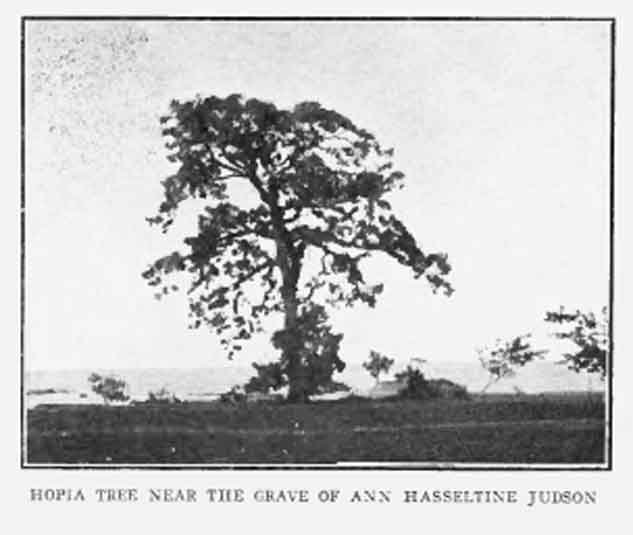
     Adoniram was shattered not only by her death, but by the knowledge he had not been able to support her at that time. Shortly thereafter, Maria also died.  Adoniram was left quite alone, and later wrote with the sad news to Ann’s mother telling her of the burial of his daughter: “The next morning we made her last bed in the small enclosure that surrounds her mother’s lonely grave. Together they rest in hope, under the hope tree, which stands at the head of the graves, and together, I trust, their spirits are rejoicing after a short separation of precisely six months. And I am left alone in the wide world. My own dear family I have buried; one in Rangoon, and two in Amhurst. What remains for me but to hold myself in readiness to follow the dear departed to that blessed world, “Where my best friends, my kindred dwell, Where God my Saviour reigns.” Adoniram was so grief-stricken at his loss that he suffered complete emotional breakdown.
     Ann Hasseltine Judson was converted at 17 during what has come to be called, "The Second Great Awakening."  She was a deeply dedicated Christ-follower, as well as a gifted teacher, linguist, preacher and author. She was instrumental in establishing a Christian church in Burma which, though heavily persecuted, still thrives to this day.  She championed the cause of female education, starting a Burmese girl’s school and tirelessly petitioning Christian sponsorship for her girls during her medical furlough in the United States.  It is generally agreed had it not been for Ann’s sacrificial efforts and representations to the governing authorities, Adoniram would not have survived his time in the death prison. It has been said of her: “She was a woman who loved intensely, loved her husband, loved her children, loved the people of Burma, but above all, she loved her God.”

     When I think of Ann one verse comes to mind: "Many women do noble things, but you surpass them all... let her works bring her praise at the city gates" (Prov. 31:29 & 31).


     If you would like to read a more full account (this was my primary though not sole source for this post) you can click here:  


In His Service, Pastor Jeff