Visitors

free counters
Showing posts with label Praise. Show all posts

11.12.2019

Fanny Crosby's Life Story

Greetings All,

     Everyone loves an inspiring story!   I came across the story below while preparing for my Sunday School class on, "100 Must Know Christians From Church History."  It is about Fanny Crosby the well-known hymn writer (well-known, at least, to those who attend churches that did, or still do, sing hymns - since many don't)!  I have taken material from three sources to create the account below, the major source being, "50 People Every Christian Should Know - Learning From Spiritual Giants of the Faith" by Warren Weirsbe.  Should you desire to look at a far more extensive recounting of her life, it can be found in her autobiography, "Fanny Crosby's Life Story," or  Edith Blumhofer's book, "Her Heart Can See."  Enjoy.


     "I believe myself still really in the prime of my life!" wrote Frances Jane Crosby at the age of eighty-three. She lived twelve more years (1820-1915)...  Donald P. Hustad has called Fanny Crosby "the most prolific and significant writer of Gospel songs in American history." She wrote more than 8000 songs, most of which are now forgotten.  But many continue to minister to people: "To God Be the Glory," "Blessed Assurance," "Praise Him, Praise Him," "Jesus keep Me Near the Cross," "All the Way My Savior Leads Me," “Safe in the Arms of Jesus,” “Rescue the Perishing,” “Savior, More Than Life to Me,” “Pass Me Not, O Gentle Savior,” and many others. 
     When Fanny was only six weeks old she developed a minor eye inflammation and the doctor's careless treatment left her blind. "It seemed to be intended by the blessed Providence of God that I should be blind all my life," she wrote in her delightful autobiography Fanny Crosby's Life Story, "and I thank Him for the dispensation."  The doctor who destroyed her sight never forgave himself and moved from the area, but Fanny held no ill-will toward him. "If I could meet him now," she wrote, "I would say "Thank you, thank you -- over and over again -- for making me blind."  In fact, she claimed that if she could have her sight restored, she would not attempt it. She felt that her blindness was God's gift to her so that she could write songs for his glory.  "I could not have written thousands of hymns," she said, "if I had been hindered by the distractions of seeing all the interesting and beautiful objects that would have been presented to my notice." 
     Fanny was greatly influenced by her mother and grandmother (her father died when she was very young). When the family moved to Connecticut a neighbor (Mrs. Hawley) read to her from the Bible and taught her Bible stories.  It seems unbelievable, but by the time Fanny was ten years old, she could recite (from memory) the first four books of the Old Testament and the four Gospels!  She could also repeat "poems without number."  She sometimes compared her mind to a writing desk, with little drawers and compartments filled with information readily available. In 1835 (at the age of 15) her mother took her to the famous "Institution for the Blind" in New York City for formal education  She proved an excellent student in everything except mathematics. In rebellion against the subject she wrote the following poem:  "I loathe, abhor, it makes me sick; To hear the word arithmetic!"  Before long, she became the resident poet for the school, and the superintendent was concerned that the growing praise might go to her head. So he called her into his office and warned her to beware of pride. He also urged her to use her gifts to the glory of God.  "His words were like bombshells," she would later write, "but they did me an immense amount of good."
     In 1845 (at the age of 25) Fanny, who was somewhat frail in health and had experienced loss through the death of loved ones, became increasingly concerned about the state of her own soul.  She had been so busy learning, teaching and nursing that she had forgotten something very important: She realized that she did not have a true love for God in her heart. She began to attend numerous churches of varying denominations in her quest to find what she needed from the Lord.  She attended Congregationalist, Episcopalian, Dutch Reformed, and Methodist Episcopal churches, as well as Wesleyan camp meetings. Her concerns intensified after an interesting dream: She dreamt one night that a friend was on his deathbed, and he asked her quite pointedly (in the dream) if she would meet him in heaven.  She responded "yes" in the dream, but when she awoke the next morning she felt uneasy about the state of her soul.  Five years later, in November of 1850, she attended revival meetings at the Broadway Tabernacle Methodist Church in New York City.  She went to altar twice, yet it was not until the singing of, "Alas! And Did My Savior Bleed? that she went forward a third time while the words of the last verse, "Here, Lord - I give myself away! 'Tis all that I can do" were being sung.  This line took hold in her heart and she began to shout!  She had been born again, and finally had the personal assurance she had been searching for.  This, needless to say, led to one of her most famous songs: "Blessed Assurance."  "My very soul was flooded with celestial light," she said. "For the first time I realized that I had been trying to hold the world in one hand and the Lord in the other." After this experience, she boldly testified about Christ and never shied away from praying in public. 
     In 1851 she published her second volume of poems, where she makes reference to her declining health in the preface -- though she would go on to live another 64 years!  In 1858 she wrote her third volume of poems -- the same year she married Alexander Van Alstyne, who had also been a student at the school for the blind and, like Fanny, had taught there upon graduating. He was a gifted musician and a perfect partner to the poetess.  The turning point in her life came in 1864 when she met William Bradbury, the famous hymn writer and publisher. "For many years I have been wanting you to write for me," he told here.  "I wish you would begin right away!"  She did begin, and the result was her first gospel song, "Our Bright Home Above." Little did anyone realize that God would use her to pen over eight thousand songs in the next fifty-one years.  How did Fanny write her lyrics?  "I never undertake a hymn," she explained, "without first asking the good Lord to be my inspiration in the work I am about to do." She would pray and meditate until she was in the right mood. Sometimes she would quote other hymns to prime the pump. Then the ideas would come and she would develop the song in her mind and commit it to memory.  At times, she would have as many as forty different songs stored away in her mind. She would let each song lie still for a few days before dictating it to a friend, who would then send it off to the publisher.
     In her day she was one of the best known women in America  In fact, on the occasion of her 85th birthday, Grover Cleveland, President of the United States, wrote to her:  "My dear friend:  It is more than fif­ty years ago that our ac­quaint­ance and friend­ship be­gan; and ev­er since that time I have watched your con­tin­u­ous and in­ter­es­ted la­bor in up­lift­ing hu­man­i­ty, and point­ing out the way to an ap­pre­ci­a­tion of God’s good­ness and mer­cy..."
     Fanny was just a few weeks away from her 95th birthday when she was called home -- a hope she had written about often in her songs. For the first time she could see, and, best of all, she could see her Savior.  Have you ever noticed how often she wrote about "seeing" in her lyrics?  Watch for the references the next time you sing a Fanny Crosby song. "Saved by Grace" is just one example, where she writes: "And I shall see Him face to face, And tell the story -- Saved by Grace; Yes we shall see him face to face, And tell the story -- Saved by Grace."  It was said of another blind hymn writer, George Matheson, that God made him blind so he could see clearly in other ways and become a guide to others.  The same tribute could be applied to Fanny Crosby, who triumphed over her handicap and used it to the glory of God."
     It's hard to summarize such a profound life of 95 years in a few simple paragraphs without leaving out many pertinent details.  Maybe the lengthy autobiography and other biographies would fill in the holes, answering such questions as: Were there brief times when she wished she could see, or struggled with the limitations brought about by her blindness?  What truths of Scripture helped her remain so grateful, joyful and positive?  What would her attitude have been if she hadn't been given parents and others who poured themselves into her in regards to her faith?  And what about the amazing gift of her near photographic memory and immense poetic skills, since we know not all are blessed with such awesome abilities?  How did such extraordinary graces help her when it came to accepting the doctor's blunder in causing her blindness?  Did he ever come to forgive himself?  So many questions and many surely without answers this side of eternity!
     For hymn lovers like myself, Fanny Crosby's songs have been an inspiration and great spiritual help.  My favorites are Blessed Assurance and To God Be the Glory.  They have always uplifted me, both the music and the words. For who could say it better?
To God be the glory great things He has done,
So loved He the world that He gave us His son,
Who yielded His life an atonement for sin,
And opened the life gate that all may go in.

Praise the Lord, praise the Lord let the earth hear His voice!
Praise the Lord, praise the Lord let the people rejoice!
O come to the Father through Jesus the Son,
And give Him the glory great things He has done

O perfect redemption the purchase of blood,
To every believer the promise of God.
The vilest offender who truly believes,
That moment from Jesus a pardon receives

Great things He has taught us great things He has done,
And great our rejoicing through Jesus the Son.
But purer and higher and greater will be,
Our wonder our worship when Jesus we see.

In His Grace, Pastor Jeff


5.07.2019

The Practice of the Presence of God

Greetings!

This past weekend the men at my church got away on a "Men's Recon"  to a couple cabins in the Pocono Mountains to spend time in quiet contemplation with God.  In doing so we read Brother Lawrence's classic work, "The Practice of the Presence of God."  It was revitalizing time.   I had my own copy of the book which I bought many years ago, so I brought it with me - fragile as it is from being loaned out and read so many times. Over the years I have copied quotes into the many blank pages and spaces in it.  So today I wanted to share some of those quotes with you.  And if you have just a moment, let me know which one(s) hit home the most. Enjoy.

"Whatever we are doing, even if we are reading the Word or praying, we should stop for a few minutes -- as often as possible -- to praise God from the depths of our hearts, to enjoy Him there in secret. Since you believe that God is always with you no matter what you may be doing, why shouldn't you stop for a while to adore Him, to praise Him, to petition Him, to offer Him your heart, and to thank Him?"
Brother Lawrence

"There is nothing but God's grace. We walk upon it. We breathe it. We live by it and we die in it."
Robert Louis Stevenson
"You have no strength but what God gives you, and you can have all the strength that God can give." 
Andrew Murray

"Wonder is the basis of worship."
Thomas Carlyle

"Faith is not an effort, a striving, a ceaseless seeking, as so many earnest souls suppose, but rather, a letting go, an abandonment, an abiding rest in God that nothing, not even the soul's shortcomings can disturb." 
Unknown

"God never asks us to give up anything unless He intends to replace it with something better."
George Mueller
"He who would not die for Jesus will never truly live for Jesus; for to earnestly live for Him requires dying daily to the self-will that we may do His will."

"God insists that we ask, not because He needs to know our situation, but because we need the spiritual discipline of asking."
Catherine Marshall

"When God wants to do His great works, He trains somebody to be quiet enough and little enough, then uses that person."
Hudson Taylor
"Enter into the inner chamber of your mind, shut out all things except God and whatever might aid you in seeking God, and having barred the door of your inner chamber, seek Him." 
St. Anselm of Canterbury

"God creates out of nothing. Therefore, until a man is nothing, God can make nothing out of him." 
Martin Luther

"Joy is not happiness as much as it is gladness; it is the ecstasy of eternity in a soul that has made peace with God and is ready to do His will."
Unknown
"Faith is not belief without proof, but trust without reservation."
Elton Trueblood

"Be patient with each other, there are no shortcuts to spirituality. The growing of fruit takes time."
Unknown

"The greatness of a man is not measured by his power or ability, but by the measure of his surrender to God."
Unknown
"The person who insists on seeing with perfect clarity before he follows Christ in the way, will never obey God's call to walk by faith. To Abraham God said, 'Leave your country and your people and your father's household, and go to the place I will (that is, in the future, far down the road) show you." 

"When, as a husband or wife, you are confronted with a very difficult choice, do what is best for your spouse and your children and God will honor it." 

"If you'd ever really gotten inside the mind of Jesus, ever had a single taste of His burning love, considerations of your own loss or gain would mean nothing."
Thomas A'Kempis
"It is possible to give without loving, but it is impossible to love without giving."
Richard Braumstein

"Though we do not have our Lord Jesus with us in bodily presence, we have our neighbor, who, for the ends of love and loving service, is as good as our Lord Himself."
Teresa of Avila

"To do so no more is the best repentance."
Martin Luther

"No one gives himself freely and willingly to God's service unless, having tasted His Fatherly love, he is drawn to love and worship Him in return." 
John Calvin

In His Service, Pastor Jeff

1.08.2019

Shut in by God

Greetings All, 


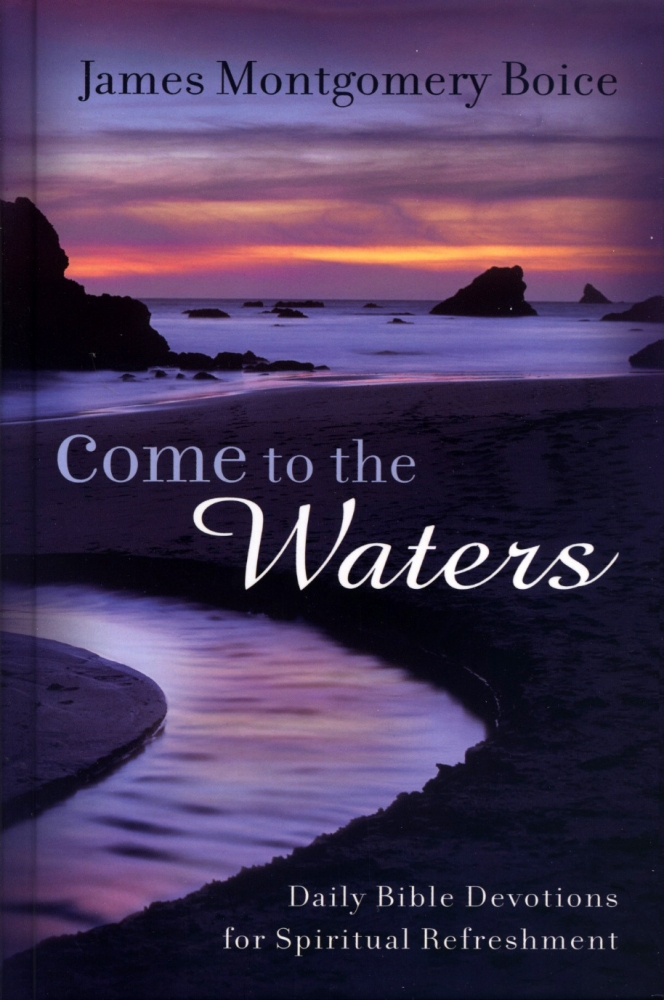
     This week's "thought" is called "Shut in by God"  It comes from a book of daily devotions complied from the writings of James Montgomery Boice, who served at 10th Presbyterian Church in Philadelphia for over 30 years before his relatively early death in 2000 at the age of 61.  Boice was a  gifted and well-known Bible teacher who held degrees from Harvard, Princeton, and the University of Basel in Switzerland, and whose "Bible Study Hour" radio program can still be heard on air and online. This is the devotional entry for - January 8th (today!) -- and offers three lessons we can learn from the biblical narrative regarding Noah and his family. Enjoy.


Shut in by God
"And the Lord shut him in..." 
Genesis 7:16


     "Consider these three lessons.
     FIRST, when the Lord shut Noah and his family up in the ark, they were totally secure and thereby become an illustration for us of the believer's perfect security in Jesus Christ. The rains    would come. The floods would rage. But nothing would touch these who had been sealed in the ark by Jehovah.  The Lord does not place the safety of his people in the hands of others. He himself throws the bolt-lock. It is said of him, "What he opens no one can shut, and what he shuts no one can open" (Rev. 3:7 NIV) The shutting in of Noah was the equivalent of our being sealed with the Holy Spirit (Eph. 4:30).  Like him we are not only saved; we are secure as well.
     SECOND, there is a lesson of God's great grace. The last thing we are told in this story before the waters actually begin to come is that, 'the Lord shut him in" (v. 16).  Presumably this was done at the last possible moment.  Noah had been preaching God's righteousness, man's sin, and warning of the great flood for years and years, but no one had believed him. They were still refusing to believe. Yet the door to the ark remained open, and any who wanted to could have gone inside. What great grace!  What magnificent forbearance on the part of God!  Since Noah had believed and had gone in, no one still outside could say that the possibility of belief was closed to him. "Whoever willed" could come. So it is today. All who will may come. Many do not, but none of these can say that the possibility of repentance from sin and turning to Christ are beyond them. 
     FINALLY, there is a lesson in that there is an end to grace. Grace is great, but it is not unending. If it is spurned, the day of reckoning eventually comes. For one final week the door stood open. But the week ended, the door was closed, and the flood came. The same God who opens doors is himself the door (John 10:7 & 9).  He also closes doors and refuses to open them when the time of grace is gone.  For you it is not yet past, whoever you may be.  This is still the day of grace, and though it will end, it has not ended yet.  Won't you come while there is still time?  God said to Noah, "Come... into the ark" (Gen. 7:1). At the end of the Bible we read, "The Spirit and the Bride say, 'Come!' And let him who hears say, 'Come!' And let him who is thirsty come; let the one who desires take the water of life without price" (Rev. 22:17)." 
     Grace is the most wonderful thing! Nothing in all the earth compares with it!  And though it is God's nature to be gracious, and the riches and glory of His grace will be (and should already be) the source of endless praise among the recipients of it, the Bible makes clear (as Boice rightly notes), that God's offer of grace will one day end.
     Isaiah 61:2, in speaking of the ministry of Jesus, states that He was to: "proclaim the year (or time) of the LORD's favor (grace), and the day of the vengeance of our God."  And Jesus did just that. He fulfilled this prophecy about Himself by proclaiming the "year" (the time, season, or epoch) of God's grace in light of the coming day of judgment. He did not preach that grace did away with God's justice and judgment forever, but that God in His great mercy was offering grace to all now in light of the impending Day of Judgment which is to come.
     The Gospel declaration (like Noah's message to the people of his day) was, "Come for safety and salvation now!  Hurry! For the day is coming when the door of God's grace and mercy will close, and the time of judgment will begin for all who have not entered in."   Peter proclaimed that  message in Acts 2:38-41 on the Day of Pentecost.  And Paul proclaims it as well in II Cor. 5:20 - 6:2.
     It assures us that the call of the Gospel must always have a sense of urgency to it.  For it's message is not, "Grace to everyone now and forevermore," it is, "Now is the time of God's favor! Today is the day of salvation! Come to Christ for mercy now, for the day of wrath and divine judgment is coming" (II Cor. 6:2, I Thess. 1:9-10, II Thess. 1:3-10).  Yes, Scripture assures us that there will come a day when the door of God's grace -- like the door on the ark -- will one day be shut and all left outside (all who spurned His offer of grace in Jesus) will experience God's great wrath.
     So come now, says Scripture!  Whosoever will, come!  Be sure you come to Christ before the door of God's free offer of grace is closed to you forever.
     If any of you have not yet come, I pray that by God's grace you would, and without delay.

In the Service of the Gospel, Pastor Jeff

1.02.2019

Attitude Adjustment

Greetings All!

     What does one do when they find their job unfulfilling?  One answer?  Try looking at their job in a different light.
     I was searching through my documents (looking for something else) when I found this "thought" which I saved over a year ago. It was written by Gene Twilley, who works for CCO (Coalition for Christian Outreach) and oversees CCO staff who work on college campuses doing outreach in the Philadelphia area.  I felt his insights could help those caught is a similar predicament, so I thought I would pass it along as we begin 2019.  It is entitled "Attitude Adjustment."  Most all of us could use that on one occasion of another!  Enjoy.


Attitude Adjustment

     "Eight months after finishing my undergraduate studies, I started working as an auto liability claims adjuster for a very large insurance company. There were ample benefits with the job—from day one, I was vested in a matched 401k; I had a pension, nearly a month of vacation per year, and great health benefits.  I loved the people I worked with An older African-American woman called me her newly adopted son. We worked in collaborative cubicles—four to a large cube—and laughed a lot.
     But I hated the work.  In a claims environment, every call is a complaint The workload is heavy. I was threatened with physical violence over the phone, bullied with potential lawsuits, and accused of all sorts of character flaws.  There were and are far worse places to be employed. But in the moment of any sort of seemingly bad circumstance, we don’t usually think about what could be worse. We long for something better.
     Then my wife and I attended a wedding for one of her co-workers, and I was making small talk with a woman I didn’t know, and who I probably wouldn’t recognize if I saw her today.  In the midst of conveying to her what I did, before I had the opportunity to complain about my job, she exclaimed, “How exciting! You have the opportunity to help put people’s lives back together every day.”

Sobering.
Clarifying.
Convicting.
     I was willing to approach my work as a Christian who had hope in Jesus, but not as a Christian who had hope that my work actually mattered.  I don’t know where this woman was in terms of faith, but she pointed out something that I was completely missing.
     Isaiah 61 is a messianic prophetic utterance. Jesus took up this section, read it in a synagogue in Nazareth, and explained, “Today this Scripture has been fulfilled in your hearing” (Luke 4:21).

     He was anointed to preach good news to the poor.
     He was sent to proclaim liberty to captives.
     He was sent to give sight to the blind
     He came to release the oppressed.

     In all of that, Jesus was announcing the “year of the Lord’s favor.” In the broader context of Isaiah 61, we see other really good things too! There is comfort for those who mourn. Those who sit in shame and in repentance are made beautiful. They are planted deeply into God’s grace, that they might praise rather than mourn. The people of God are called by the Servant of God to be re-creators of things that are broken… All that hope, that expectation, that rebuilding of the things that have been broken—it’s in Isaiah 61. It all finds its beginning, current, and end in Jesus.
     And this is the kind of hope that can lift me out of myself and all my meandering thoughts about greener pastures. I start to ask different questions.  After all, aren’t we called to care about the situations that God has placed us in, the broken places already in our midst? How can we make the most of our God-given opportunities today? How might we redeem the time that he’s given into our possession?
     As a claims adjuster, I was occupied with my work—getting through the day, looking for the next best thing. It was a job, not a calling.  Or was it?  What if every opportunity to serve others is a calling from the Lord?  Tim Keller explains, “our work can be a calling only if it is re-imagined as a mission of service to something beyond merely our own interests. Thinking of work mainly as a means of self-fulfillment and self-realization slowly crushes a person.”
     Calling is found at the sweet spot where my vertical and horizontal relationships meet—where I love the Lord and where I love my neighbor. Too often, maybe we’re disappointed with where we are because we simply don’t see the potential of the work ahead of us. But what if some of us are so concerned with our own emptiness that we don’t see the joy set before us?  Isaiah 61 tells a bigger story, and in this story, work becomes service, pain becomes joy, and despair becomes hope.  Come, Lord Jesus. Give us eyes to see." 
     Where might an "attitude adjustment" (or simply looking at something from a different perspective) help you in your struggle to find fulfillment in something which is not at present?  Only you can know. But it is worth pondering!

Living in the Grace of Jesus, Pastor Jeff 


11.27.2018

Attitude Adjustment

Greetings All!

     This week's "thought," which comes to you from F. Congreve, has to do with a commonly needed "attitude adjustment" in the believers heart and mind.  For as believers in Jesus we can sometimes we fall into the trap of thinking (because of the sinful things we did in our past) that we should not be joyful. That joy would be wrong.  That being joyful would somehow imply we didn't take our past sins seriously enough. But often just the opposite it true.  The sense that we must remain sullen comes not from the fact that we haven't taken our past sin seriously enough, but that we haven't taken divine forgiveness seriously enough!  For if we are forgiven - truly forgiven by God - how can we not experience joy, even despite the sinful things we may have done.
     Hopefully today's thought will reinforce that truth.  If God has forgiven your sins there are only two reasonable responses: 1.) Tears of joy and gratitude (Luke 7:38) and 2.) smiles of joy and gratitude.  But never should the knowledge of our gracious forgiveness lead to a conscious attempt on our part to repress the sense of joy that should follow!  For as Paul says, "Blessed is the person whose sins are forgiven; whose transgressions are covered. Blessed is the man whose sin the Lord will never count against him" (Rom. 4:7-8).  Enjoy.
     "The feast which Levi gave to our Lord Jesus on the occasion of his conversion (Luke 5:27-35) is such a cheerful metaphor of the Christian life.  It is a festival of joy and gratitude for a conversion.  We are sinners forgiven - abundant reason for perpetual praise.  A feast represents a forgiven sinner's whole course; he is embraced, welcomed home, and has brought more joy to heaven than there was before.  His sorrow for sin is not a mortified, humiliated, angry disgust with himself.  It is a humble, hopeful sorrow always 'turning into joy'.  So, if his very sorrows become the material for his joy, his life may be represented by the feast Levi gave to the Lord, who had forgiven and called him. 
     "But I am unworthy of joy," says the forgiven sinner.  "I am willing to work and suffer if need be. I don't deserve joy."  That is the sentiment true of a pagan, but it contradicts the whole Creed of the Church - "I believe in...the forgiveness of sins."  So, our life ought to be full of the joy of grateful love; the remembrance of sin means the remembrance of the love that called us out of our sins and forgave us our whole sin-debt.
     And notice that Levi did not just make Jesus a feast, he made Jesus a great feast.  It is not that we are to be cheerful for our own gratification.  Our life is to be full of praise and thanksgiving, singing and making melody in our hearts to the Lord - for the honor of Jesus.  Levi made the great feast for Him.  Our habitual joy is due God, and honors God, and our joy means not simply a reflection of the joy of God, but is the joy of God... If we are sinners forgiven, we ought to behave as forgiven, welcomed-home sinners. People crowned with wonderful love in Christ. We should cheer and encourage everyone around us, who often go about so heavily because we have reflected our gloom upon them instead of our grateful love, hope and confidence."
     It's a thought worthy of prayerful consideration!

Living in the Grace of Jesus, Pastor Jeff

7.10.2018

Spiritual Inebriation


Greetings All!

     I have always contended that who we become in life has to do, not only (of course) with the direct input of God into our lives through His Word and His Spirit, but the guidance, influences, and input of other people whose wisdom and counsel and insights we have sought out. This is one of the reasons I always check out the libraries of other people!  I want to see who they have turned to for guidance and inspiration, and have thus, in some way, helped form them.  James Stuart Bell also understands this principle. And therefore he sought to inquire who the authors were that influenced the life of someone he admired -- A. W. Tozer.


     This selection, therefore, comes from his book, "From the Library of A. W. Tozer -- Selections from Writers Who Influenced his Spiritual Journey."   This particular excerpt (only one of hundreds in his book) is from a book in Tozer's library by Jan Van Ruysbroeck's (or John of Ruusbroec, born in 1293 A.D. near Brussels, Belgium) called, "The Adornment of the Spiritual Marriage."  In this selection he speaks of one of the joys of being the Bride of Christ -- "Spiritual Inebriation."  Enjoy.
Spiritual Inebriation

"The joy of the Lord is our strength."
Nehemiah 8:10

"Do not be drunk with wine, with leads to debauchery, 
but instead, be filled with the Holy Spirit."
Ephesians 5:18
     "Spiritual inebriation is this: that a man receives more sensible joy and sweetness than his heart can either contain or desire.  Spiritual inebriation brings forth many strange gestures in men. It makes some sing and praise God because of the fullness of joy, and some weep with great tears because of the sweetness of heart.  It makes one restless in his in all his limbs, so that he must run, jump, and dance, and so excites another that he must move and clap his hands.  Another cries out with a loud voice and so shows forth the plenitude his soul feels within, and another must be silent and melt away because of the rapture which he feels with all his senses.
     At times he thinks that all the world must feel what he feels; at times he thinks that none can taste what he has attained. Often he thinks that he never could, nor ever shall, lose this sense of well-being; at times he wonders why all men do not become God-desiring.  At one time he thinks that God is for him alone, or none other as much as him; at another time he asks himself with amazement of what nature these delights can be, and whence they come, and what happened to him.
     This is the most rapturous life (as regards our bodily feelings) which man may attain upon earth.  Sometimes the excess of joy becomes so great the man thinks that his heart must burst. And for all these manifold gifts and miraculous works, he shall, with a humble heart, thank and praise and honor and reverence the Lord, who can do all this, and thank Him with fervent devotion because it is His will to do all this.  And the man shall always keep in his heart and speak through his mouth with sincere intention: "Lord, I am not worthy of this. Yet I have need of Your boundless goodness and of Your support." In such humility he may grow and rise into higher virtues." 
     On the day of Pentecost unbelievers accused the disciples of being drunk (Acts 2:15).  Why?  Surely it was because of the sheer joy they felt, and the glow on their faces that attested to it (similar to what is described above) when the Holy Spirit came and fell upon them on that day.  After all, it was only 9:00 o'clock in the morning and they were obviously full of intense joy and energy (or the Spirit's "power" - Acts 1:8 - or dunamis in the Greek, the same word from which we get our English word "dynamite").  Of course, speaking in tongues (or languages they had not learned) may have played into it as well!
     Though some fear the intense emotions that can often attend centered prayer, joyful worship, or the experience of the Holy Spirit, it did seem to be part of the experience of the early disciples and apostles. Have you experienced such times? Have you ever found your heart so full of joy it was hard to contain?  Ever been moved to sing, praise, clap, cry or dance, touched as you were by the overwhelming sense of God's grace, goodness and love?  Ever sensed the presence of God's holiness and complete otherness in such a way that it moved you to feel that to even speak a word, or simply move, would have been inappropriate and irreverent?   Have you ever become so conscious of the reality and presence of God that it altered the way you viewed everything happening around you, and made even the most common things beautiful and sacred?
     Such experiences are not uncommon in Scripture. And dare I suggest that if we pursued God with the intensity of many of those in Scripture, we might find such experiences more commonplace too? 

Living in the grace of Jesus, Pastor Jeff