Visitors

free counters
Showing posts with label Leland Ryken. Show all posts

6.28.2016

Puritans

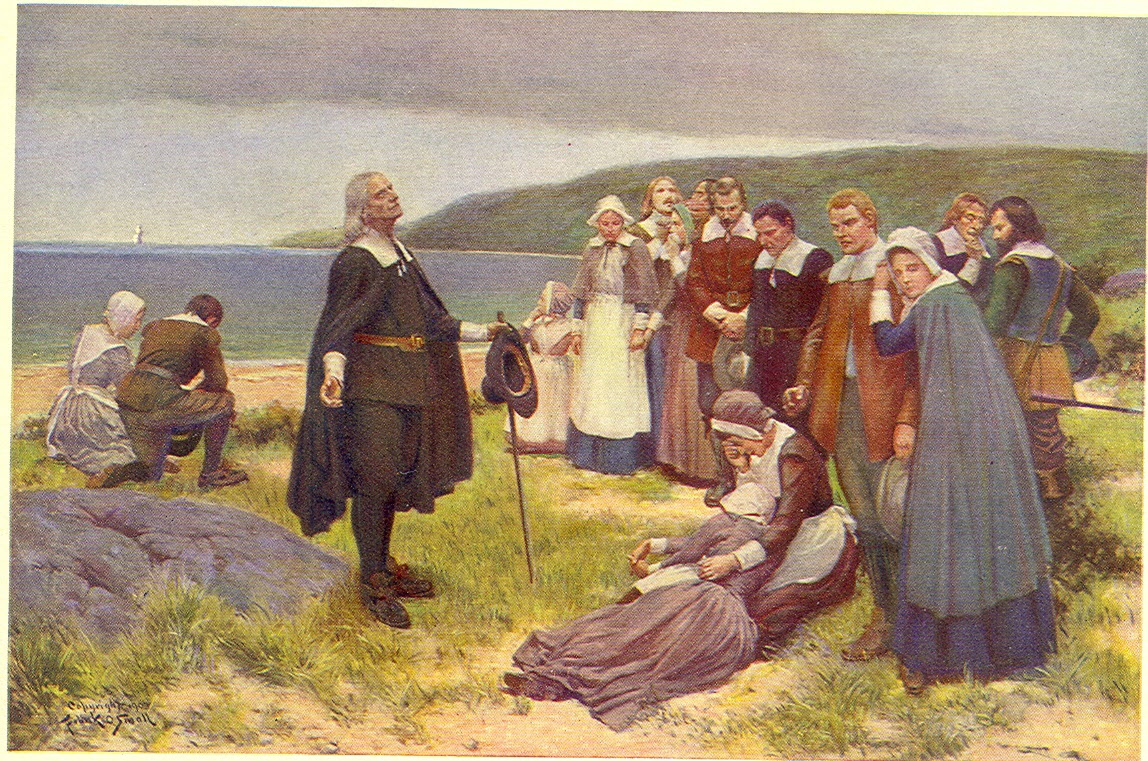
Greetings All!

     This week's "thoughts" come to you from a selection of different Puritans. Yes, Puritans!  I know many are prejudiced against the Puritans from the start (often by exposure to exaggerated and untrue propaganda) but I would ask you (if you are such a person) to let them speak for themselves and not read them through the filter of another person's opinion of them.  Ryken's Book "Worldly Saints" is a wonderful corrective to many of the common myths.
Overall (with a few minor exceptions) they were a very gospel-centered and grace-oriented group of people. Yet you would only know that if you took the time to read the things they actually wrote themselves, instead of things others have written about them (often without ever having taken the time to do what I just suggested)!  After all, wisdom and fairness would say we should never formulate an opinion of someone until we get to know and interact with them personally.
     So, with that said, here are some "Puritan" thoughts! In terms of a time frame, the vast majority lived between the years 1600 - 1690.   Enjoy.

     "The man whose heart is endeared to the woman he loves... dreams of her in the night, has her in his eye and apprehensions when he awakes, muses on her at he sits at table, and walks with her when she travels... She lies in his bosom, and his heart trusts in her, which forces all to confess that the stream of his affection, like a mighty current, runs with full tide and strength." 
Thomas Hooker
     "There is no relationship more near, more entire, more needful, more kindly, more delightful, more comfortable, more constant, more continual, than the relationship of a man and his wife, the main root, source, and origin of all other relationships." 
Thomas Gataker

     "Creatures, like pictures, are most beautiful from a distance.  But it is not so with Christ. The nearer the soul approaches Him, and the longer it lives in the enjoyment of Him, still the sweeter and more desirable He becomes... He is bread to the hungry, water to the thirsty, a garment to the naked, and healing to the wounded. Whatever a soul can desire is found in Him."
John Flavel

     "What is the Gospel itself but a merciful moderation, in which Christ's obedience is esteemed ours, and our sins laid upon Him, wherein God, from being a judge, becomes our Father, pardoning our sins and accepting our obedience, though feeble and blemished."
Richard Sibbes
     "Men would sooner believe that the Gospel is from heaven, if they saw more of its heavenly effects in the hearts and lives of those who profess it."
Richard Baxter

     "One word of seasonable, prudent advice, given by a minister to persons in need, may be of more use than many sermons."
Richard Baxter

     "It is the same impossibility for a thing to be created out of nothing, as to be created by nothing." 
William Law

     "He only that stills the stormy seas, can quiet the distressed and tempestuous soul."
John Flavel
     "A man may easier see without eyes, or speak without a tongue, than truly mortify one sin without the Spirit."
John Owen

     "Humility is a strange flower -- it grows best in winter weather and under storms of affliction."
Samuel Rutherford

     "There are two aspects to love; the one is to give, the other is to forgive." 
John Boys

     "In marriage a husband must choose his love, and then he must love his choice." 
Henry Smith
     "God commands nothing but what is beneficial...  To obey God is not so much our duty as our privilege." 
Thomas Watson

     "If you neglect instructing your children in the way of holiness, will the devil neglect to instruct them in the way of wickedness? No. If you will not teach them to pray, he will teach them to curse, swear, and lie.  If ground remain uncultivated, weeds will spring up on it."
John Flavel

     "Prayer will make a man cease from sin, or sin will entice a man to cease from prayer."
John Bunyan
     "All married persons must above all things, love, respect and cherish grace in one another."
Thomas Taylor

     In the Bonds of Christian Affection, Pastor Jeff

10.13.2011

On the Puritans

Greetings All,
 
       This week's "thought" has to do with a group of people who are often wrongly maligned and accused of being or doing things they did not do (or at least not to the degree people say).  They are the Puritans.  We've been studying them for a couple weeks now in our adult Sunday school class and approaching our study from the standpoint of, "What the Puritans were really like, as opposed to what people often say or think they were like."  What we've found is that the gap between the two is often huge.  I discovered that same thing when I did my doctoral dissertation on the Puritans and actually started reading them, instead of what others (like Nathaniel Hawthorne) said about them.   
 
       In this regard I highly recommend Leland Ryken's book: "Worldly Saints: The Puritans As They Really Were."  If you love history as opposed to fiction, it's a treasure trove of quotes from actual Puritans sermons and books showing what they really believed.  And with Thanksgiving coming up shortly (for those of you in the U.S. anyway!), it would be a great way to clear up many of the common misunderstandings (both secular and religious in origin) and at least give them a fair shake -- especially since the Pilgrims were themselves Puritans. 
 
      These thoughts come from two sources:  J.I. Packer's book, "A Quest for Godliness - The Puritan Vision of the Christian Life," and from Edmund S. Morgan's book, "The Puritan Family."  The quotes (I believe) rightly sumarize the Puritans, though you (if you've swallowed Hawthorne's warped perspective hook, line, and sinker) may find what they say a bit surprising.  If so, maybe its a good time to go out and purchase a few books!  In addition to Ryken's book, J. I. Packer's list of other authors (stated below) would be a good place to start.  I offer these thoughts to challenge common modern day misconceptions often held by people who have interestingly never once read a Puritan author!
Enjoy.
 
J. I. Packer writes: 
 
    "Taught by Perry Miller, William Haller, Marshall Knappen, Percy Scholes, Edmund Morgan and a host of more recent researchers, informed folk now acknowledge that the typical Puritans were not wild men...  The belief that the Puritans, even if they were responsible citizens, were comic and pathetic in equal degree, being naive and superstitious, primitive and gullible, super-serious, over-scrupulous, majoring in minors and unable and unwilling to relax, dies hard. (Knowledge, alas, travels slowly in some quarters.)
 
 What do the Puritans have to offer us? 
 
    "The answer, in one word, is maturity.  Maturity is a compound of wisdom, goodwill, resilience, and creativity.  The Puritans exemplified maturity; we don't.  We are spiritual dwarfs.  A much-travelled leader, a native American (be it said), has declared that he finds North American Protestantism, man-centered, manipulative, success-oriented, self-indulgent and sentimental, as it blatantly is, to be 3,000 miles wide and half an inch deep.  The Puritans, by contrast, as a body, were giants.  They were great souls serving a great God.  In them clear-headed passion and warm-hearted compassion combined.  Visionary and practical, idealistic and realistic too, goal-oriented and methodical, they were great believers, great hopers, great doers and great sufferers.  But their sufferings, on both sides of the ocean (in old England from the authorities and in New England from the elements), seasoned and ripened them until they gained a stature that was nothing short of heroic.  
 
     Ease and luxury, such as our affluence brings us today, do not make for maturity; hardship and struggle however do, and the Puritans' battles against the spiritual and climatic wilderness in which God set them, produced a virility of character, undaunted and unsinkable, rising above discouragement and fears, for which the true precedents and models are men like Moses, and Nehemiah, and Peter after Pentecost, and the apostle Paul.  
 
    Spiritual warfare made the Puritans what they were.  They accepted conflict as their calling, seeing themselves as their Lord's soldier-pilgrims, just as in Bunyan's allegory, and not expecting to be able to advance a single step without opposition of one sort or another.  Wrote John Geree, in his tract, The Character of an Old English Puritan or Nonconformist (1646): 'His whole life he accounted a warfare, wherein Christ was his captain, his arms, prayers and tears. The Cross was his Banner, and his word [motto] was, Vinicit qui patitur [He who suffers conquers].' 
 
    The Puritans lost, more or less, every public battle that they fought.  Those who stayed in England did not change the Church of England as they hoped to do, nor did they revive more than a minority of its adherents... Those who crossed the Atlantic failed to establish a New Jerusalem in New England; for the first fifty years their little colonies barely survived.  They hung on by the skin of their teeth.... [Yet] It was out of this constant furnace-experience that their maturity was wrought and their wisdom concerning discipleship was refined.  George Whitfield, the evangelist, wrote of them as follows: 'Ministers never write or preach so well as when under the cross; the Spirit of Christ and of glory then rests upon them.  It was this, no doubt, that made the Puritans such burning and shining lights... Though dead, by their writings they yet speak; a peculiar unction attends them even to this very hour." 
 
Edmund S. Morgan writes:


     "In a thousand sermons they repeated to their congregations that religion was not morality, that righteousness in society was not righteousness before God, that salvation, not civilization, was the chief goal of man, and that salvation was unattainable by good behavior.  Only faith in Christ could bring redemption from the sin of Adam, and faith was the free gift of God, not to be won by human efforts.  'Not man, but God alone is the author of regeneration,' they insisted, 'so men are altogether passive in their conversion, and the Eternal Spirit is the only principal Agent therein.' ...
 
      [God] provided not only salvation but also the faith for which salvation was the reward.  Faith was not attainable by mere human volition.  It was a belief inspired by the Almighty in those whom He wished to save.  And with it came sanctification, a gradual restoration of the faculty for obedience.  As long as a man remained on earth, the restoration must be incomplete, but as soon as it began, the man would demonstrate the fact in his outward behavior.  He would, so far as possible, love his neighbors and endeavor to obey the laws of God.   He would be, in Puritan terms, a 'visible saint.' "
 
 
   With prayers that you'll take the time to research such statements more fully, and if you disagree with them, then prove them false by actually reading Puritan authors such as Richard Sibbes, Thomas Watson, Christopher Love, William Gurnall, John Bunyan, Thomas Boston, William Bridge, Thomas Brooks, Stephen Charnock, John Owen, Jeremiah Burroughs, and the like,  
 
Pastor Jeff