Visitors

free counters
Showing posts with label Scripture. Show all posts

11.26.2019

Brokenness is the Pathway to Spiritual Fruitfulness

Dear Friends,

     Today's "thought" confronts us with a reality we sometimes wish were not so.  Yet, it's a truth proclaimed both in Scripture and from the mouths or pens of numerous saints throughout history: Brokenness is the pathway to spiritual fruitfulness.  Before God can truly use you, He must first break you.  As much as we might wish it were otherwise, it is true. This selection comes from the devotional, "Streams in the Desert" by L. B. Cowman (with added content).  Enjoy.

“The sacrifices of God are a broken spirit;
a broken and contrite heart, O God,
you will not despise.”
Psalm 51:17
     “Those people God uses most to bring glory to Himself are those who are completely broken, for the sacrifice He accepts is, "a broken and contrite heart.”  It was not until Jacob’s natural strength was broken, when “his hip was wrenched” at Peniel (Gen. 32:25), that he came to the point where God could clothe him with spiritual power.  It was not until Moses struck the rock at Horeb, breaking its surface, that cool “water flowed out of it for the people to drink” (Ex. 17:6).  It was not until Gideon’s three hundred specially chosen soldiers “broke the jars that were in their hands” (which symbolized brokenness in their lives, Judg.7:19), that the hidden light of the torches shone forth and brought terror to their enemies.
     It was once the poor widow broke the seal on her only remaining jar of oil and began to pour it out that God miraculously multiplied it to pay her debts and thereby supplied her means of support (2 Kings 4:1–7).  It was not until Esther risked her life and broke through the strict laws of a heathen king’s court that she obtained favor to rescue her people from death (Est. 4:16).  It was only when Jesus took “the five loaves . . . and broke them” (Luke 9:16) that the bread was multiplied to feed the five thousand.  It was through the loaves being broken that the miracle occurred.  It was when Mary broke her beautiful “alabaster jar of very expensive perfume” (Matt. 26:7), and destroyed its future usefulness and value, that the wonderful fragrance filled the house.
     Mary (the mother of Jesus) was not only told of the joy of her being chosen by God to give birth to the Messiah, but that her heart would be pierced also -- cut and broken in two, as if by a sword. Overwhelming grief would cut deep into the joys of bearing and raising Jesus.  Peter was broken of his stubborn pride through the crushing and humiliating experience of denying Jesus three times in His hour of greatest need. Yet, through such failure and humiliation, he was made more humble and dependent on the Spirit, readied through the pain of brokenness to lead the early church.  Heartless Paul was broken on the road to Damascus as Christ appeared to him and blinded him, and he was led helpless, dazed, humbled, and broken in spirit, into the city, like a little child.  Likewise, it was when Jesus allowed His precious body to be broken by thorns, nails, and a spear, that His inner life was poured out like an ocean of crystal-clear water for thirsty sinners to drink and live! 
     It is not until a beautiful kernel of corn is buried and broken in the earth by DEATH, that its inner heart sprouts heavenward and grows to produce hundreds of other seeds or kernels. And so it has always been throughout history — GOD USES BROKEN THINGS.  Those who have been gripped by the power of the Holy Spirit and are used for God’s glory are those who have been broken in their finances, broken in their self-will, broken in their ambitions, broken in their lofty ideals, broken in their worldly reputation, broken in their desires, and often broken in their health.  Yes, He uses those who are despised by the world and who seem totally hopeless and helpless, just as Isaiah said: “The lame will carry off plunder” (Isa. 33:23).
     ‘Oh, break my heart; but break it as a field is plowed and broken for the seeds of corn… Oh, break my heart; break it, victorious God, that life’s eternal well may flow abroad... Break it as when the captive trees, breaking icy bonds, regain their liberties.  And as thought’s sacred grove to life is springing, be joys, like birds, their hope, Your victory singing.’ (Thomas Toke Bunch)”
     This theme is spoken of repeatedly throughout church history.  Martin Luther once wrote in similar terms suggesting: “God creates out of nothing. Therefore, until a man nothing, God can make nothing out of Him.”  Another saint said, “God always builds on ruins.”   Alan Redpath said: “God will never plant the seed of His life upon the soil of a hard, unbroken spirit. He will only plant that seed where the conviction of His Spirit has brought brokenness, and where the soil has been watered with tears of repentance as well as tears of joy.”   Hudson Taylor the famous missionary to China said, “When God wants to do His great works, He trains somebody to be quiet enough and little enough, and then He uses that person.”  Revival, says Isaiah, comes not to those who think they have it together, but to the broken: “This is what the high and lofty One says – He who loves forever and whose name is holy: “I live in a high and holy place, but also with him who is contrite and lowly in spirit, to revive the spirit of the lowly and revive the heart of the contrite.” (57:15).  Being broken is never pleasant, but it is the path that leads to spiritual fruit and usefulness.
     The way God makes us whole is to permit us to go through experiences that "break us" — because brokenness is the pathway to wholeness and restoration.  Pride is like steel that must be softened in the heat of the furnace before it becomes something that can be formed and molded.  The human heart is by nature like hard parched ground which must be watered with tears, and broken by the plow of trials, before the seed of His word can penetrate and take root. The will of man is like a hard lump of clay which the Potter must first pound and squeeze and stretch and then repeat the process all over again, before he can then take it and make it into a beautiful piece of colorful pottery.  Lord, how we wish there was an easier way... 

In His Service, Pastor Jeff


10.01.2019

It Is Well With My Soul

Greetings All,

     My daughter Bekah sent me the link to this devotional by Tori Kelly the other day, because she knows Horatio Spafford's hymn "It Is Well With My Soul" is one of my favorites. I opened it, read it, felt there was much honest transparency and biblical truth in it, and therefore thought I would pass it along to you. I trust it will encourage and speak to you as well.  Enjoy.

SOUL’S ANTHEM (IT IS WELL)

     Suffering is guaranteed in this life. The devil is always throwing fiery darts at us. Right now in this moment he’s trying to attack my family, my health, my relationships, and my peace. He’ll do anything to take my eyes off of Jesus.  He wants to take everything away from me, and most importantly, he wants to take my faith.
     Our faith is not grounded in our circumstances.  Neither can our joy in Christ be.  Recently, my grandfather passed away in the time I felt I needed him most.  I felt like I had lost my best friend. It was so painful to go through and I cried so much -- until my eyes had nothing left.  But through every tear, God was with me in those hard moments. I could still be in a dark and lonely place, and even be mourning, but my joy could not be stolen because it is secured in Jesus.  No matter what happens, no matter what arrows are thrown my way, no matter how dark it gets, I know I will be okay.  It’s not always easy to believe, but I know that when I remind myself that God is in control I find rest and am able to sing, “it is well with my soul.”
     Most importantly, I can always sing “it is well” because God spoiled the movie for us and we get to know how this story ends. “It is well with my soul” because there is a place called heaven where death will be no more, every tear will be wiped away, and any tears shed in this life will be redeemed (he has bottled each one).
     Maybe your suffering is different than losing a grandfather. Maybe it’s worse. Maybe it’s as bad as the writer of “It is Well” who lost his entire family in the days prior to when he penned this hymn.  Even still, God says all of it is not even worthy to be compared to the glory to come to us.  Like an adult reflecting on his experience in kindergarten, so believers in heaven will remember their suffering in this life, saying, “Oh yeah... I think I vaguely remember...”
     Suffering comes to each of us in a different way - broken relationships, physical illness, economic hardships, loss, crime, slander, betrayal, depression, humiliation, you name it. Scripture assures us of this. Jesus assures his disciples of this. "In this world you WILL have trouble (tribulations). But take heart!  I have overcome the world" (John 16:33).  Jesus never promises us a trouble-free life in this world. His promised overcoming of the world means, as Tori Kelly rightly points out, we already know how the story ends!  Jesus is the Victor!  It's already a done deal!  God has won!  The world loses!  And we get to be over-comers with him in the victory he's already won!
     John 16:33 was spoken prior to the cross and resurrection.  Yet it is spoken in the past tense - "I have overcome..."  It is spoken before the cross an resurrection, but with as much confidence and assurance in the promise as if those those things had already taken place!  (If only they had truly "heard" him!)  In fact, in a very real sense the cross had already taken place, as John assures us in Revelation 13:8, where it speaks of Jesus as, "the Lamb slain from the creation of the world."   Jesus' ultimate victory of overcoming the world had already been decreed and determined and worked out in the providence of God before God ever created the world!  And we get to rejoice and participate in many of the benefits of that victory in this life (not all of them just yet), remembering as Paul assures us,  "Our light and momentary trials are achieving for us an eternal glory that far outweighs them all" (I Corinthians 4:17).
     Resting in the victory of God until the promise becomes our experienced reality in eternity, Pastor Jeff


8.06.2019

Thoughts on Leadership


Greetings All!

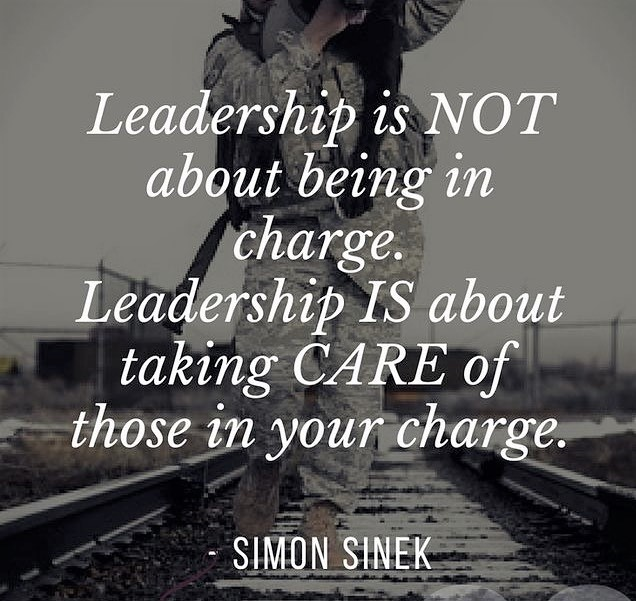
     This week's post is a collection of 25 quotes relating to leadership.  I post them for three reasons.  First, because it is my conviction that no matter who we are, someone is looking up to us as an example, or for guidance of one sort of another, which makes us a leader of sorts even when we don't have the title and didn't ask for the responsibility.  One does not have to be delegated the authority to carry out the role, and we can inadvertently carry out the role without even knowing we are!  The person simply trying to be an example to others is being a leader in their own right.
     The second reason I post them is because we can all gain insight and wisdom from leaders of the past who have shared what guided their leadership -- even if we don't consider ourselves to be one.  And last, I share it because as I looked hem over I was amazed how much current thought of leadership is little more than a confirmation (plagiarization of sorts) of the teaching of Jesus on the topic, or practical insights gained from His words and example, even when those giving the advice are not themselves Christians. I had many more than listed. I paired them down to 25. I offer them as the best of what I found.  If you have a favorite (or favorites) and have a chance, let me know which ones.  Enjoy.

Thoughts on Leadership

1. "The true test of a leader is this: A respect for that person that is so deep that people will continue following their lead even when the official title and delegated authority have been taken away."

2. “I start with the premise that the function of leadership is to produce more leaders, not more followers.”  Ralph Nader

3. “Leaders must possess courage.  Yet do not be mistaken: Courage is not the absence of fear; courage is the determination not to let our very real fears paralyze us, hold us back, or scare us into silence and inactivity when words and actions are what is needed.”
4. “You aren’t fit to lead until you know how to follow.  If you want to become a remarkable leader, follow a leader of character, conviction, and vision. Don’t ask people to follow you until you’ve humbly followed someone else. Following is perhaps the most neglected development principle of remarkable leadership… Follow advice from those more knowledgeable.  Follow a vision bigger than yourself.  Follow someone you respect.  Follow the most noble person available.  Follow someone who is going somewhere.  Remarkable leaders are remarkable followers. Admiration of big-egoed-leaders degrades us all.  Worry less about becoming a remarkable leader and more about becoming a remarkable follower.”   Dan Rockwell

5. “The chief characteristic of Christian leaders, Jesus insisted, is humility not authority, and gentleness not power… The authority by which the Christian leader leads is not power but love, not force but example, not coercion but reasoned persuasion. Leaders have power, but power is safe only in the hands of those who humble themselves to serve.”  John Stott

6. “A leader is one who knows the way, goes the way, and shows the way.”   John C. Maxwell

7. “Perfection is not attainable, but if we chase perfection, we can catch excellence.”    Vince Lombardi

8. “When everything seems to be going against you, remember that the airplane takes off against the wind, not with it...  I never failed, I just learned 10,000 ways that won't work.”   Henry Ford
9. “According to Scripture, virtually everything that truly qualifies a person for leadership is directly related to character.  It’s not about style, status, personal charisma, clout, or worldly measurements of success. Integrity is the main issue that makes the difference between a good leader and a bad one.”   John MacArthur

10. “Be strong enough to stand alone, smart enough to know when you need help, and brave enough to ask for it.”   Unknown

11. “True greatness, true leadership, is found in giving yourself in service to others, not in coaxing or inducing others to serve you.”   J. Oswald Sanders

12. "My research debunks the myth that many people seem to have… that you become a leader by fighting your way to the top. Rather, you become a leader by helping others to the top.  Helping your employees is as important as, and many times more so than, trying to get the most work out of them."   William Cohen

13. "The first and most important choice a leader makes is the choice to serve, without which one's capacity to lead is severely limited."    Robert Greenleaf

14. “The ability to learn is the most important quality a leader can have.”   Sheryl Sandberg

15. "We must be silent before we can listen.  We must listen before we can learn.  We must learn before we can prepare.  We must prepare before we can serve.  We must serve before we can lead."   William Arthur Ward
16. “To change your life, you have to admit what’s not working. You have to humble yourself. You have to ask for help. You have to learn... Your ego will defend your current circumstances, but you cannot allow a fleeting feeling of shame to eclipse reason. You cannot live the rest of your life as you are just because you are too prideful to admit something isn’t right.”   Brianna Wiest

17. “If your objective is to be as good as you can be, then you’re going to want criticism.”  Ray Dalio

18. "If leadership serves only the leader, it will fail.  Ego satisfaction, financial gain, and status can all be valuable tools for a leader, but if they become the only motivations, they will eventually destroy a leader. Only when service for a common good is the primary purpose are you truly leading."   Sheila Murray Bethel

19. “A leader takes people where they want to go. A great leader takes people where they don’t necessarily want to go but ought to be.”   Rosalynn Carter

20. "People do not care how much you know until they know how much you care."   John C. Maxwell
21. "When you get to be the president, there are the honors, the 21-gun salutes, all those things.  You have to remember it’s not for you.  It’s for the presidency…  It's amazing what you can accomplish if you do not care who gets the credit.”    President Harry S. Truman

22. "Be more concerned with your character than your reputation, because your character is what you really are, while your reputation is merely what others think you are."    John Wooden

23. “A man who wants to lead the orchestra must turn his back on the crowd.”   Max Lucado

24. "Do the thing you fear, and the death of fear is certain."   Ralph Waldo Emerson

25. "Servant leadership is all about making the goals clear and then rolling your sleeves up and doing whatever it takes to help people win.  In that situation, they don't work for you; you work for them."   Ken Blanchard
     So, what are the key characteristics of good leadership?  Humility, learning to be a follower, the heart of a servant, integrity, character, love, determination, a desire to see others excel, pushing beyond our fears, and many more. They are all virtues that anyone can apply to their lives.  And when we do, we may in some cases find people following our lead -- even when that wasn't our objective.

Living in His Grace, Pastor Jeff

7.23.2019

The Pursuit of Holiness

Greetings All,

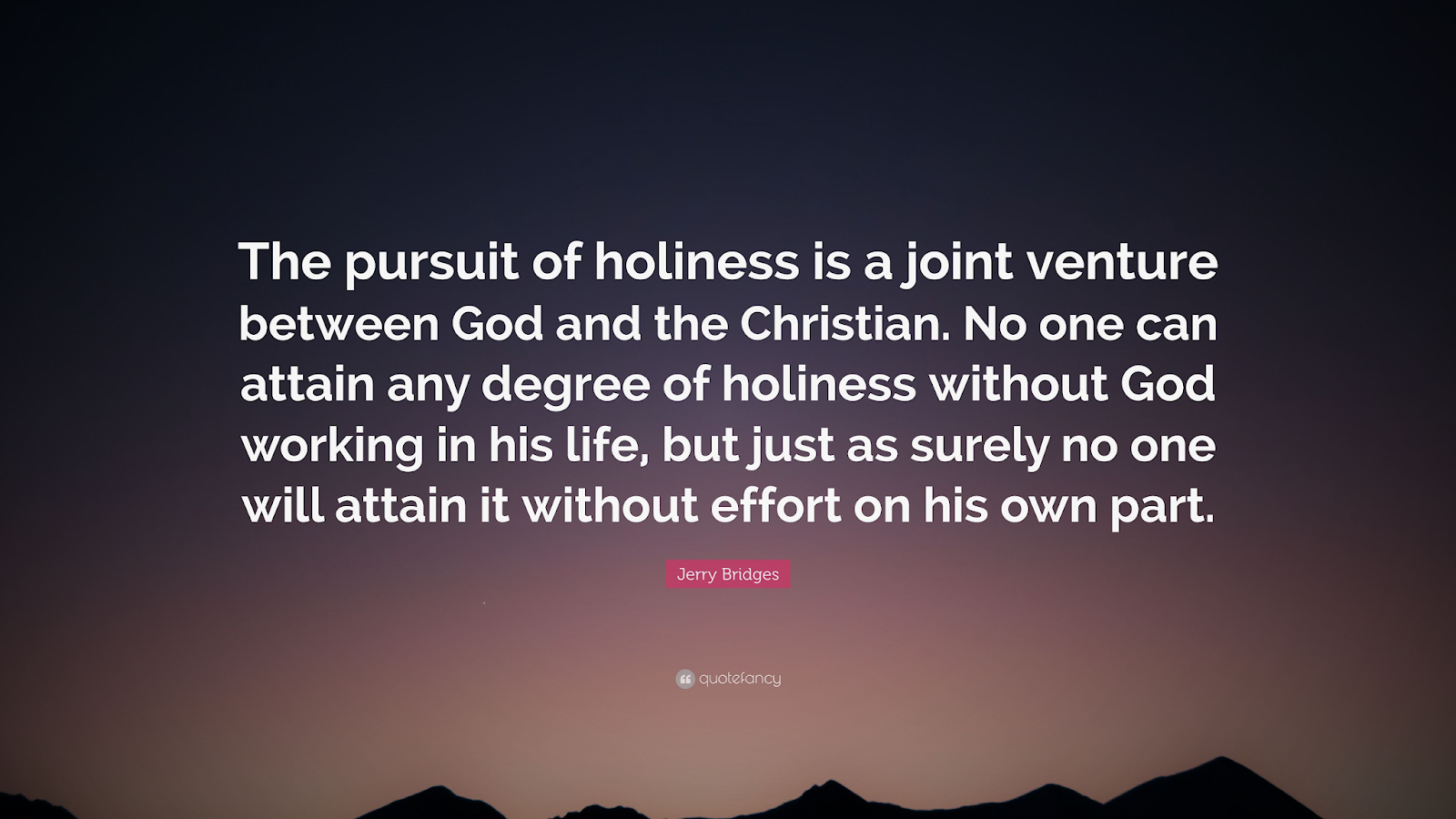
     This week's "thought" speaks of a topic which I don't hear much about any more -- holiness.  Therefore I thought it would be a good reminder for us all.  It is taken from Jerry Bridges book, "The Pursuit of Holiness."   I once had the privilege of hearing Mr. Bridges speak at a conference alongside John Piper, John MacArthur, and others. They were all good, but the one thing that struck me about Mr. Bridges (as opposed to the others, whose content was unquestionably superb) was his humility.  I can't remember all that he said, yet that was partly because I was so struck (distracted?) by the sense that here was a truly holy and humble man That's what stood out the most to me as I listened to him speak.  And it was confirmed a few years later when I took a class on "Grace and Discipline" with him while pursuing my doctorate. Thus I offer this selection on holiness from a humble man who took to heart the earnest pursuit of it.  Enjoy. 
     "God expects every Christian to live a holy life.  Holiness is not only expected; it is the promised birthright of every Christian.  Paul's statement in Rom. 6:14 is true: "For sin shall not be your master, because you are not under law, but under grace."  The concept of holiness may seem a bit archaic to our current generation. To some minds the very word holiness brings images of bunned hair, long skirts, and black stockings. To others the idea is associated with a repugnant "holier than thou" attitude.  Yet holiness is very much a Scriptural idea. The word "holy" in it's various forms occurs more than 600 times in the Bible.  One entire book, Leviticus, is devoted to the subject, and the idea of holiness is woven elsewhere throughout the fabric of Scripture.  More importantly, God specifically commands us to be holy (see Leviticus 11:44 / I Peter 1:16).
     The idea of exactly how to be holy has suffered from many false concepts.  In some circles, holiness is equated with a series of specific prohibitions -- no smoking, drinking, dancing, etc. The list of prohibitions varies depending on the group.  When we follow this approach to holiness, we are in danger of becoming like the Pharisees with their endless lists of trivial do's and don'ts, and their self-righteous attitude. For others, holiness means a particular style of dress and mannerisms. And for still others, it means unattainable perfection, an idea that fosters either delusion or discouragement about one's sin. All these ideas, while accurate to some degree, miss the true concept. To be holy is to be morally blameless. It is to be separated from sin and, therefore consecrated to God. The word signifies, "separation to God [to be set apart for God], and the conduct befitting those so separated."
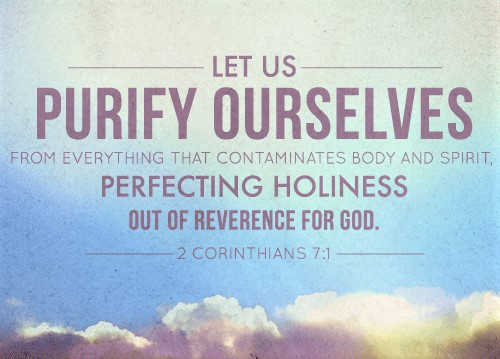
     Perhaps the best way of understanding the concept of holiness is to note how writers of the New Testament used the word.  In I Thessalonians 4:3-7, Paul used the term in contrast to a life of immorality and impurity.  Peter used it in contrast to living according to the evil desires we had when we lived outside of Christ (I Peter 1:14-16).  John contrasted one who is holy with those who do wrong and are vile (Revelation 22:11).  To live a holy life, then, is to live a life in conformity to the moral precepts of the Bible and in contrast to the sinful ways of the world. It is to live a life characterized by the "[putting] off of your old self, which is being corrupted by its deceitful desires.... and [putting] on the new self, created to be like God in true righteousness and  holiness" (Ephesians 4:22-24)...
     At the risk of oversimplification, the lack of personal holiness can be grouped into three basic problem areas:

     1st) Our first problem is that our attitude toward sin is more self-centered than God-centered. We are more concerned about our own "victory" over sin than we are about the fact that our sins grieve the heart of God. We cannot tolerate failure in our struggle with sin chiefly because we are success-oriented, not because we know it is offensive to God.  W S. Plumer said, "We never see sin aright until we see it as against God...  All sin is against God in this sense: that it is His law that is broken, and His authority that is despised.... As the returning prodigal said, "I have sinned against heaven and before you," and David said to God (after his adulterous affair with Bathsheba), 'Against You, and You only, have I sinned."  God wants us to walk in obedience, not victory. Obedience is oriented toward God, victory is oriented toward self...
     2nd) Our second problem is that we have misunderstood "living by faith" (Galatians 2:20) to mean that no effort at holiness is required on our part. In fact, sometimes we have even suggested that any effort on our part is, "of the flesh." The words of J. C. Ryle are instructive to us at this point: "Is it wise to proclaim in so bold, naked and unqualified a way as many do, that the holiness of converted people is by faith only, without any personal exertion?  Is it according to the proportion of God's Word?  I doubt it. That faith in Christ is the root of all holiness, no well-instructed Christian will ever think of denying.  But surely the Scriptures teach us that in following holiness the true Christian needs personal exertion and work as well as faith."  We must face the fact that we have a personal responsibility for our walk of holiness...
     3rd) Our third problem is that we do not take some sin seriously.  We have mentally categorized sins into that which is unacceptable and that which may be tolerated a bit... But the Scripture tells us it is, "the little foxes that ruin the vineyards" (Song of Songs 2:15).  It is compromise on the little issues that leads to greater downfalls...   As Andrew Bonar said, "Is the Lord to be obeyed in all things whatsoever He commands? Is He a holy lawgiver? Are all His creatures bound to give implicit assent to His will?"  Are we willing to call sin "sin" not because it is big or little, but because God's law forbids it?  We cannot categorize sin (suggesting some sins are ok and others to be avoided) if we are to live a life of holiness... Will you begin to take personal responsibility for your sin, realizing that as you do, you must depend on God's grace?  And will you decide to obey God in all areas of life, however insignificant the issue may seem to you?"
     When it comes to "holiness" most all people view it in slightly different ways.  Some as stern and joyless, others as restrictive and still others as refreshing.  And some, having been exposed to a counterfeit version of it (which was super-strict, joyless and judgmental) -- want nothing to do with it.  Yet, we are (as Bridges points out) called to pursue it, and to do something in our pursuit of it, for our struggle with sin does require resisting temptation, repenting of sin, clothing ourselves with Christ, putting to death the sinful nature, and so on. 
     We are often so afraid of hearing someone accuse us of being "legalistic" that we shy away from the pursuit of holiness, forgetting that what makes something "legalistic" is not personal effort, but the thought that by that effort we are earning salvific credits, or securing our justification with God. It is thinking our obedience earns us our salvation.
     Yet the pursuit of holiness is not like that. It is simply seeking to avoid that which grieves the heart of the God who has so loved us that He saved us.  It is working from grace, not for grace. It is working from the place of God's acceptance, not for a place in His acceptance.  And it must be said that just because we have God's acceptance through Christ, and the Gospel, doesn't mean we stop seeking to do what pleases Him. It simply means we are secure in His acceptance as we seek to please Him.  "Legalism" seeks to gain an acceptance it feels it doesn't have through it's efforts; a sanctified pursuit of holiness simply pursues godliness as it rests in the acceptance it knows by faith that it already has and can't lose -- that's why it can't be called legalism.

     Living in the Grace of Jesus as we pursue the holiness that is our Christian birthright, Pastor Jeff

7.09.2019

You Can't Take It With You

Greetings All,

     Today's "thought" is at the same time interesting, intriguing and convicting. It is a critique on our culture, and upon us at the same time.  It is worth reading simply because it's true, and the truth of it should make us do some inner reflection. It may even cause us to make some healthy changes or do some cleaning out. Above all it should make us consider what's important, reevaluate our priorities, and consider how we could better use our resources in a world with much so much need.
     It comes from John Ortberg's book (written with a somewhat satirical flair) "When The Game Is Over, It All Goes Back in the Box."   It is available in shortened form in, "You Can't Take It With You."  Enjoy.


Stuff, Stuff and More Stuff

     "We all have stuff. We see it, want it, buy it, display it, insure it, and compare it with other people's stuff.  We talk about whether or not they have too much stuff; we envy or pass judgment on other people's collections of stuff.  We collect our own little pile of stuff.  We imagine that if that pile got big enough, we would feel successful or secure. That's how you keep score in Monopoly, and that's how our culture generally keeps score as well. You get a large house, then you have to get stuff to put in it...
     There are now more than 30,000 self-storage facilities in the country offering over a billion square feet  for people to store their stuff. [That was in 2009 when the book was written. Today in 2019 it is estimated there are 52,000 and close to 2 billion square feet and growing!]  In the 1960's this industry did not exist. We now spend $12 billion a year [in 2018 it was $38 billion a year] just to pay someone to store our extra stuff!  It's larger than the music industry.  Psychologist Paul Pearsall comments on people finding it difficult to give their stuff away: "Many people can't bring themselves to get rid of any of their stuff. You may require a 'closet exorcist.'  A trusted friend can help prevent the 're-stuffing phenomena.'  Re-stuffing happens when, in the process of cleaning out closets and drawers, we are somehow stimulated to acquire new stuff..." 
     Some people have a gift for acquiring stuff. Not long ago I took my daughter to a place called Hearst Castle. William Randolph Hearst was a "stuffaholic."  He had 3,500-year-old Egyptian statues, medieval Flemish tapestries, and centuries-old hand-carved ceilings, and some of the greatest work of art of all time. Hearst built a house of 72,000 square feet to put his stuff in.  He acquired property for his house -- 265,000 acres. He originally owned 50 miles of California coastline.  He collected stuff for eighty-five years. Then you know what he did?  He died.  Now people go through Hearst's house by the thousands. They all say the same thing: "Wow, he sure had a lot of stuff."  People go through life, get stuff, and then they die -- leaving all their stuff behind.  What happens to it?  The kids argue over it. The kids -- who haven't died yet, who are really just pre-dead people -- go over to their parents house. They pick through their parents old stuff like vultures, deciding which stuff they want to take to their houses. They say to themselves, "Now this is my stuff."  Then they die and some new vultures come for it.
     People come and go. Nations go to war over stuff, families are split apart because of stuff.  Husbands and wives argue about stuff more than any other single issue. Prisons are full of street thugs and CEO's who committed crimes to acquire stuff.  [Some people will even kill others for their stuff.]  Why?  It's only stuff.  Houses and hotels are the crowning jewels in Monopoly. But the moment the game ends they go back in the box. So it is with all our stuff.  Christ said, "Do not store up for yourselves treasures on earth, where moth and rust destroy, and where thieves break in and steal.  But store up for yourselves treasures in heaven, where moth and rust do not destroy, and where thieves do not break in and steal. For where your treasure is, there your heart will be also" (Matthew 6:20).... 
     So Jesus says it is wise to store up treasure in what's eternal -- God and people.  To an adult, it's ironic when a two-year-old says, "Mine."  Adults know that two-year-olds don't earn any of their stuff.  It is all provided for them.  It is a gift from someone much larger and wiser than they.  They don't even generally take very good care of it.  Nevertheless, two-year-olds get extremely attached to their stuff.  If someone tries to take something, that item suddenly becomes their favorite stuff.  Two-year-olds can be so deluded, can't they?" 

     As Christians we need to pause every so often and consider where our values and priorities come from.  Do they come from Christ, or do we get them from our culture?  And if (or when) they are in conflict with each other, which takes precedence in dictating our actions and habits?  Do we heed the voice of culture over Christ, or the voice of Christ over culture?   Which do you personally follow and obey? 
     It is worth considering what Jesus would have to say about the thousands upon thousands of storage facilities in our country, and the billions upon billions of dollars spent just to store the excess stuff we don't use or have room for in our houses.  What might he say about that $38 billion spent each year simply storing excess stuff (an average of $88.00 per month per unit)?  Actually, Jesus already spoke quite clearly on that subject in Matthew 6:20.  So, we don't need to ask his opinion, we already know what that is.  So what we do need to ask him is what we should do about all our stuff in light of what he says. How should we respond?  Do we really need all the stuff we have?  How could the money spent storing it be better spent on "storing up treasures in heaven"? How could it be better used in the service of God's kingdom or relieving the plight of people who have so little?  In light of the Jesus we know from Scripture, it is at least worth asking.
     And I know that by now someone is probably thinking, "Don't get legalistic on us, Pastor Jeff."   I find that's a common response whenever what we believe or practice appears to be in conflict with what Jesus taught.  We pull out the"legalistic" card to try and shut down such questions or suggestions. Yet, isn't the goal of our lives to follow the teachings of Jesus more closely.  The Jesus who often turns the values of the world upside down.  And in this case, the Jesus who, if He did have stuff, had very little, since Scripture tells us he had no house (or storage unit) to store it in (Matthew 8:20, Luke 9:58).
     It is true that Scripture does not forbid us from owning things, and there is the ever-present need for housing and shelter and some of the things that make life in it functional. But it is at least worth asking, "At what point we violate Jesus' clear instruction not to 'store up for ourselves treasures on earth'"?
     Is it time to take a trip to the Salvation Army Thrift Shop? 
     Is there someone in real need who could use something we simply have stuffed away in our closet, attic, cellar, garage or storage unit?
     How can we turn an unused "earthly treasure" into a "treasure in heaven"?  Can we break free from it's hold on us and get rid of some stuff without re-stuffing? 
     
     I don't know about you, but I do know I need to unstuff some of my stuff without re-stuffing -- and bless someone else in the process.  And not just once, but as an ongoing habit, lest that stuff comes to have too much of a hold on me, and dictate my attitudes and choices more than the words of the One I have come to call my Lord.

Living in the Grace of Jesus, Pastor Jeff

7.02.2019

The Comforter

Greetings All!

This week's "thought" comes from someone we haven't heard from for quite a while - Charles H. Spurgeon.  He has been dubbed the "Prince of Preachers" and is considered by many to be the most gifted preacher ever.  This excerpt comes from a message he preached on October 6, 1872 entitled "The Comforter."   Spurgeon began his preaching career in 1850 at the age of 15. By the time he was 19 he had accepted a call to pastor one of the biggest Baptist churches in London.  Within a short time they had to build an addition onto the church to increase the seating capacity from 1200 to 5000 seats to accommodate the weekly crowds. He was an extraordinarily gifted man.
     To those who wrongly believe that Christianity was universally popular back in the mid-to-late-800's in England, this somewhat auto-biographical account should clear up that misunderstanding.  I've been reading this sermon in my devotional time and found it both interesting and true; that's why I wanted to pass it along to you.  Enjoy.


The Comforter

     “In the 15th chapter of John’s Gospel we find the Savior describing His saints in the world as hated and persecuted for His sake, and He bids them expect this. But He consoles them in verses 26-27: “When the Comforter is come, whom I will send unto you from the Father, even the Spirit of truth which proceeds from the Father, He shall testify of Me. And you also shall bear witness, because you have been with Me from the beginning.”
     Now verses 18-27 mean just this—while Jesus Christ was here on earth, if anyone had anything to say against Him or His disciples, the Master came forward to the front, and He soon baffled His foes so that they confessed, “Never has anyone spoken like this man” (John 7:46). At this present time our Master and head is gone from us, so how are we to answer the attacks of the world?  The answer is we have another Counselor who comes to speak for us, and if we had but confidence in Him, beloved, He would have spoken for us much more loudly than He has sometimes done!
     Whenever we learn to leave the business in His hands, He will do two things for us:  FIRST - He will speak for us Himself, and SECOND - He will enable us also to bear witness.  At this present time many questions of doctrine are brought up for discussion, many objections to the truth of God are blocked, and there are many who would lay the axe at the very root of Christianity and cut it down as a rotten tree!  What is our answer?  I will tell you: Nearly all the books that have been written to answer modern philosophies are a waste of time and a waste of paper.  The only way in which the church can hold her own, and answer her detractors is by real power from God!

     Has she done anything for the world?

     Can she produce results?

     By her fruits shall she be proved to be a tree of life to the nations!
     Now the Spirit of God, if we would but trust Him, and give up all this idolatry of human learning, cleverness, genius, eloquence, rhetoric, and I know not what beside, would soon answer our adversaries!  He would silence some of them by converting them as He answered Saul of Tarsus by turning him from a persecutor to an apostle. He would silence others by confounding them and making them see their own children and relations brought to know the truth of God! If there is not a miraculous spiritual power in the Church of God at this day, she is an impostor!  At this moment the only vindication of our existence is the presence and work of the Holy Spirit among us.  Is He still working and witnessing for Christ? I fear He is not in some churches.
     Here in our fellowship we behold Him. Look at His workings in this place.  Nearly 20 years ago [back in August of 1854] our ministry began in this city under much opposition and hostile criticism. The preacher [that is, Spurgeon himself] being condemned on all hands as vulgar, unlearned, and, in fact, a “nine days’ wonder”!  Jesus Christ was preached by us in simpler language than men had been accustomed to hear, and every one of our sermons was full of the old-fashioned gospel. Many other pulpits were intellectual, but we held to the pure Scriptures.  Rhetorical essays were the wares retailed by most of the preachers, but we gave the people the gospel.  We brought out before the world the old Reformers’ doctrines, Calvinistic truth, Augustinian teaching, and Pauline dogma! We were not ashamed to be the, “Echo of a long-dead evangelism,” as some wiseacre called us.
     We preached Christ and Him crucified, and by the space of these 20 years have we ever lacked a congregation? When has not this vast hall been thronged? Have we ever lacked conversions? Has a Sunday passed over us without them? Has not the history of this church, from its littleness in Park Street until now, been a march of triumph with the hearts and souls of men being the spoils of the war and the flag under which we have marched been Christ crucified?
     And it is so everywhere! Only let men come back to the gospel and preach it ardently, not with pretty words and the artificiality of polished speech, but as a burning heart compels them, and as the Spirit of God teaches them to speak it.  Then will great signs and wonders be seen!  We must have signs following—else we cannot answer the world!  Let them sneer; let them rave; let them curse; let them lie—God will answer them!  It is ours in the power of the Spirit of God to keep on preaching Christ and glorifying the Savior.  Just as Jesus always met the adversary in a moment, and the disciples had no need of any other defender, so we have another Helper, who in answer to prayer will vindicate His own cause, and gloriously avenge His own elect.”
     In a world of competing ideas and religious views, something must set Christianity apart from all the rest. Something more than "mere morality" as C. S. Lewis called it.  Something more than mere religious gatherings.  Something that shows our faith to be different from all the rest.  And that "something" (as Spurgeon points out) must be the power of God!  People must be able to see and sense the evidences of God's presence and the supernatural working of the Holy Spirit among His people if we are to truly testify to the reality of Jesus and His gospel (I Cor. 14:24-25 / II Cor. 10:3-5).
     Be it the miracle of an extraordinary and other-worldly love; the miracle of someone turned to repentance and faith; the miracle of a healing or a prophetic word that hits home as if it were tailor made; or the miracle of a regenerate heart -- the greatest miracle of all -- the power of God must be seen if people's objections are to be stifled!  "The only way in which the church can hold her own, and answer her detractors is by real power from God!...  If there is not a miraculous spiritual power in the Church of God at this day, she is an impostor!  At this moment the only vindication of our existence is the presence and work of the Holy Spirit among us...  Only let men come back to the gospel and preach it ardently, not with pretty words and the artificiality of polished speech, but as a burning heart compels them, and as the Spirit of God teaches them to speak it. Then will great signs and wonders be seen!  We must have signs following—else we cannot answer the world!"
     To use the words of Isaiah in his deep yearning for a visible and incontestable manifestation of God's power: "Oh, that you would rend the heavens and come down, that the mountains would tremble before you!" (Is. 64:1-2) That's what we need more than anything else -- a fresh outpouring of the Spirit of God in incontestable and saving power!  Not manufactured miracles, but God-given miracles.  Not the stuff of mere human emotion, but the supernatural intervention of a sovereign God.  And it must stem from earnest prayer and the gospel ardently preached, as Spurgeon says, from a burning heart that's moved and compelled by the Holy Spirit.  Our prayer, Like Isaiah's, must be, "Come down Lord!"

     With Prayer for the Renewing of Christ's Church on Earth, Pastor Jeff