Visitors

free counters
Showing posts with label self-righteousness. Show all posts

10.31.2017

Four Wrong Answers to the Question “Why Me?”

Greetings All,

This week's "thought" comes from Tim Keller's blog ( www.Redeemercitytocity.com ) in an entry dated August 6, 2012.  It is a little lengthy, but who can honestly deal with the question of why there is suffering in the world in just one or two paragraphs?  If you have ever asked, or had someone ask you the question, "Why Me?"  it will be worth the time it takes for you to read this entry.  Obviously, I offer it to those earnestly interested in knowing how to respond to such a question since those who aren't truly interested will not take the time to go through it.  Keller (as usual) offers some very good insights. Enjoy.


Four Wrong Answers to the Question “Why Me?”

     When I was diagnosed with cancer, the question "Why me?" was a natural one. Later, when I survived but others with the same kind of cancer died, I also had to ask, "Why me?” Suffering and death seem random, senseless… As a minister, I’ve spent countless hours with suffering people crying: “Why did God let this happen?”  In general, I hear four answers to this question—but each is wrong, or at least inadequate.
     The FIRST answer is: "This makes no sense—I guess this proves there is no God." But the problem of senseless suffering does not go away if you abandon belief in God. Dr. Martin Luther King, Jr., in his “Letter from Birmingham Jail,” said that if there was no higher divine Law, there would be no way to tell if any particular human law was unjust or not. If there is no God, then why have a sense of outrage and horror when suffering and tragedy occur? The strong eat the weak—that’s life—so why not? When Friedrich Nietzsche heard that a natural disaster had destroyed Java in 1883, he wrote a friend: “Two hundred thousand wiped out at a stroke—how magnificent!” Nietzsche was relentless in his logic. Because if there is no God, all value judgments are arbitrary. All definitions of justice are just the results of your culture or temperament. As different as they were in other ways, King and Nietzsche agreed on this point. If there is no God or higher divine Law, then violence is perfectly natural. So abandoning belief in God doesn’t help with the problem of suffering at all, and as we will see, it removes many resources for facing it.
     The SECOND answer is: “If there is a God, senseless suffering proves that God is not completely in control of everything. He couldn’t stop this.”  As many thinkers have pointed out—both devout believers as well as atheists—such a being, whatever it is, doesn’t really fit our definition of God. And this leaves you with the same problems mentioned above. If you don’t believe in a God powerful enough to create and sustain the whole world, then the world came about through natural forces, and that means, again, that violence is natural. Or if you think that God is an impersonal life force and this whole material world is just an illusion, again you remove any reason to be outraged at evil and suffering or to resist it.
     The THIRD answer to seemingly sudden, random death is: "God saves some people and lets others die because he favors and rewards good people." But the Bible forcefully rejects the idea that people who suffer more are worse people than those who are spared suffering. This was the self-righteous premise of Job’s friends in that great Old Testament book. They sat around Job, who was experiencing one sorrow in life after another, and said, "the reason this is happening to you and not us is because we are living right and you are not." At the end of the book, God expresses his fury at Job’s "miserable comforters." The world is too fallen and deeply broken to issue in neat patterns of good people having good lives and bad people having bad lives.
     The FOURTH answer is: "God knows what he’s doing, so be quiet and trust him." This is partly right, but inadequate. It is inadequate because it is cold and because the Bible gives us more with which to face the terrors of life. God did not create a world with death and evil in it. It is the result of humankind turning away from him. We were put into this world to live wholly for him, and when instead we began to live for ourselves everything in our created reality began to fall apart—physically, socially, and spiritually. Everything became subject to decay. But God did not abandon us. Of all the world's major religions, only Christianity teaches that God came to earth (in Jesus Christ) and became subject to suffering and death himself—dying on the Cross to take the punishment our sins deserved—so that someday he can return to earth to end all suffering without ending us.
     Do you see what this means? Yes, we don’t know the reason God allows evil and suffering to continue, or why it is so random, but now at least we know what the reason isn’t—what it can’t be. It can’t be that he doesn’t love us! It can’t be that he doesn’t care. He is so committed to our ultimate happiness that he was willing to plunge into the greatest depths of suffering himself.  He understands us, he’s been there, and he assures us that he has a plan to eventually to wipe away every tear…
     Someone might say, "But that’s only half an answer to the question 'Why?'" Yes, but it is the half that we need.  If God actually explained all the reasons why he allows things to happen as they do, it would be too much for our finite brains. Think of small children and their relationship to their parents. Three-year-olds can’t understand most of what their parents allow and disallow for them. But though they aren’t capable of comprehending their parents’ reasons, they are capable of knowing their parents’ love, and therefore capable of trusting them and living securely. That is what they really need. Now the difference between God and human beings would be infinitely greater than the difference between a thirty-year-old parent and a three-year-old child. So we should not expect to be able to grasp all God’s purposes, but through the Cross and gospel of Jesus Christ, we can know his love. And that is what we need most.
     In Ann Voskamp’s book, One Thousand Gifts, she shares her journey to understand the senseless death of her sister, crushed by a truck at the age of two. In the end, she concludes that the primary issue is whether we trust God’s character. Is he really loving? Is he really just? Her conclusion:  "[God] gave us Jesus... If God didn’t withhold from us His very own Son, will God withhold anything we need? If trust must be earned, hasn’t God unequivocally earned our trust with the splintery wood on the raw wounds, the thorns pressed into the brow, your name on the cracked lips? How will he not also graciously give us all things He deems best and right? He’s already given the incomprehensible.”

In the Service of Jesus, Pastor Jeff

6.10.2015

"You Have No Right to Judge Me!" Really?

Greetings All,

     This week's 'thought' comes in response to many comments I've seen this past week (though they are nothing new).  Comments directed in response to posts where the writer of some blog, or some Christian person, shared an opinion contrary to what the majority believes -- and was chastised as being "judgmental" because they said they felt that something was wrong.
     All one has to say is that they disagree with something, or believe something to be wrong, and they are instantly hit with a reference to Matthew 7:1 -- which almost every non-Christian seems to know about even if they've never picked up a Bible in their life!
     Yet, is it wrong to have an opinion contrary to what the majority holds? Is simply believing that something is wrong being "judgmental"?  Society would have us think so.  Hopefully today's excerpt from Tim Wildmon from the afaJournal, and the commentary I share which follows it, will clarify the issue just a little bit. Enjoy. 

"You Have No Right to Judge Me!"  Really?

     "Do you know the favorite Bible verse of those who don't believe in the Bible's authority? Think about it.  It's not hard. The favorite Bible verse of those who do not believe the Bible is: "Judge not that you be not judged." 
     These folks cannot tell you where this verse is in the Bible, because they don't read it.  But they have heard it is in the Scriptures somewhere, so if they don't like something you say when you pronounce something right or wrong, they whip out Matthew 7:1, and that is supposed to be the end of the discussion.
     One of the problems is, if you tell others they have no right to judge someone else, you have thereby judged them for judging.  You have done precisely what you claim to be against -- judging. That makes you a hypocrite. But that then begs the question -- why is it wrong to be a hypocrite?  Who made that judgment?  We just assume that to be a true statement, which is a pre-supposition. But presuppositions need a foundation to be authoritative. For example, the teachings of Jesus Christ are authoritative for those who believe He is the Son of God.  Each one has a worldview on which we base our lives, presuppositions we operate under and make decisions on. Because of our country's heritage, most Americans, either consciously or subconsciously, derive their presuppositions about life and morality from the Bible.
     Ask the average person on the street if lying is right or wrong behavior, and they are going to tell you it's wrong.  Ask them who decided lying is wrong, and they will either say, "It just is," or "My parents taught me it is wrong," or "The Bible says so."  However, "It just is," is not an answer to the question; it is an opinion. Neither is, "My parents taught me."  Parents are an authority figure, but they do not define morality in any absolute way, because they are humans whose opinions are subject to change.  "The Bible says so," is a legitimate answer because if you believe the Bible is God's Word, then you want to obey God so you don't fall into disfavor with a supreme being who controls your eternal destiny.
     Many Americans will say they subscribe to the idea that a person should be free to do whatever he wishes, "as long as it does not hurt anyone else." This view is based on the presupposition that freedom is good and it is morally wrong to hurt someone else.  But who made these rules?  Who says freedom is morally superior to bondage? And why is it wrong to hurt someone else?  Who says?  To injure or hurt someone goes against biblical teaching. That is where the idea of it being wrong to hurt someone comes from in the first place. The Golden Rule was given to us by Jesus. (See also Rom. 13:10).
     Some societies use an atheistic state government as the agent for defining what is right or wrong behavior. It's called totalitarianism for a reason.  In Muslim countries, Islamic law and teaching dominate people's behavior.  Islam defines good and evil, wrong and right. Most European countries have what's left of their Christian heritage to guide them, although the continent today is mostly secular with Islam rising as a possible replacement to secularism in the coming decades.
     It is a healthy exercise to ask ourselves where we get the moral values that govern our lives. Is each person for himself, or do we acknowledge a higher power with authority to declare such?"
         To his comments I do need to add that as I've been preaching through the book of James, it has become abundantly clear that we are called to exercise wisdom, and that wisdom has a moral character to it (James 3:17-18).  That's one of the reasons our culture values knowledge, but not wisdom -- it can't be divorced from making ethical value judgments when confronted by trends, ideas, beliefs, or behaviors.
     This is made clear throughout Scripture, but nowhere more clearly than in I Kings 3:4-15 where Solomon is told he can ask God for anything and chooses to ask for a wise and discerning heart. "Give your servant a discerning heart to govern your people and distinguish between right and wrong."  That's one of the primary traits of wisdom -- the ability to discern what's right and what's wrong and choose the best ethical course of action.
     That's what people today seem to forget.  Jesus (who was the wisest person who ever lived) made ethical value judgments (Matthew 5:21-26, 27-30, 31-32, 33-37, 38-42, 43-48, etc., etc., etc.). He held that certain things were right and certain things were wrong, and often expressed those value judgments to the very people who held to them or disagreed with Him (Matthew 7:15-23,  11:20-24, Luke 12:13-21).
     Likewise, He was regularly calling people to "repent"  -- to change their wrong opinions, attitudes and behaviors if they held to certain beliefs, engaged in certain habits, or indulged in God-forbidden and God-dishonoring activities.
     That's where people who quote Matthew 7:1 often get it wrong.  They forget there are TWO types of judging -- one that is encouraged by Scripture, and one that is forbidden.
     1.) The judging that is forbidden is judging that condemns another person.  It is judging that seeks to belittle, hurt, humiliate, or demean others.  And it is especially condemnation-worthy when the person doing the condemning  is actively engaging (publicly or secretly) in the very things he condemns in the other person, or engages in another equally reprehensible thing (Matthew 7:3-5 / Romans 2:1-4). This forbidden type of judging is often harsh, and done in anger, with the proverbial "pointing finger" aimed at another, giving evidence of a graceless, un-gospel-like, holier-than-thou type of smug self-righteousness (Luke 18:9-14, John 8:1-11, James 2:13).
     Likewise, the Christ-follower is forbidden from judging anyone on issues Scripture does not definitively address  -- the "disputable issues" (Rom. 14:1).  The morally grey areas of life that are merely matters of personal preference, or one's own conscience, and not defined as right or wrong by Scripture (Romans 14:1-15:13).
     2.) But there is also a "judging" that is actually encouraged in the Bible. In fact, refusing to engage in this type of judging would be disastrous on both the individual and social scale.  Solomon encourages "sound judgment" (that is, evaluating situations and circumstances and making good, wise, ethical choices) throughout the book of Proverbs.  We also see this in Luke 7:43, John 5:30, John 7:24, Acts 15:19, I Corinthians 2:15, 6:1-8 and 11:31.
     Guided by Scripture, and not mere human preference, this type of judging helps us avoid making unwise, impulsive, and disastrous choices (Prov. 7:7) that could bring harm to us, our loved ones, the church, the community or country we live in.  In fact, without exercising this type of judgment, we would all ruin our own lives, and likely the lives of those around us.  For the person who makes no "judgment calls" will inevitably try anything or experiment in anything -- even that which hurts them and does damage to others physically, emotionally, or in regard to their character.  It is not "judging" (in the forbidden sense) to simply say you believe something is wrong.
     I do appreciate those who tell me "not to judge" whenever I express an opinion contrary to theirs.  It's a chance to see if I am truly engaging in the scripturally forbidden type of judging -- and for that I am thankful.  Yet if that person suggests I should stop making all value-judgments, or exercising discernment, or should somehow adopt a view that says there are no rights and wrongs, I must lovingly agree to disagree.  Such an unwise and lopsided rebuke should always be rejected by the Christ-loving person.  A half-truth, even when spoken in earnest, is still an untruth, and an untruth -- when seen as the whole truth -- can be terribly harmful and misleading.
With Prayers That We Might Be Ever-Conscious of the Need for the One, Without Delving into the Other, Pastor Jeff

2.26.2014

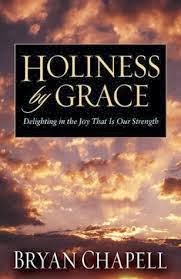
Holiness by Grace

Greetings All,

     This week's 'thought' comes to you from Bryan Chapell.  It is found in his superb book entitled: Holiness by Grace. This book (in my opinion) is a must read for all who are looking for good, solid, practical, Gospel-centered advice on how to grow in godliness. I have left out some sections to make this entry shorter -- merely hoping to whet your appetite for more!  Enjoy.

     "Early in my ministry I didn't recognize how damaging it is to threaten people with God's judgment (or my disapproval) as the primary means for motivating Christian obedience. I used lots of this kind of guilt as a pastor. And I saw people's behavior change... for a while. Still, I often discovered later that he people who did change simply because I had made them feel guilty did not mature. Those whom I pressured with guilt did not grow in faith nor seem more spiritually whole even though their outward actions may have changed.
     For instance, I might deal with a married couple whose relationship was coming apart because they were not being faithful to each other.  I would tell them that if they changed their behaviors God would bless them, but as long as they pursued sinful relationships they could not expect him to love them. With this threatening advice, such a couple might very well cease their immoral activities, but I would later see that their abandonment of the immorality did not necessarily better their lives spiritually. A year of two down the road these same people were often locked into depression, pursuing other addictive behaviors, or were simply disinterested in godly priorities. 
     It took me a few years (we preachers can be notoriously dense), but finally I figured out what was happening. I was telling people that the way to get rid of guilt before God, and assure his blessing, was to change their behaviors. But what did this imply?  If people expect behavior change to get rid of their guilt, then whom are they trusting to take away their guilt?  Themselves!...  I was encouraging people to look to themselves rather than to the cross as the place for guilt's erasure.
     Only Christ can remove the guilt of our sin. By letting people think that what they did made them right with God, I was driving a wedge of human works between them and God. The people who listened to me, though they may have changed some aspect of their lives to get my approval, or secure God's affection, were actually further away from God spiritually than when I began to 'minister' to them. When mercy got out of view, grace went away and a works-righteousness jumped into its place before I even knew it.  My words were making people try to become acceptable to God by being good enough... I was teaching that if people just did things right, they could make things right with God. How foolish was my instruction.
     The Bible says that when we have done all we can do, we are still unworthy servants (Luke 17:10), and our best works are only filthy rags to God (Is. 64:6). I was teaching people that if they just offered God more filthy rags he would favor them more, or smile more, or love them more. What an eccentric and cruel God I painted for them!
     I denied people grace by teaching them that God's love was dependent on their goodness. It was I who had made them intolerant of less mature believers. By listening to me, they had to gauge their holiness by their works. And what better way is there to confirm your own righteousness than by finding fault in others!...
     We should know from our own family experiences how unproductive is obedience motivated by guilt. What happens to a child who obeys only out of fear of parental rejection -- a child who stays good to stay loved? He may obey when he is young, but he is scarred for life. Because such parental love is never more certain than the child's actions, acceptance is always in doubt. As a result, the child grows up calloused or weakened -- hating his parents and doubting himself.
     Many of us know these truths very well because we were manipulated by guilt as children and we may still bear the scars.  We hate what makes us feel guilt to gain favor... We cannot offer loving service to a God who loves us only when we are good.
     If God's love is conditional, if he is only waiting to get us if we step out of line, if avoidance of his rejection, or relief of our guilt is our reason for serving him, then we may obey him for a time, but we will not like him very much....
     Paul exhorts us to keep mercy in view because grace alone will keep us serving the Lord. If we try to compensate for the guilt that only Christ can remove, then we will lose the capacity to love him and to serve him rightly. God doesn't want us to punish ourselves to erase our guilt. He punished his Son to cancel our guilt. God will not build his kingdom on our pain, because he is building it on his mercy."

     One of the most spiritually hurtful ideas (and it's common in the Church) is the idea that by our efforts, or by greater efforts, we can "purchase" more of God's love.  That by repenting, reforming, or performing better we can earn more of His love (at least until we mess up the next time).
     Yet, though it is the cause of much striving and effort in church circles, it would do us good to pause and then counter such un-Gospel-like notions by remembering and believing the Gospel truth that in the economy of grace there is no place for merit (Luke 17:10). That we can never obtain even the smallest fraction more of God's love than what Christ both displayed, and irrevocably secured for us, when He went to the cross to pay the sin-debt for all our innumerable transgressions.
     We do well to remember the love of God is given, not earned. It's a gift of grace, not pay for increased effort or attempts at greater moral renovation. It isn't ours if we "fix" ourselves, it was there long(!) before we ever even come to the conclusion we were in dire need of fixing!
     We work FROM grace, not FOR grace.  We stand in grace, we don't have to strive for it. By faith we discover ourselves to have been the undeserving objects of a free love, not hired hands called to make ourselves worthy of a conditional love.
In the Service of the Gospel, Pastor Jeff

11.12.2013

The Problem of Evil

Greetings All,

     This week's 'thought' comes to you from Franklin Graham and is entitled, "The Problem of Evil."  It is found in "Decision" magazine, June 2013 issue.
     I found his thoughts interesting (though I doubt they will ever be popular) because he points out that so many today look for the cause of evil behaviors in a person's past experience.  They look at that person's upbringing, or for some type of abuse, or to some present situation of being bullied -- anything they can point to -- except the possibility that human nature is just plain flawed from the start. Unpopular as this thought is to the contemporary mind, Mr. Graham handles it well. Enjoy.

The Problem of Evil
     "After the tragedies of the Newtown school shooting and the Boston Marathon terrorist bombing, cultural observers and commentators were at a loss to explain what could have possibly caused such horrific violence.  Could these murderous and wanton acts spring from the misguided influence of friends or family? Was there any behavioral evidence or traits that might have predicted the kind of deeds that shocked a nation?
     Not surprisingly, in a society that increasingly rejects moral absolutes and personal accountability, the search turned to conjecture about genetics. Is it possible that "evil" genes are to blame? 
     After the rampage in Newtown, scientists at the University of Connecticut were asked to analyze the DNA of Adam Lanza to look for a genetic explanation for his coldblooded brutality.
     A May 2011 article in the Wall Street Journal speculated about the chromosomal connection with violent behavior: "It's presumably neither ethical nor practical, but supposing that somebody could sequence Osama bin Laden's genome, which genes would you want to examine to try to understand his violent desires?"
     Well, the Bible is clear on the cause of evil, and it doesn't have anything to do with gene sequencing. Jeremiah 17:9 says, "The heart is deceitful above all things, and desperately wicked."   When sin entered the world with Adam and Eve's rebellion against God, it brought death, destruction and evil.
     The Psalmist David, who himself was responsible for plotting the egregious murder of his loyal soldier Uriah, said "surely I was sinful at birth, sinful from the time my mother conceived me" (Psalm 51:5).  David clearly understood that he was directly responsible for his heinous deed, and because of that he confessed his sin and sought God's forgiveness. "For I know my transgressions, and my sin is always before me" (Psalm 51:5).
     Evil lurks and resides in the heart and soul of man, and its link to behavior is directly connected to rebellion and disobedience to the Lord and His commands. Jesus said: "What comes out of man is what makes him 'unclean.' For from within, out of men's hearts, come evil thoughts, sexual immorality, theft, murder, adultery, greed, malice, deceit … All these evils come from inside" (Mark 7:20-23).
     Gene therapy can't save anyone from sin. The only cure is to come to Christ and His cross, where God's wrath and punishment for sin was meted out by the Father on His Son, who bore our foul iniquities in our stead. It is only in the Person and work of the Lord Jesus Christ that man can find forgiveness and deliverance from sin and its evil work in our hearts.
     When we come to Christ in repentance and faith, we are given new hearts that are no longer fully controlled by sin. "I will give you a new heart and put a new spirit in you; I will remove from you your heart of stone and give you a heart of flesh. And I will put my Spirit in you and move you to follow my decrees" (Ezekiel 36:26-27).
     Yet even the believer, fully forgiven of his sin, still struggles with evil and its effects in the world. We have an evil adversary, the devil, who maliciously works his woe, but as we trust in the triumph of Christ, we can increasingly and daily experience ongoing victory.
     One day--soon I believe--evil will be eradicated once and for all when Christ returns for His own. Sin, death and Satan will be done away with, and God's justice will prevail for all eternity. Sinners will be judged and punished in an eternal hell, and the righteous-those who have trusted in Christ for forgiveness of sin-will live in eternal fellowship with the Savior.  How I look forward to that day."

     People today (and this unfortunately includes many Christians) want to believe (contrary to Scripture) that people are born innocent, with a totally clean slate and no innate stain of sin or inbred proclivity toward evil.  In this way any issues that a "deviant" person might struggle with can be attributed entirely to dysfunctional parenting, some type of abuse, getting in with the wrong people, etc., etc., etc.  Anything that can help behavioral scientists say that as opposed to the rest of humanity, this was why so-and-so did what he/she did.
     The Bible tells us otherwise. As Mr. Graham rightly points out quoting Psalm 51:5, the bent toward sin is in us from conception.  When two full-grown sinners come together sexually the product of their joint union is a new baby sinner!  The sin may not be as apparent in the little one, but it is there.
     As Jonathan Edwards once stated speaking of John the Baptist's rebuke of the Pharisees as a "brood of vipers" -- children are "little vipers." That is, the gland that will one day produce the venom which adult snakes use to injure or immobilize their victims is in the little snake (in a smaller quantity) from birth. The baby snake doesn't become a viper by some fluke of nature, or hurtful experience, it is born a viper and thus simply grows to be what it is.  "We are not sinners because we sin," as R. C. Sproul says, "we sin because we are sinners."
     In fact, in relation to any sin (even the ones I think myself incapable of) a friend once told me to say to myself: "There, but by the grace of God, go I."  I frequently do, lest I inadvertently succumb to the sin of self-righteousness more than I'm already inclined to do so!

In Christ my Savior, Pastor Jeff