Visitors

free counters
Showing posts with label Missions. Show all posts

4.30.2019

Pioneer Missionary Ann Hasseltine Judson

Greetings All,

     In my last "thought" I shared about Adoniram Judson.  A couple days later I was asked to send one out highlighting the brave and heroic commitment of his wife -- Ann Hasseltine Judson.  This is her story (or at least part of it). Her profound influence in regard to the place of women in missions has few rivals.  As the first woman missionary sent out from the U.S., she set the standard for future generations.  This is by far the longest thought I've ever sent out (and it has been heavily redacted to shorten it to what it is)!  Yet, with Mothers Day fast approaching, I thought honoring her contribution as a wife, mother and missionary was warranted. Enjoy.

     "Two hundred and nine years ago in 1810, a young man named Adoniram Judson composed an extraordinary letter to the father of the young woman he wanted to marry. He wrote as follows: “I have now to ask, whether you can consent to part with your daughter early next spring, to see her no more in this world; whether you can consent to her departure for a heathen land, and her subjection to the hardships and sufferings of a missionary life; whether you can consent to her exposure to the dangers of the ocean; to the fatal influence of the southern climate of India; to every kind of want and distress; to degradation, insult, persecution, and perhaps a violent death. Can you consent to all this, for the sake of him who left his heavenly home and died for her and for you; for the sake of perishing immortal souls; for the sake of Zion, and the glory of God?” 
     At 21 years of age, her parents left the choice to Ann.  She decided to marry Adoniram and to leave everything behind for the unknown. She knew she would probably never see her family again. The voyage was far too long, perilous and expensive for the possibility of any visit from relatives or friends. Letters took months, and might well never arrive. There was no established mission network to give support or counsel. There was no American Embassy in Asia to give protection. There was no certainty that these pioneer missionaries would even find a place in which they could safely minister. Nothing was guaranteed – neither safety, health, toleration, and least of all success. But Adoniram, Ann, and the other young people with them understood that Christ did not issue the Great Commission on the condition that health, comfort and safety could be guaranteed. Christ had said simply, “GO.”  Therefore they married on February 5, 1812 and the very next day the newlyweds sailed from Salem, Massachusetts...
     The religion of Burma was Buddhism: a system of belief that arose in the sixth century BC with the enlightenment of Gautama, the Buddha The Buddha taught that all appearance is characterized by transience, that there is not really a soul, and no eternal God… Ann wrote bluntly in her journal of the emptiness of Buddhism: “The religion of Burmah, then, is, in effect, atheism; and the highest reward of piety, the object of earnest desire and unwearied pursuit, is annihilation. How wretched a system is this; how devoid of adequate motives to virtue; and how vacant of consolation!”  Consequently, the Burmese had no concept of an eternal God, and no means in their language to express such an idea. Ann and Adoniram worked hard studying up to 12 hours a day for two years learning the difficult language. Eventually Adoniram produced a gospel tract in Burmese and commenced working on a Burmese translation of the New Testament. Ann authored a Burmese language catechism, translated the books of Daniel and Jonah into Burmese, and began to teach women’s Bible classes. She was also the first person to translate Bible passages into Siamese. Ann also formed a society of native women who met together on Sundays to pray and read the Scriptures.
     By 1820, six years after their arrival in Burma, Ann was so seriously ill that she had to seek medical help in Calcutta. Two years later she was told that unless she returned either to Europe or America for treatment, she would die. She had previously consented to her husband accompanying her to Calcutta, but the longer voyage to England (and a possible further trip to America) would take at the least two years, and she refused to consider Adoniram abandoning the infant church and the crucial Bible translation for that long. As a result, in 1822, she made the long and difficult journey alone. She sailed first for England, and Christians there raised funds for her passage to America.  Back at home, she received skilled medical care and was reunited with her family and that of Adoniram. The whole trip took two years, and of this separation Adoniram said that it felt like cutting off his right arm and gouging out his right eye.
     Ann returned in 1824, but her reunion with her husband, though joyful, was pitifully brief.  War between Burma and England began, and all male foreigners fell under suspicion of being English spies. So Adoniram and his associate Mr. Price, were thrown into the notorious death prison from which few ever emerged alive. While in prison they awaited execution in the most filthy and sordid of conditions, weighed down with fetters so that they could not walk. Daily they observed the torture and execution of their fellow prisoners, not knowing when their time would come. Nightly they were placed in the stocks, and their legs and bodies raised so that only their head and shoulders remained on the ground. They remained incarcerated for one and a half years, during which time they were never able to wash, were often ill with no access to medical help, and had little contact with the outside world...
     During her husband’s imprisonment, Ann petitioned tirelessly on the prisoners’ behalf with no regard for personal risk. Daily she walked the two miles from their small home to the prison in hopes of supplying them with food and drink. Sometimes she was allowed to see them, but often they were forbidden to speak. She also visited every person of influence to whom she could gain access, trying to explain that as missionaries they had nothing to do with the English war effort. She was quite alone through this ordeal, and she was pregnant. Eight months after Adoniram had been arrested, in February 1825, she gave birth to little Maria, and was able to visit the prison with the infant, whom the father could only observe from afar. Their first baby had been stillborn, their second had died at eight months, and this child’s chances of survival seemed even more slender.  Of this terrible time she wrote:  “Sometimes for days and days together, I could not go into the prison till after dark, when I had two miles to walk, in returning to the house. O how many, many times, have I returned from that dreary prison at nine o’clock at night, solitary and worn out with fatigue and anxiety… My prevailing opinion was, that my husband would suffer violent death; and that I should, of course become a slave, and languish out a miserable though short existence in the tyrannical hands of some unfeeling monster. But the consolations of religion, in these trying circumstances, were neither `few nor small.’  It taught me to look beyond this world, to that rest, that peaceful happy rest, where Jesus reigns, and oppression never enter.”
     Eventually she had to set up a little shelter near the prison, as the daily four-mile-round-trip proved too much to walk in the blazing heat. As the weather brought unbearable heat, the conditions in the prison only worsened. Of this time her memoirs record: “The situation of the prisoners was now distressing beyond description. It was at the commencement of the hot season. There were above a hundred prisoners shut up in one room, without a breath of air excepting from the cracks in the boards. I sometimes obtained permission to go to the door for five minutes, when my heart sickened at the wretchedness exhibited. The white prisoners, from incessant perspiration and loss of appetite, looked more like the dead than the living…”
     It would seem that things could not get worse. But with the British troops advancing to the capital, the foreign prisoners were removed on a death march to a remote spot in the country some miles north of the capital, where rumor had it they were to be buried alive as an offering to the gods in the path of the advancing troops. Their sufferings on the march were indescribable, their survival remarkable. Even more remarkable was the determination of Ann to follow them. With her three-month-old infant, plus two little girls she was looking after, and a faithful Burmese helper, she immediately set out by boat, and then by rough cart, in pursuit of the prisoners. For the duration of their imprisonment outside of the capital she persuaded their jailer to let her and the children share his two-room hut. From there she continued to try to minister such help as she could to her husband and Price. During this appalling period she became so ill that she had no milk for the baby, and the only way Maria survived was by bribing the jailer to allow Adoniram out of prison to carry the baby round the local village, begging nursing mothers to let Maria have a little of their milk.
     When the Burmese realized how hopeless the struggle against England was, they decided they needed all the help they could get in negotiating the least humiliating peace settlement. Adoniram and Price were released to help with the peace negotiations, as they could speak both Burmese and English. Again Ann and Adoniram had a wonderfully happy but tragically brief reunion. They enjoyed two blissful weeks of freedom and comfort at the British base before Adoniram was summoned elsewhere for further negotiations. This was to be their final separation. Ann’s health had been broken by the sufferings of the previous two years, and her body, past the point of exhaustion, finally broke and succumbed to cerebral meningitis. Her final sufferings were to be endured without her husband. She was thirty-seven.
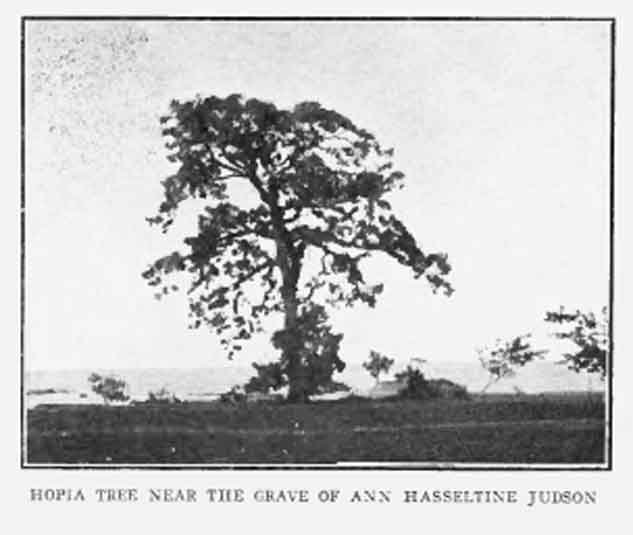
     Adoniram was shattered not only by her death, but by the knowledge he had not been able to support her at that time. Shortly thereafter, Maria also died.  Adoniram was left quite alone, and later wrote with the sad news to Ann’s mother telling her of the burial of his daughter: “The next morning we made her last bed in the small enclosure that surrounds her mother’s lonely grave. Together they rest in hope, under the hope tree, which stands at the head of the graves, and together, I trust, their spirits are rejoicing after a short separation of precisely six months. And I am left alone in the wide world. My own dear family I have buried; one in Rangoon, and two in Amhurst. What remains for me but to hold myself in readiness to follow the dear departed to that blessed world, “Where my best friends, my kindred dwell, Where God my Saviour reigns.” Adoniram was so grief-stricken at his loss that he suffered complete emotional breakdown.
     Ann Hasseltine Judson was converted at 17 during what has come to be called, "The Second Great Awakening."  She was a deeply dedicated Christ-follower, as well as a gifted teacher, linguist, preacher and author. She was instrumental in establishing a Christian church in Burma which, though heavily persecuted, still thrives to this day.  She championed the cause of female education, starting a Burmese girl’s school and tirelessly petitioning Christian sponsorship for her girls during her medical furlough in the United States.  It is generally agreed had it not been for Ann’s sacrificial efforts and representations to the governing authorities, Adoniram would not have survived his time in the death prison. It has been said of her: “She was a woman who loved intensely, loved her husband, loved her children, loved the people of Burma, but above all, she loved her God.”

     When I think of Ann one verse comes to mind: "Many women do noble things, but you surpass them all... let her works bring her praise at the city gates" (Prov. 31:29 & 31).


     If you would like to read a more full account (this was my primary though not sole source for this post) you can click here:  


In His Service, Pastor Jeff

3.11.2019

Two Thoughts to Ponder

Greetings All!

     Today I send to two short and totally unrelated "thoughts" for you to ponder.  The first is "Doubt as the Doorway to Truth" by Madeleine L'Engle.  I have found this to be true in my own experience.  In fact, about three years after I came to Christ, I prayed for greater faith. The result (quite to my surprise) was to be assaulted by many doubts that seemed to come out of nowhere!  It confused me entirely. I asked for faith and I received doubts It wasn't until later that I realized that it was in seeking answers to those doubts that faith came.  God's ways are not our own! 


     The second "thought" is a true story passed on to me by a friend who leads short term mission trips overseas -- Paul Hatmacher of "Churches in Missions.'  It's a story that displays the providential intervention of God in the life of one very unsuspecting man.  Enjoy!


Doubt as the Doorway to Truth 

     "We are often taught that it is unfaithful to question traditional beliefs, but I believe that we must question them continually -- not God, not Christ, who are at the center of our lives... but what human beings say about God and about Christ. Otherwise, like the church establishment of Galileo's day, we truly become frozen people. Galileo's discoveries did nothing whatsoever to change the nature of God; they threatened only man's rigid ideas of the nature of God....
     The great metaphysical poet, John Donne, writes: 'To come to a doubt, and a debatement of any religious duty, is the voice of God in our conscience: Would you know the truth? Doubt, and then you will inquire." If my religion is true, it will stand up to all my questioning. There is no need to fear. But if it is not true, if it is man imposing strictures on God (as men of the religious establishment did in the days of Galileo) then I want to be open to God, not what men say about God. I want to be open to revelation, to new life, to new birth, to new light. Revelation. Listening. Humility. Remember -- the root word of humble and human is the same: Humus. Earth.  We are dust. We are created. It is God who made us and not we ourselves."

An Incredible Story 

     "Joseph Stalin ordered the purge of all Bible's and believers in Russia.  Millions of Bibles were confiscated and multitudes of believers were sent to die in prison camps.  Recently, COMission Ministry, sent a team to Stravopol (east of the Black Sea in Russia) and had literally thousands trust in Christ. They needed Bibles and heard from a local that there was a warehouse outside of town where Stalin had the Bibles stored.  Wondrously, the officials gave them permission to check it out and they found thousands of Bibles that had been taken from believers.  So the team hired students from a local college to clean out the warehouse. 
     One young man they hired was a skeptic, but he accepted the job for the money.  As the day wore on they noticed the young man had disappeared. They eventually found him in the corner of the warehouse weeping. He had slipped away having taken a Bible.  What he found shook him to the core.  Out of the thousands of Bibles, he had found one belonging to his grandmother... a woman persecuted all her life, who had died in prison.  No wonder he was weeping.  God had just dramatically revealed Himself to this young man.  His grandmother had no doubt prayed for him and for that city. Her prayers had followed him. And now this young man's life has been transformed by the very Bible that his grandmother found so dear." 
     God's ways truly are mysterious - beyond searching out (Romans 11:33).  He moves and guides in ways we least expect. "The heart of man plans his way, but the LORD directs his steps" (Prov. 16:9). Little did that skeptic know at the beginning of the day (following his hearts desire for a little extra money) that his life would be blessed in an infinitely greater way by the time he headed home that evening.  God's ways are so much higher than ours -- and always better!

Living in the Grace of Jesus, Pastor Jeff

12.12.2017

Advent Devotional Thoughts

Greetings All!

This week's "thought" comes as one selection from a series of Advent Devotional Thoughts sent out by an organization called CCO (Coalition for Christian Outreach) which seeks to place people for Gospel outreach purposes on college campuses. One of the things it focuses on in its discipleship of students is to help them see that their career (in whatever field it may be in) can be their "calling from the Lord" just as much as some full-time work in the local church or missions. One does not have to go into the ministry, or some exclusively "Christian" service, to be "serving the Lord full time."  This is nothing new, as Martin Luther stressed it 500 years ago as one of the many insights of the Reformation.  Yet it does continue to get overlooked (even to this day) in some Christian circles. The author is Gene S. Twilley who serves as CCO Campus Ministry Staff at Delaware County Community College in Media, PA. Enjoy.


Attitude Adjustment 

     Eight months after finishing my undergraduate studies, I started working as an auto liability claims adjuster for a very large insurance company. There were ample benefits with the job—from day one, I was vested in a matched 401k; I had a pension, nearly a month of vacation per year, and great health benefits.  I loved the people I worked with. An older African American woman called me her newly adopted son. We worked in collaborative cubicles—four to a large cube—and laughed a lot.  But I hated the work. In a claims environment, every call is a complaint. The workload is heavy. I was threatened with physical violence over the phone, bullied with potential lawsuits, and accused of all sorts of character flaws.  There were and are far worse places to be employed. But in the moment of any sort of seemingly bad circumstance, we don’t usually think about what could be worse. We long for something better.
     Then my wife and I attended a wedding for one of her coworkers, and I was making small talk with a woman I didn’t know, and who I probably wouldn’t recognize if I saw her today.  In the midst of conveying to her what I did, before I had the opportunity to complain about my job, she exclaimed, “How exciting! You have the opportunity to help put people’s lives back together every day.

Sobering.
Clarifying.
Convicting.
     I was willing to approach my work as a Christian who had hope in Jesus, but not as a Christian who had hope that my work actually mattered.  I don’t know where this woman was in terms of faith, but she pointed out something that I was completely missing.  Isaiah 61 is a messianic prophetic utterance. Jesus took up this section, read it in a synagogue in Nazareth, and explained, “Today this Scripture has been fulfilled in your hearing” (Luke 4:21).

    He was anointed to preach good news to the poor.
    He was sent to proclaim liberty to captives.
    He was sent to give sight to the blind.
    He came to release the oppressed.
     In all of that, Jesus was announcing the “year of the Lord’s favor.” In the broader context of Isaiah 61, we see other really good things too! There is comfort for those who mourn. Those who sit in shame and in repentance are made beautiful. They are planted deeply into God’s grace, that they might praise rather than mourn. The people of God are called by the Servant of God to be re-creators of things that are broken… All that hope, that expectation, that rebuilding of the things that have been broken—it’s in Isaiah 61.  It all finds its beginning, current, and end in Jesus.
     And this is the kind of hope that can lift me out of myself and all my meandering thoughts about greener pastures. I start to ask different questions.  After all, aren’t we called to care about the situations that God has placed us in, the broken places already in our midst? How can we make the most of our God-given opportunities today? How might we redeem the time that he’s given into our possession?
     As a claims adjuster, I was occupied with my work—getting through the day, looking for the next best thing. It was a job, not a calling.  Or was it?  What if every opportunity to serve others is a calling from the Lord? Tim Keller explains, “our work can be a calling only if it is reimagined as a mission of service to something beyond merely our own interests. Thinking of work mainly as a means of self-fulfillment and self-realization slowly crushes a person.”  Calling is found at the sweet spot where my vertical and horizontal relationships meet—where I love the Lord and where I love my neighbor. Too often, maybe we’re disappointed with where we are because we simply don’t see the potential of the work ahead of us. But what if some of us are so concerned with our own emptiness that we don’t see the joy set before us?  Isaiah 61 tells a bigger story, and in this story, work becomes service, pain becomes joy, and despair becomes hope.
Come, Lord Jesus. 
Give us eyes to see."

     One of the blessings of understanding the biblical concept of "the priesthood of all believers" is to grasp that all believers are called to minister Gods grace in all is various forms to others, but not all are called to do it in the same way or in the setting of being on staff at a church, parachurch organization or a mission.  People can live out their divine calling while being an engineer, nurse, teacher, athlete, lawyer, accountant, construction worker, farmer, technician, programmer, and so forth and so on!  Their "prayer room" is their office.  Their "congregation" consists of their co-workers. Their "pulpit" is their position. And their "testimony" is their honesty, approachability, and integrity -- all done for the glory of God -- which paves the way for opportunities to share the Gospel over a cup of coffee in the break room, or as they frame a house together with others.  God forbid that the only place "ministry" happens is through the pastor in the church! That's NOT how God ever intended it!
     As Gene Twilley reminds us, any job, profession or occupation can become exciting when we see it as a way to be "re-creators of things that are broken."   A simple "job" can become a calling from the Lord when we come to see it as "an opportunity to serve others."   Or as Tim Keller reminds us: “our work can be a calling only if it is reimagined as a mission of service to something beyond merely our own interests. Thinking of work mainly as a means of self-fulfillment and self-realization slowly crushes a person.”
     So, as Christmas approaches give yourself a present.  Re-envision your job as a ministry.  God has placed you there.  Opportunities for service and outreach abound.  In many places of employment, you will rub shoulders every day with people who have never heard the Gospel.  Redeem the time.  Work well and with integrity.  And as the opportunity arises, "be ready to give an answer for the hope that is in you with meekness and fear" ( I Peter 3:15).  God may have strategically placed you where you are for the very purpose of reaching out to that one person who would never darken the doors of a church, but may come to Christ because you -- outside the doors of the church -- cared enough to reach out to them in love.

In The Service of the Gospel, Pastor Jeff

2.16.2016

Gateway to Joy

Greetings All,

     Today's "thought" is a tribute to an extraordinary woman of God who passed into glory June 15, 2015 - Elisabeth Elliot.


     She taught in many of the foreign missions classes I took at Gordon-Conwell Theological Seminary (1982-1986) where I majored in missions. And as a missionary herself, who endured many hardships, her thoughts were always extremely helpful.
  For some she is best known as "the wife of Jim Elliot" one of the five missionaries martyred on January 8th, 1956, in the jungles of Ecuador (two months after I was born)! They were attempting to contact and reach out to the remote Auca Indians with the Gospel.  Jim's well-known quote which guided his life was: "He is no fool who gives what he cannot keep to gain what he cannot lose."

     Yet those who know Elisabeth better know that her reputation does not hang on her husbands coattails. She had a significant ministry of her own, doing Bible translation into the Quechua language, and then going into the jungle to live for two years with the very Indians who killed her husband, taking her three year old daughter Valerie with her. It's a ministry chronicled in her book, "The Savage My Kinsman."
     After leaving Ecuador and returning to the States she became a sought after spokesperson for foreign missions.  One of the first books she authored was, "Through Gates of Splendor," the story of the five martyred missionaries. The documentary by the same name had a profound impact on me and fed my desire to be involved in missions.  In my opinion they should both be on the required reading and viewing list for every missionary candidate. The contemporary sequel, "The End of the Spear" is extremely informative and challenging as well.

Elisabeth has written many other books, including the classic biographical work, "A Chance to Die" -- about the great missionary to India, Amy Carmichael -- one of her childhood hero's. Carmichael rescued, and then started a home for young Hindu girls who had been forced into temple prostitution.
     Elliot also wrote Shadow of the AlmightyKeep a Quiet Heart, Passion for Purity, Quest for Love, A Path Through Suffering, Be Still My Soul, These Strange Ashes, Gateway To Joy, and about 20 others!  She is now in the presence of the One she spent her life serving, but her legacy here will continue through the many who heard her speak, and will continue to read her many books. This particular excerpt comes from, "Gateway to Joy."  Enjoy!

One of the "Gateways to Joy" -- COMMIT TO SERVICE 

     "There has been a tendency to think of service to God as necessarily entailing physical hardship and sacrifice. Although this is not really a scriptural idea, it has gained wide acceptance.  It is easy to recall the saints who climbed the steep ascent of heaven through peril. But the Bible also makes mention of Dorcas, whose service to God was the making of coats...
     When I lived in the Auca settlement (deep in the Ecuadorean jungle)... some correspondents envied me, some pitied me. Some admired, some criticized. I could not help asking myself if perhaps I had been mistaken. Was I really obeying God, or had I merely obeyed some misguided impulse, some lust for distinction, some masochistic urge to bury myself in the forsaken place?  There was no way of being sure what was in the murky reaches of my subconscious, but I was sure I had committed myself to God for His service, and I knew no other motivation.
     The opinions of others -- whether they commended or condemned -- could not alter my duty.  But their very diversity caused me to ponder carefully what that duty was...  My duty was one thing, theirs another.  My responsibility lay there, but the responsibility of some of my correspondents (who gazed starry-eyed at my role) lay perhaps in an office, or a kitchen, or the cockpit of an airplane.  The commitment to wholehearted service in obedience to God looks different for everyone. 
COMMIT AT ANY COST...

     When I was sixteen years old I copied in the back of my Bible a prayer of missionary Betty Scott Stam, whose visit in our home when I was very small (living in Brussels, Belgium, with my missionary parents) had made such a deep impression on me.  Her prayer:
"Lord, I give up all my own plans and purposes, all my own desires and hopes, and accept Your will for my life. I give myself, my life, my all, utterly to You, to be Yours forever.  Fill me and seal me with Your Holy Spirit.  Use me as You will, send me where You will, work out Your whole will in my life at any cost, now and forever." 
     The cost, for her, was quite literally her life only a few years after she had prayed that prayer.  Betty was martyred in China in 1934." 

       Some of you may have prayed similar prayers -- yet your commitment to service and obedience has looked much different. 
    God is not into making clones. He is putting together a body that is made up of many different parts with many varied gifts. And therefore, what may be obedience for one would be disobedience for another.  The path one is called to trod is not the same path we are all called to follow.  His plan for the ages sends people down a plethora of varied paths - some rough and some much smoother. The key, or the gateway to joy, though, remains the same for all -- commitment at any cost to do His unique will for your life.
       Hopefully we can all pray, with earnest and transparent hearts:
"Lord, I give up all my own plans and purposes, all my own desires and hopes, and accept Your will for my life. I give myself, my life, my all, utterly to You, to be Yours forever. Fill me and seal me with Your Holy Spirit. Use me as You will, send me where You will, work out Your whole will in my life at any cost, now and forever." 
     Two women prayed the same prayer. One was led to China where she was martyred for the faith.  The other ended up losing her husband, living in the jungles of Ecuador for a time, and then spent her later years speaking, writing, teaching, and doing a weekly broadcast north of Boston, Massachusetts. For others it may be a career, parenthood, fidelity in marriage, service in the local church, a neighborhood outreach, helping at a homeless shelter, Hospice, some support group, or another form of obedient service.  The, "as You will... where You will," is up to God and looks different for all.  Yet the call to commit, or, "give ourselves, our lives, and our all, utterly to God, to be His forever" -- that is the same for every believer. Offer Him that and you will find your place in His plan.
With Prayers for a Surrendered Heart, Pastor Jeff 

12.08.2015

The Life and Diary of David Brainerd

Greetings All,

     I had a breakfast with a few friends today and the name David Brainerd came up. It led me to think of offering you some thoughts regarding his missionary activity among the Indians in eastern Pennsylvania and New Jersey between June 1744 through June of 1745. He ministered near the Susquehanna, the Forks of the Delaware River, and in Crossweeksung, before succumbing to tuberculosis, riding his horse from there to Massachusetts, and then passing away in the home of Jonathan Edwards at the young age of 29.
     Brainerd was born in Haddam, Connecticut, on April 20, 1718. His father died when he was nine, and his mother when he was 14 -- leaving him (his four brothers and four sisters) orphaned.  In July of 1739 (at the age of 21), he was so overcome by the sense of God's wrath against his sins, and the imperfection in all his religious duties, that it drove him to seek -- by faith in Christ alone -- "that way of salvation that is entirely by the righteousness of Christ." 
     He started at Yale College in New Haven in September of that year, studying to enter the pastorate. Though he was at the top of his class, and likely to be the valedictorian that next year at graduation, he was casually asked by two friends what he thought of one particular professor (Mr. Whittelsey).  He answered that he had no more grace (in him) than the chair he was sitting in. Another student, who happened to overhear his remark, told the faculty and Brainerd was dismissed from the college or ever returning. It would be hard to describe the shame and brokenness of spirit this caused Brainerd -- since without a degree from Harvard or Yale, or a European college, one could not gain a pulpit in New England.
     Yet, by the providence of God, this led Brainerd to his short but impactful life's work among the Indians.  Due to the severe conditions of working outside, and traveling with the Indians, he succumbed to tuberculosis and died in 1747. Jeshua Edwards (Jonathan Edwards 17 year old daughter) fell in love with him as she nursed him during the last six months of his life in their house.  In the last week of his life he told her: "If I had thought that I should not see you, and be happy with you in another world, I could not bear to part with you..."  She herself contracted tuberculosis from him and died the next winter at the age of 18.
     The excerpts that follow are taken from his journal and diary which were never intended to be public, or published.They were discovered by Edwards after he died, who after editing out some of the more personal content published them under the title: "The Life and Diary of David Brainerd."  It was one of the volumes which William Carey read that inspired him to pursue foreign missions. My son David is named after him.  Enjoy.

     Saturday, October 5, 1745: "Preached to my people (the Indians at Crossweeksung, N.J.) from John 14:1-6.  The divine presence seemed to be in the assembly. Numbers were affected with divine truths and it was a season of comfort to some in particular. Oh what a difference there is between these Indians and the Indians I had lately ministered to at the Susquehanna!  To be with them seemed like being banished from God, and all His people; but to be with these, is like being admitted into His family, and to the enjoyment of His divine presence!  How great is the change lately made upon numbers of these Indians, who not many months ago were as thoughtless and adverse to Christianity as those upon Susquehanna! And how astonishing is that grace which has made this change!"
     Sunday, Lord's Day, October 6, 1745: "Preached before noon from John 10:7-11. There was a considerable melting among my people. The dear young Christians were refreshed, comforted and strengthened, and one or two persons newly awakened (or made alive in Jesus). In the afternoon I discoursed on the story of the jailer in Acts 16, and in the evening expounded Acts 20:1-12. There was at this time a very agreeable melting spread through the whole assembly. I think I scarce ever saw a more desirable affection in any number of people in my life. There was scarce a dry eye to be seen among them, and yet nothing boisterous or unseemly. Nothing that tended to disturb public worship. But rather, to encourage and excite a Christian ardor an spirit of devotion. Those who, I have reason to hope, were savingly renewed, were the first affected, and seemed to rejoice much, but with brokenness of spirit and godly fear... appearing to be the genuine effect of a Spirit of adoption.
     After public service was over I withdrew (being much tired with the labors of the day) and the Indians continued praying among themselves for nearly two hours together. These continued exercises appeared to be attended with a blessed quickening influence from on high. I could not but earnestly wish that numbers of God's people had been present at this season to see and hear these things, which I am sure must refresh the heart of every true lover of Zion's interest..."
     October 24, 1745:  "Discoursed from John 4:13-14. There was a great attention, a desirable affection, and an unaffected melting in the assembly. It is surprising to see how eager they are of hearing the word of God. I have oftentimes thought they would cheerfully and diligently attend divine worship twenty-four hours straight, had they an opportunity so to do."
     October 25, 1745: "Discoursed to my people respecting the resurrection, from Luke 20:27-36. And when I came to mention the blessedness the godly shall enjoy at that season; their final freedom from death, sin, and sorrow; their equality to the angels in regard to their nearness to, and enjoyment of Christ (an imperfect degree of which they are favored with in the present life, and from whence springs their sweetest comfort)... numbers of them were much affected and melted with a view of this blessed state."
     October 26, 1745: "I was asked to help assist in the serving of the Lord's Supper at a nearby congregation (of Englishmen). Invited my (Indian) people to go with me. In general they accepted the opportunity cheerfully, and attended the several discourses (in English) with diligence and affection, most of them now understanding something of the English language."
     Lord's Day, October 27, 1745: "While I was preaching to a vast assembly of people, there was one Indian woman, a stranger, who never heard me preach before, nor ever regarded anything about religion. She was persuaded by some of her friends to come to meeting, though much against her will. She was seized with pressing concern for her soul, and soon after expressed a great desire of going home, more than 40 miles distant, to call her husband, that he might also be awakened to a concern for his soul. Some other of the Indians also appeared to be affected with divine truths this day. The pious people of the English (numbers of whom I had opportunity to converse with) seemed refreshed with seeing the Indians worship God in that devout and solemn manner with the assembly of His people. And with those mentioned in Acts 11:18, they could not but, "glorify God, saying, "Then hath God also to the Gentiles granted repentance unto life."
     October 28, 1745: "Preached again to a great assembly, at which time some of my people appeared affected. And when public worship was over, were inquiring whether there would not be another sermon in the evening, or before the celebration of the Lord's Supper ended, being still desirous to hear God's word."
     About a year before his death (September of 1746) he wrote in his diary: "My heaven is to please God, and glorify Him, and to give all to Him, and be totally devoted to His glory. That is the heaven I long for. That is my religion, and that is my happiness, and always was ever since I suppose I had any true religion in me."
     May the Lord be pleased to pour out upon the lives of many in our day the same spirit of hungering after God. In God's providence Brainerd was kept from pastoring a comfortable New England church.
     Yet he was driven by his love for souls to preach -- to the Indians -- people he came to love so much that he often pleaded for their rights against the settlers, "complaining of the horrid practice of making the Indians drunk, and then cheating them out of their lands, and other properties, with too much warmth of spirit" (righteous anger).
In His Service, Pastor Jeff