Visitors

free counters
Showing posts with label Great Commission. Show all posts

4.30.2019

Pioneer Missionary Ann Hasseltine Judson

Greetings All,

     In my last "thought" I shared about Adoniram Judson.  A couple days later I was asked to send one out highlighting the brave and heroic commitment of his wife -- Ann Hasseltine Judson.  This is her story (or at least part of it). Her profound influence in regard to the place of women in missions has few rivals.  As the first woman missionary sent out from the U.S., she set the standard for future generations.  This is by far the longest thought I've ever sent out (and it has been heavily redacted to shorten it to what it is)!  Yet, with Mothers Day fast approaching, I thought honoring her contribution as a wife, mother and missionary was warranted. Enjoy.

     "Two hundred and nine years ago in 1810, a young man named Adoniram Judson composed an extraordinary letter to the father of the young woman he wanted to marry. He wrote as follows: “I have now to ask, whether you can consent to part with your daughter early next spring, to see her no more in this world; whether you can consent to her departure for a heathen land, and her subjection to the hardships and sufferings of a missionary life; whether you can consent to her exposure to the dangers of the ocean; to the fatal influence of the southern climate of India; to every kind of want and distress; to degradation, insult, persecution, and perhaps a violent death. Can you consent to all this, for the sake of him who left his heavenly home and died for her and for you; for the sake of perishing immortal souls; for the sake of Zion, and the glory of God?” 
     At 21 years of age, her parents left the choice to Ann.  She decided to marry Adoniram and to leave everything behind for the unknown. She knew she would probably never see her family again. The voyage was far too long, perilous and expensive for the possibility of any visit from relatives or friends. Letters took months, and might well never arrive. There was no established mission network to give support or counsel. There was no American Embassy in Asia to give protection. There was no certainty that these pioneer missionaries would even find a place in which they could safely minister. Nothing was guaranteed – neither safety, health, toleration, and least of all success. But Adoniram, Ann, and the other young people with them understood that Christ did not issue the Great Commission on the condition that health, comfort and safety could be guaranteed. Christ had said simply, “GO.”  Therefore they married on February 5, 1812 and the very next day the newlyweds sailed from Salem, Massachusetts...
     The religion of Burma was Buddhism: a system of belief that arose in the sixth century BC with the enlightenment of Gautama, the Buddha The Buddha taught that all appearance is characterized by transience, that there is not really a soul, and no eternal God… Ann wrote bluntly in her journal of the emptiness of Buddhism: “The religion of Burmah, then, is, in effect, atheism; and the highest reward of piety, the object of earnest desire and unwearied pursuit, is annihilation. How wretched a system is this; how devoid of adequate motives to virtue; and how vacant of consolation!”  Consequently, the Burmese had no concept of an eternal God, and no means in their language to express such an idea. Ann and Adoniram worked hard studying up to 12 hours a day for two years learning the difficult language. Eventually Adoniram produced a gospel tract in Burmese and commenced working on a Burmese translation of the New Testament. Ann authored a Burmese language catechism, translated the books of Daniel and Jonah into Burmese, and began to teach women’s Bible classes. She was also the first person to translate Bible passages into Siamese. Ann also formed a society of native women who met together on Sundays to pray and read the Scriptures.
     By 1820, six years after their arrival in Burma, Ann was so seriously ill that she had to seek medical help in Calcutta. Two years later she was told that unless she returned either to Europe or America for treatment, she would die. She had previously consented to her husband accompanying her to Calcutta, but the longer voyage to England (and a possible further trip to America) would take at the least two years, and she refused to consider Adoniram abandoning the infant church and the crucial Bible translation for that long. As a result, in 1822, she made the long and difficult journey alone. She sailed first for England, and Christians there raised funds for her passage to America.  Back at home, she received skilled medical care and was reunited with her family and that of Adoniram. The whole trip took two years, and of this separation Adoniram said that it felt like cutting off his right arm and gouging out his right eye.
     Ann returned in 1824, but her reunion with her husband, though joyful, was pitifully brief.  War between Burma and England began, and all male foreigners fell under suspicion of being English spies. So Adoniram and his associate Mr. Price, were thrown into the notorious death prison from which few ever emerged alive. While in prison they awaited execution in the most filthy and sordid of conditions, weighed down with fetters so that they could not walk. Daily they observed the torture and execution of their fellow prisoners, not knowing when their time would come. Nightly they were placed in the stocks, and their legs and bodies raised so that only their head and shoulders remained on the ground. They remained incarcerated for one and a half years, during which time they were never able to wash, were often ill with no access to medical help, and had little contact with the outside world...
     During her husband’s imprisonment, Ann petitioned tirelessly on the prisoners’ behalf with no regard for personal risk. Daily she walked the two miles from their small home to the prison in hopes of supplying them with food and drink. Sometimes she was allowed to see them, but often they were forbidden to speak. She also visited every person of influence to whom she could gain access, trying to explain that as missionaries they had nothing to do with the English war effort. She was quite alone through this ordeal, and she was pregnant. Eight months after Adoniram had been arrested, in February 1825, she gave birth to little Maria, and was able to visit the prison with the infant, whom the father could only observe from afar. Their first baby had been stillborn, their second had died at eight months, and this child’s chances of survival seemed even more slender.  Of this terrible time she wrote:  “Sometimes for days and days together, I could not go into the prison till after dark, when I had two miles to walk, in returning to the house. O how many, many times, have I returned from that dreary prison at nine o’clock at night, solitary and worn out with fatigue and anxiety… My prevailing opinion was, that my husband would suffer violent death; and that I should, of course become a slave, and languish out a miserable though short existence in the tyrannical hands of some unfeeling monster. But the consolations of religion, in these trying circumstances, were neither `few nor small.’  It taught me to look beyond this world, to that rest, that peaceful happy rest, where Jesus reigns, and oppression never enter.”
     Eventually she had to set up a little shelter near the prison, as the daily four-mile-round-trip proved too much to walk in the blazing heat. As the weather brought unbearable heat, the conditions in the prison only worsened. Of this time her memoirs record: “The situation of the prisoners was now distressing beyond description. It was at the commencement of the hot season. There were above a hundred prisoners shut up in one room, without a breath of air excepting from the cracks in the boards. I sometimes obtained permission to go to the door for five minutes, when my heart sickened at the wretchedness exhibited. The white prisoners, from incessant perspiration and loss of appetite, looked more like the dead than the living…”
     It would seem that things could not get worse. But with the British troops advancing to the capital, the foreign prisoners were removed on a death march to a remote spot in the country some miles north of the capital, where rumor had it they were to be buried alive as an offering to the gods in the path of the advancing troops. Their sufferings on the march were indescribable, their survival remarkable. Even more remarkable was the determination of Ann to follow them. With her three-month-old infant, plus two little girls she was looking after, and a faithful Burmese helper, she immediately set out by boat, and then by rough cart, in pursuit of the prisoners. For the duration of their imprisonment outside of the capital she persuaded their jailer to let her and the children share his two-room hut. From there she continued to try to minister such help as she could to her husband and Price. During this appalling period she became so ill that she had no milk for the baby, and the only way Maria survived was by bribing the jailer to allow Adoniram out of prison to carry the baby round the local village, begging nursing mothers to let Maria have a little of their milk.
     When the Burmese realized how hopeless the struggle against England was, they decided they needed all the help they could get in negotiating the least humiliating peace settlement. Adoniram and Price were released to help with the peace negotiations, as they could speak both Burmese and English. Again Ann and Adoniram had a wonderfully happy but tragically brief reunion. They enjoyed two blissful weeks of freedom and comfort at the British base before Adoniram was summoned elsewhere for further negotiations. This was to be their final separation. Ann’s health had been broken by the sufferings of the previous two years, and her body, past the point of exhaustion, finally broke and succumbed to cerebral meningitis. Her final sufferings were to be endured without her husband. She was thirty-seven.
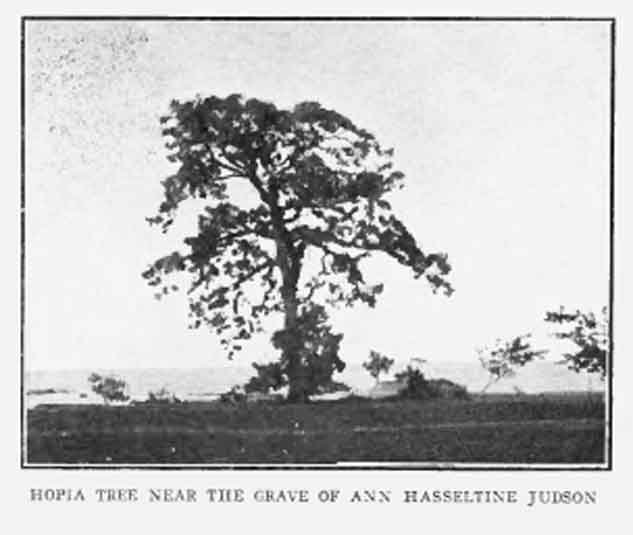
     Adoniram was shattered not only by her death, but by the knowledge he had not been able to support her at that time. Shortly thereafter, Maria also died.  Adoniram was left quite alone, and later wrote with the sad news to Ann’s mother telling her of the burial of his daughter: “The next morning we made her last bed in the small enclosure that surrounds her mother’s lonely grave. Together they rest in hope, under the hope tree, which stands at the head of the graves, and together, I trust, their spirits are rejoicing after a short separation of precisely six months. And I am left alone in the wide world. My own dear family I have buried; one in Rangoon, and two in Amhurst. What remains for me but to hold myself in readiness to follow the dear departed to that blessed world, “Where my best friends, my kindred dwell, Where God my Saviour reigns.” Adoniram was so grief-stricken at his loss that he suffered complete emotional breakdown.
     Ann Hasseltine Judson was converted at 17 during what has come to be called, "The Second Great Awakening."  She was a deeply dedicated Christ-follower, as well as a gifted teacher, linguist, preacher and author. She was instrumental in establishing a Christian church in Burma which, though heavily persecuted, still thrives to this day.  She championed the cause of female education, starting a Burmese girl’s school and tirelessly petitioning Christian sponsorship for her girls during her medical furlough in the United States.  It is generally agreed had it not been for Ann’s sacrificial efforts and representations to the governing authorities, Adoniram would not have survived his time in the death prison. It has been said of her: “She was a woman who loved intensely, loved her husband, loved her children, loved the people of Burma, but above all, she loved her God.”

     When I think of Ann one verse comes to mind: "Many women do noble things, but you surpass them all... let her works bring her praise at the city gates" (Prov. 31:29 & 31).


     If you would like to read a more full account (this was my primary though not sole source for this post) you can click here:  


In His Service, Pastor Jeff

2.04.2019

Does This Truth Paralyze or Energize?

Greetings All,

     This past week I received a book in the mail that was printed in 1918 -- just a month and a week past being exactly one hundred years ago!  The book contains the addresses presented by various people at the Philadelphia Prophetic Conference in May of 1918.  As a lover of history I had to read through it to see if what was said then was relevant to today.  Much of it was, of course, since it centers around the Bible. Yet because it took place the year WWI ended, eleven years before the stock market crash of 1929 and the Great Depression, and about 20 years before the outbreak of WWII, some of the applications of the Bible were obviously dated.
     I particularly enjoyed the presentation of one Pastor Herbert Mackenzie, a former missionary to Africa who "retired" to take a church pastorate in Cleveland, Ohio.  This message, entitled, "Does This Truth Paralyze or Energize?"  focuses on Matthew 24:14"This Gospel of the kingdom shall be preached in the whole world, as a testimony to all nations, and then the end shall come," and the command in II Timothy 4:1 to, "preach the word in season and out" in view of Christ's appearing and His kingdom.  I hope you might find encouragement through it as well. Enjoy. 

     "Jesus has said unto us, 'Go ye therefore into all the world and preach the Gospel to every creature.'  In light of this war, we all recognize our duty as citizens to to do our best for our country, and for the world in a crisis as grave as the one which we are now passing through. We also recognize we have a Leader (Jesus Christ) who is leading us on in a spiritual conflict; that we have a commission which must be obeyed and completed in order that He may come again and receive us unto Himself.
     Doctrine always decides duty.  It does matter what a man believes...  Doctrine is the plan of teaching that precedes the plan of duty... The doctrine is intended to be the inspiration that gives us the impulse and impetus to obey all the commands of our Lord... A man asked me not so long ago what was the greatest thing he could do for God.  I said, 'The greatest thing that you can do for Him is to do what He is doing.'  That is what God wants for you and me to do.  To long for that for which Christ is longing. And Christ is longing to see a completed body; a body that must be drawn out from all the people of the earth.  Those who know the Lord's purpose do not need to be given any personal appeals. I have never asked any individual for a dollar for missions in 20 years. Men whose hearts are touched by the promise of the Lord's return need only to be informed of the need and are satisfied to give their best to the Lord, for they live in the light of the gleams of the coming glory...
     The Word of God instructs us concerning the plan of God for our service. Somebody has said that Judaism and heathen religions have respect for boundaries and are content to leave everyone else alone. But the man who knows the plan of God is not willing to leave anyone alone.  It does not matter how near or far away the man may be who needs the Gospel. I have come to the conclusion (by examining my own heart) that we can never be like Christ until we love the world.  Christ loved the world, and no man can begin to be like Him until in some measure he too can say, 'I love the world'... 
     In the first chapter of Acts Jesus says to His disciples, "But you shall receive power after the Holy Ghost is come upon you, and you shall be witnesses to me in Jerusalem and Judea and Samaria and to the uttermost parts of the earth."  And those disciples knew what he meant by 'witnesses.'  For that word witness (marturos) means 'martyr-testifiers.'  Those men knew when He uttered that word that this testimony which they were called to give, this witness which was to be their work, was to be of more value to them than their own lives. There are boys, perhaps your boys, your brother, your friend, who will lay down their life, or are willing to lay down their life, for their country in this war. Yet there is something wrong with you, and with me, if our lives are worth more in our sight than the witness for Christ which He has left to our trust... 
     Years ago (in the early 1890's) I was traveling through Central Sudan.  I found that from the west coast clear up to Lake Chad about 40 tribes were waiting for the Gospel.  Only one tribe of the 40 had the complete record of the Scriptures.  Forty tribes in ignorance (of the Word), in idolatry, in superstition, steeped in paganism -- with a thousand Moslem teachers and traders sent out to convert them from paganism to Mohammedanism. All that in comparison to one Christian missionary sent out by the entire church of God.  I walked 17 miles a day for 7 days without finding a trace of any person who believed in the Lord Jesus Christ.  Scores of villages waiting, waiting, WAITING -- while you and I are enjoying the fullness of His blessing, sitting at His feet and looking into His blessed face.  My time (because of my age) has gone. I want, however, to say this. Somebody has spoken here about rewards. Somebody has said in this conference something about taking a crown and laying it at His feet. I know of no other way of securing a crown to lay at His feet than by gaining it in the work of soul winning; of making known to the world the glories of His cross. 
     There was a moment in the life of the Lord Jesus when He stood before that earthly judge, took the curse from beneath our feet, and permitted His enemies to take those thorns and entwine them into a crown and place it on His brow. He loved us enough to take earth's curse from beneath our feet and to lift it to His blessed brow.  Oh, what a delight that some day we may be able to take the crown which He has placed upon our heads and consider that the highest that He can give to us for our service, is only worthy to be placed at the feet of Him whose shoe latchet John tells us we are unworthy to loosen."
     Sudan is still a place which needs to be reached with the Gospel, as are many other places in Africa, the Middle East, and Asia -- not to mention (due to the changes in the spiritual climate since this book was published in 1918) the former strongholds of the Christian faith -- Britain, Continental Europe, Canada and the U.S.   What he pointed out then is still true today -- "there is something wrong with you, and with me, if our lives are worth more in our sight than the witness for Christ which He has left to our trust..."   If we would be willing to die in the service of our country, but not in the service of our Lord, something is terribly wrong deep in the recesses of our soul.
     The truth of Matthew 24:14 still stands before us: "This Gospel of the kingdom shall be preached in the whole world, as a testimony to all nations, and then the end shall come."  Will the hope of seeing His appearing, and His kingdom, motivate you to do all you can to join with Him in doing what He is doing? Will it move you to share the Gospel and carry out the task laid upon the whole church -- the task of taking the Gospel to the world we are called to love as Jesus loves it?

Living in the Grace of Jesus, Pastor Jeff

6.27.2017

Three "thoughts" from Dietrich Bonhoeffer

Greetings All!

     This week's "thoughts" (there are three of them) come once again from one of my favorite Christian authors - - Dietrich Bonhoeffer.  Writing prior to and during WWII, and martyred by the Nazi's just one month before the war ended, he looked around him at the church-going Germans who claimed the Christian faith, and somewhat of a watered-down allegiance to Christ, but at the very same time endorsed (or turned a blind eye) to the policies and activities of Hitler and the Nazis.
     It was in this context that he wrote the quotes below. They are not the musings of an unaffected observer, but the writings of a man who knew that by placing his commitment to Christ above all else, and being critical of Hitler and Nazi policies (even taking steps to oppose them for Jesus' sake) it might cost him his life -- as it eventually did.  In this sense he stands as an example of a man who sought to live consistently and fully for Jesus.  Enjoy

     “If you board the wrong train, it is no use running along the corridor in the other direction.” 
     “Jesus Christ lived in the midst of his enemies. At the end all his disciples deserted him. On the Cross he was utterly alone, surrounded by evildoers and mockers. For this cause he had come, to bring peace to the enemies of God. So the Christian, too, belongs not in the seclusion of a cloistered life but in the thick of foes. There is his commission, his work. 'The kingdom is to be in the midst of your enemies. And he who will not suffer this does not want to be of the Kingdom of Christ; he wants to be among friends, to sit among roses and lilies, not with the bad people but the devout people. O you blasphemers and betrayers of Christ! If Christ had done what you are doing who would ever have been spared' (Luther).”  (Life Together)
     “Cheap grace means grace sold on the market like cheap wares. The sacraments, the forgiveness of sin, and the consolations of religion are thrown away at cut prices. Grace is represented as the Church's inexhaustible treasury, from which she showers blessings with generous hands, without asking questions or fixing limits... Cheap grace is the preaching of forgiveness without requiring repentance, baptism without church discipline, Communion without confession, absolution without personal confession. Cheap grace is grace without discipleship, grace without the cross, grace without Jesus Christ, living and incarnate…
     Costly grace (on the other hand) is the treasure hidden in the field; for the sake of it a man will go and sell all that he has. It is the pearl of great price which the merchant will sell all his goods to attain. It is the kingly rule of Christ, for whose sake a man will pluck out the eye which causes him to stumble; it is the call of Jesus Christ at which the disciple leaves his nets and follows him…  Costly grace is the gospel which must be sought again and again and again, the gift which must be asked for, the door at which a man must knock. Such grace is costly because it calls us to follow, and it is grace because it calls us to follow Jesus Christ.
     It is costly because it costs a man his life, and it is grace because it gives a man the only true life. It is costly because it condemns sin, and grace because it justifies the sinner. Above all, it is costly because it cost God the life of his Son: 'Ye were bought at a price', and what has cost God much cannot be cheap for us. Above all, it is grace because God did not reckon his Son too dear a price to pay for our life, but delivered him up for us. Costly grace is the Incarnation of God.”  (The Cost of Discipleship) 
     Cheap grace, we could say, is grace used to keep us from having to live as Jesus calls us to (it's grace used to excuse us from living the Christian life), whereas true grace (or as Bonhoeffer calls it, "costly grace") is grace we need, and must constantly rely upon, in order to even approach living as Jesus calls us to in this world.  Cheap grace is grace used to help us escape or excuse our Christian responsibility to seek to live out our faith in this fallen world that often opposes it, true grace is what we are forced to rely upon daily if we are ever to even approach living it out in this age.
     And lest we misunderstand, Bonhoeffer is not speaking of perfection in any sense of the word.  He is speaking of true faith, honesty and integrity.  A faith that truly seeks (by the grace God supplies) to live as Christ calls us to live in the Gospels -- which occasionally (no, often) puts us at odds with the values and priorities of this world.
     Which "grace" are you most familiar with?  The grace that empowers you to live out the difficult and impossible commands (humanly speaking) that Christ has laid before us, or the "grace" that let's you off the hook so you don't have to even try doing those things that are hard and stretch us far beyond our own human resources?  I ask because all of us (myself included) need to do an occasional self-evaluation, lest our cherishing of grace be for all the wrong reasons, and we learn to love it simply because we think it frees us from the need to listen to and obey Jesus (Matt. 7:21 / Luke 6:46). 

In the Service of Jesus, Pastor Jeff

(If you are interested, the four session DVD documentary "Bonhoeffer" by Eric Metaxas is a powerful and inspirational summary of Bonhoeffer's life and death.)

5.23.2017

Five Reasons Church Members Attend Church Less Frequently

Greetings All!

     This weeks "thought" has to do with a problem that is becoming increasingly worse and very alarming to those who love and cherish the Church of Jesus Christ, as well as it's God-given mission to the world.  It's the lack of commitment among believers to gather together for worship, sharing, instruction, encouragement, accountability and joint-effort in carrying out the commission Christ gave to His Body to bring the gospel to those across the street and across the sea.
     There is a very good reason the author of Hebrews 10:25 says, "Let us not give up meeting together, as some are in the habit of doing..."  That is, let us not give up meeting together as the gathered church, or the congregation of the faithful, for worship and celebration.  (Yes, it was even a problem back then!)  And the reason he called them to gather was not a legalistic effort to gain more of God's favor by doing so, but because of what such gathering does for us, and the others in the body, in terms of our spiritual health and the strengthening of the Church.  In the immediate context verse 23 suggests it helps us, "hold unswervingly to the hope we profess."   Verse 24 suggests it's one of the ways we can, "spur one another on toward love and good deeds."   And the rest of verse 25 suggests that our gatherings do the opposite of what being absent does -- it enables us to, "encourage one another, and all the more as we see the Day approaching."
     My presence (and yours) on a Sunday morning, encourages others. It gives us an opportunity to carry out our God-ordained ministry of serving, encouraging, and bearing the burdens of others.  If I view my gathering with others as I should (as a time to minister encouragement to others through my words, heart-felt worship, prayers, listening ears, and actions) I have the blessed honor and privilege of being able to love others with brotherly affection, help to the struggling, listen to the lonely, assist the elderly, encourage the young, and share in people's growth as believers.  So let me share the whole verse:  "Let us not give up meeting together, as some are in the habit of doing, BUT LET US ENCOURAGE ONE ANOTHER, and all the more as we see the Day approaching."
     That leads us to today's entry from the blog of researcher, Thom S. Rainer, entitled, "Five Reasons Church Members Attend Church Less Frequently." (His small but very good book, "I Am A Church Member," only 77 pages long, is also a great read for further discussion on the reality and effects of this phenomena.)  Enjoy.

FIVE REASONS CHURCH MEMBERS ATTEND CHURCH LESS FREQUENTLY

     "About 20 years ago, a church member was considered "active" in the church if he or she attended three times a week. Today, a church member is considered active in the church if he or she attends three times a month. Something is wrong with this picture. For 2,000 years, the local church, as messy as it is, has been God’s place for believers to gather, worship, minister, and be accountable to one another.
     Yet every time I write something about church membership and attendance, I inevitably hear cries of “legalism” or “the church is not a building” or “the church is a messed up institution.”  But the local church -- the messy local church -- is what God has used as His primary instrument to make disciples. But commitment is waning among many church members.

Why?

     1.) We are minimizing the importance of the local church. When we do, we are less likely to attend. A few drops of rain may keep many folks from attending church, but it won’t stop them from sitting three hours in the downpour watching their favorite football team (and often pay a hefty price to do so).
     2.) We worship the idols of activities. Many members will replace a day in their church with a day at kid’s soccer or softball games or sleeping off the hangover of the previous day’s activities.
     3.) We take a lot of vacations from church. I am not anti-vacation. But 20 years or so ago, we would make certain we attended a church where we were taking a vacation. Today, many members take a vacation from church.
     4.) We do not have high expectations of our members. Any purposeful organization expects and gets much of it members, whether it’s a sports team or a civic organization. It is ironic that most churches do not come close to being a high expectation church.
     5.) We make infrequent attendees leaders in our churches. When we do, we are making a clear statement that even the leaders of the church do not have to be committed to the place they supposedly lead.
     I heard a leader of an organization tell the members he did not want them if they were not fully committed. They could not be AWOL if they wanted to be a part of the group. He expected full commitment [Sounds a bit like Jesus - Luke 14:25-33]. He is a high school football coach. And all the team members follow that high expectation of commitment. If we truly expect to make a difference in our communities, and our families, members of local churches need to have at least the same level of commitment as members of sports teams.  After all, the mission of each local church is far more important.  At least it should be..."
     One of my favorite hymns since becoming a believer is one written in 1800 by Timothy Dwight, "I Love Thy Kingdom, Lord."   You don't hear it much any more, and many would even struggle to sing it if they were required to be totally truthful and honest before doing so.  Yet, although the church is messy, and it's members are (as the Word assures us) sinners in the process of being sanctified, and thus there are and always will be problems (as in any human gathering of diverse souls), it is still the Bride Christ loves. The ones He chose to join to Himself in holy union. The objects of His sacrificial joy and affection, and His chosen means to continue carrying out His work on earth (feeble as we often are at that task).
     That's why this hymn resonates with me. Because when I am loving His church, I am loving those He loves, has redeemed, has laid down His life, and is preparing for an eternity in His presence (Eph. 5:25-27). See if you could sing these words:
"I Love Thy Kingdom, Lord. The House of Thine abode. 
The Church our blest Redeemer saved, with His own precious blood.

I love Thy Church, O God!  Her walls before Thee stand, 
Dear as the apple of Thine eye, and graven on Thy hand.
For her my tears shall fall; For her my prayers ascend; 
To her my cares and toils be giv'n, Till toils and cares shall end.

Beyond my highest joy, I prize her heav'nly ways, 
Her sweet communion, solemn vows, and hymns of love and praise."

     Oh for more members of the Bride who felt the same way about the Bride!  It would be "self-love" of the best kind!  Not because the Church is perfect (it never will be, at least in this age), but because in doing so we are loving those Christ chose as His Bride. We are doing as He commanded when He said to His disciples: "Love one another as I have love you."
Just more food for thought...
In His Service, Pastor Jeff 

5.29.2014

Turning to God - Reclaiming Christian Conversion as Unique, Necessary and Supernatural

 Greetings All,

This week's 'thought' has to do with conversion. That is, what many think it is, as opposed to what the Bible assures us it is.  It comes from David Wells superb book, "Turning to God - Reclaiming Christian Conversion as Unique, Necessary and Supernatural." It is well worth the read for any earnest Gospel-sharing Christian.
     This selection speaks for itself.  Enjoy.

     "Conversion rests upon Christ, is grounded in him, looks to him, is supernaturally caused, and has eternal results... This truth has sometimes been inadvertently obscured in the evangelical world... If Christianity is true, and if conversion is a part of its message, then those who have turned to Christ will have a story to tell. They will have experienced God's forgiveness of sins. They will know what it is to return in the rags and tatters of human depravity, with no right to a place in God's house, and find the embrace of God. They will know what it is to be accepted by the Father, whose arms are opened wide, to be clothed in fine robes, and to take their seat at a welcoming banquet. They will experience the indwelling power of the Holy Spirit and will receive assurance of their salvation. If Christian faith is true -- and it is -- there will be experience of which we can speak.
     Nevertheless, we are not testifying to our own selves, as if our own personal biography had a compelling claim to everyone's attention. No, we are testifying to Christ! That, at least, is what witness-bearing in the New Testament is like. There, the focus is on the objective reality of God's redemptive work. It is to that reality, not to themselves, that early believers pointed. And this is what is unique; our experience is not...
     The truth of the gospel is not tied to our testimony to it. It is tied to what God did in Christ in reconciling us to himself. Therefore, while we can and should speak about our experience of this, that speaking needs to come in the framework that is also apologetic and draws people not to ourselves as those who are forgiven, but to Christ through whom forgiveness is found.
     Additionally, the widespread use of testimony, perhaps as a habit passed on from the revivals, has had the unintended consequence of placing an emphasis on conversion that the New Testament does not have... Conversion is only the threshold to the building of salvation. We are not called to stand, year in and year out, gazing at the threshold and testifying to it, but enter the building. Conversion does not stand alone; it is the beginning of a lifelong journey of growing in Christ and being conformed to his image. Discipleship must follow on conversion as living and breathing follow on birth. There is no life without birth and there is no Christian faith without regeneration (supernaturally being made alive in Christ) and conversion (turning in faith away from sin to follow Jesus).
     In the Christian world today, however, what we have all too often is an aberration -- spiritual birth that is not followed by an obvious spiritual life. And that is what has produced considerable in-authenticity at the very moment when, in Western cultures, people are searching for what is genuine. They are looking for what is real a midst the hype and marketing frauds of modernity.
     Outside the context of personal authenticity, testimonies about being converted do far more harm than good... Just as there is no discipleship without conversion, so there also can be no conversion without discipleship. The two belong together. That, at least, should be our insistence. And if we fail here, our testimonies to God's grace in our conversion become empty, discordant, and unbelievable." 

     It doesn't take long (going through the gospels) to see that Jesus call was, "follow me," or "leave everything and follow me." It was a call to discipleship and the issue of conversion (turning from how they were living to a life of following Jesus) was thrust upon them simply by considering the cost of becoming a disciple. Shall I or shall I not?
     Likewise, from the practice of many in the Church in recent years you would think Jesus had simply asked us to preach the Gospel of forgiveness and solicit "decisions" for Him, or a show of hands, and that the Great Commission is simply a call to make "converts."
     Yet we know that's not true. The call of the Great Commission is to make disciples -- disciples who have been taught everything He has commanded us (Matthew 28:20). Better yet, disciples who are trained to go out and become disciple-makers themselves.
     The call is, "Go therefore and make disciples of every nation (ethne = people group)..."  What a daunting task!  And one that still carries the same sense of urgency as the day Jesus gave it.
In the Bonds of Christian Charity, Pastor Jeff